
Vancouver Corner

The Brooding Soldier is a memorial commemorating the Canadian soldiers who died during the first gas attack on this battlefield, from April 22 to 24, 1915, during the Second Battle of Ypres.
Located along the N313 at the Vancouver Corner in Saint-Juliaan, near Langemark-Poelkapelle, in the northern region of Ypres, Belgium, pays tribute to their sacrifice.
The Vancouver Corner marks the meeting point of the British and French sectors during the First World War, making it an important site of the Ypres Salient.
The Brooding Soldier is a striking statue, visible for miles around and illuminated at night, constantly watching over those who perished in this corner of Flanders a century ago.
Frederick Chapman Clemesha
Although simple and elegantly understated, The Brooding Soldier exudes an extraordinary depth of emotion and sorrow that words alone cannot express.
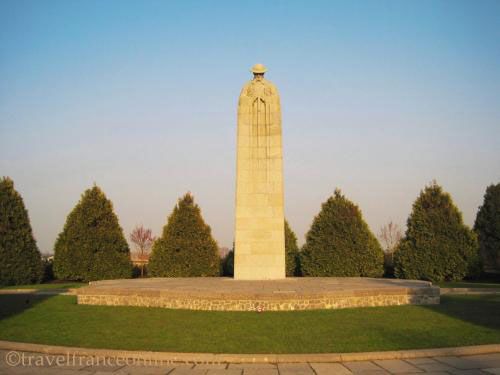
The architect Frederick Chapman Clemesha, himself severely wounded during the First World War, created this memorial to honour the memory of the Missing.
Aware of the need to commemorate its soldiers who fell on European battlefields, the Canadian Battlefields Memorials Commission (CCMB) embarked on the construction of a series of commemorative monuments.
Clemesha’s design won second prize in the competition organised by the CCBM in 1922. Although The Brooding Soldier is a remarkable testament to Clemesha’s talent and sensitivity, the winning design, an equally impressive and massive memorial, was erected on Vimy Ridge.
Brooding Soldier Canadian Memorial
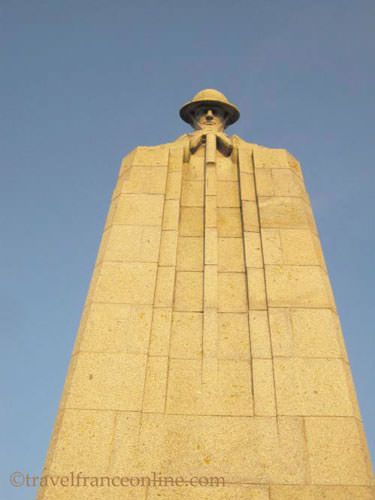
The Memorial to The Brooding Soldier is an imposing 11-metre-high monolith, carved directly into a square column.
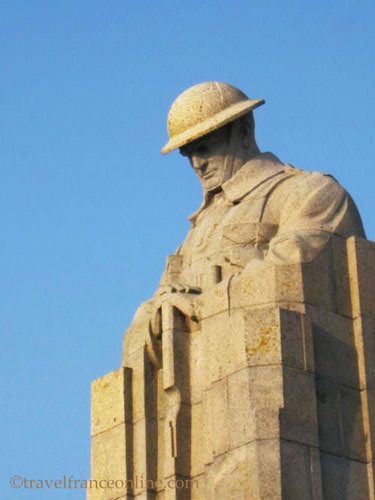
The statue of a Canadian soldier, depicted only up to the waist, stands at the top of this column. His head is bowed, protected by a helmet, and his hands rest on his overturned rifle, adopting the traditional posture observed during military funerals. Made in Brussels, the sculpture is carved from a cream-colored stone from the French department of Vosges.
At the base of the column, an inscription in French and English commemorates the sacrifice and bravery of those it honours:
“This column marks the battlefield where 18,000 Canadians, belonging to the British Left Wing, resisted the first German gas attacks, from April 22 to 24, 1915. Two thousand fell and rest here.”
The Brooding Soldier Memorial stands on the battlefield where Canadian soldiers perished. While many of them rest in the cemeteries of the Ypres salient, countless others remain buried on the battlefields, their remains never recovered.

The memorial stands on a low circular terrace of stone slabs, in the centre of a small garden bordered by cedars carefully trimmed into the shape of shells to recall the explosions.
Soil from all Canadian provinces was brought in and scattered in the garden to honour the diverse origins of the Canadian soldiers who fought in this battle.
The Duke of Connaught inaugurated the memorial on July 8, 1923. Marshal Foch, Supreme Commander of the Allied Forces on the Western Front, also paid tribute to the 1st Canadian Division, which was the first to endure the horrors of the first gas attack during the Second Battle of Ypres.
First gas attack on April 22-25, 1915
The German gas attack, which took place from April 22 to 25, 1915, was devastating as it took the Allies completely by surprise, marking the first use of this terrible weapon in wartime!
Positioned on the left flank of the Allied lines, the French Colonial troops managed to break through the German lines before the gas attack.
Tragically, Canadian regiments and some British reinforcement regiments, including the Buffs, Middlesex, York and Leicesters, found themselves on the front line of the gas assault during the fighting.
Lacking gas masks, they suffered the terrifying effects of the gas attacks on April 22 and 25, enduring excruciating pain.
Those who were lucky enough to survive in the trenches resorted to desperate measures, such as stuffing wet handkerchiefs in their mouths, to mitigate the devastating effects of the gas.
Despite their efforts, many suffered permanent injuries and, tragically, many people succumbed in the months and years that followed.
Note: “The Geneva Protocol on gas is an international law treaty signed in 1925 by most of the world’s countries, prohibiting the use of chemical and biological weapons in warfare.”
Belgium – Vancouver Corner – Saint-Juliaan near Langemark-Poelkapelle
Coordinates: Lat 50.899585 – Long 2.940185


