
A legend forged in darkness
The Padirac chasm is located in the heart of the Causses of Quercy, about twenty kilometres northeast of the famous pilgrimage town of Rocamadour.
For centuries, its origins were shrouded in superstition.
The locals whispered that this deep fissure in the earth was not a natural wonder, but the work of the devil, dug to trap Saint Martin, Bishop of Tours, and steal his soul. From this fear was born a legend that endures to this day.
However, over time, terror gave way to necessity. During the Hundred Years War and the Wars of Religion, the chasm became a place of refuge. But when peace returned, the villagers once again distanced themselves from its sinister depths.
Discovery and exploration
The situation changed in 1889, when floods revealed an opening!
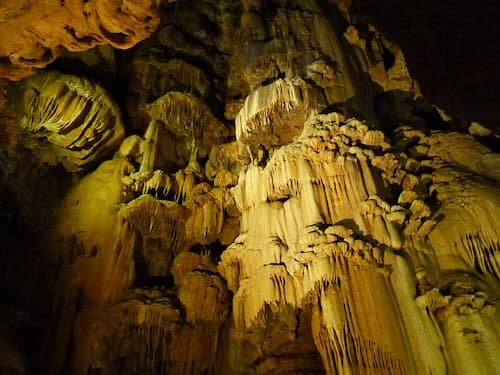
The pioneering speleologist Édouard-Alfred Martel ventured into its depths and discovered collapsed rock chambers leading to vast underground galleries lined with fantastic mineral formations. The Padirac Cave opened to the public nine years later, on April 10, 1899. Electric lighting was installed the following year, revealing a world that, until then, had belonged only to legend.
Today, more than 500,000 visitors descend into this abyss each year, exploring more than 22 kilometres of mapped galleries that follow the course of the underground river to its source at the Cirque de Montvalent, on the Dordogne. Considered one of the greatest geological wonders of France, the Padirac Chasm is the country’s first underground site to be classified as National Heritage.
Formation of the Padirac chasm
The Padirac Chasm owes its existence to the unique geology of the Causses du Quercy. The region’s limestone plateau, sculpted over millennia by acidic rainwater, has given rise to canyons, caves, and underground rivers. As water seeps through the cracks, it dissolves the softer rock, creating cavities. Over time, the ceilings of these voids collapse, leaving behind vast sinkholes.
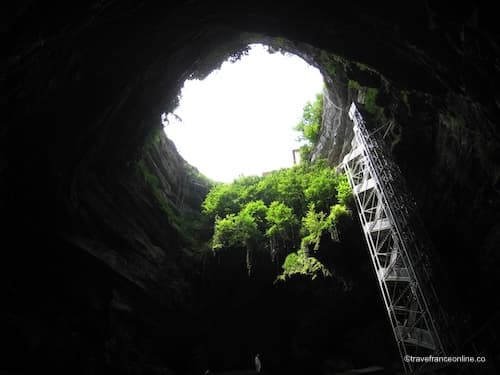
The chasm opens 75 metres deep and 35 metres wide, a spectacular gateway to the hidden underground world! Today, visitors descend by elevator or a metal staircase reminiscent of the Eiffel Tower‘s: at the bottom, walls covered with vegetation and the rocky remains of the collapsed ceiling, which can be crossed via a footbridge.
The cave entrance then leads to the Galerie de la Source, which slopes gently down towards the Rivière Plane. There, boats are waiting to take you along a 400-metre stretch of underground waterway, gliding through the darkness at a depth of 103 metres. The river, cool and crystalline at a constant temperature of 12°C, flows between walls draped with strange mineral shapes, sinuous stalactites, cascading curtains of calcite and ceilings studded with eccentric concretions that seem to defy gravity.
Marvels of stone and water
The journey reveals one wonder after another. At the Lac de la Pluie (Rainfall Lake), droplets constantly fall from the ceiling, feeding its shimmering surface.
The Grande Pendeloque (Great Pendant) is a gigantic stalactite suspended above the lake, 78 metres high, one of the largest known in the world.
As you venture deeper into the cave, you will discover the Pas du Crocodile (Crocodile’s Step), which leads to the Grand Pilier (Great Pillar), a monumental column 40 metres high, formed by the millennia-old meeting of stalactites and stalagmites.
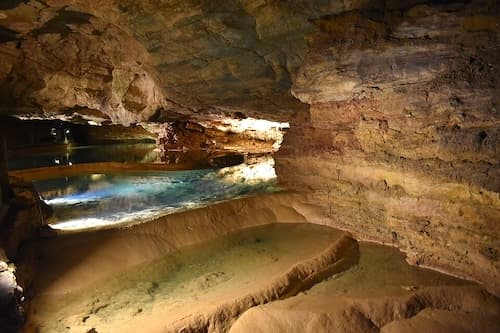
Not far from there, the Salle des Grands Gours opens onto a series of natural pools and ponds, where calcite has erected delicate walls separating pools of sparkling water. Some even harbour tiny spherical “cave pearls”, formed drop by drop over centuries.
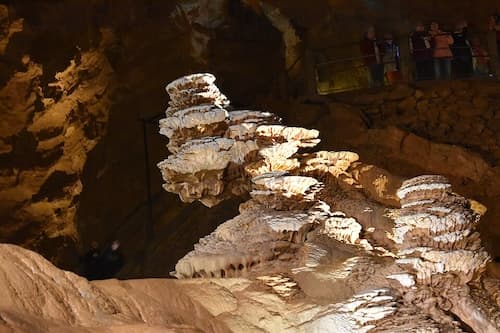
Further on is Lac Supérieur (Upper Lake), where water seepage has sculpted extraordinary formations, including the famous Pile d’Assiettes (Stack of Plates), a surreal stalagmite resembling a precarious tower of dishes.
The underground cathedral
The journey ends in the Salle du Grand Dôme (Great Dome Hall).
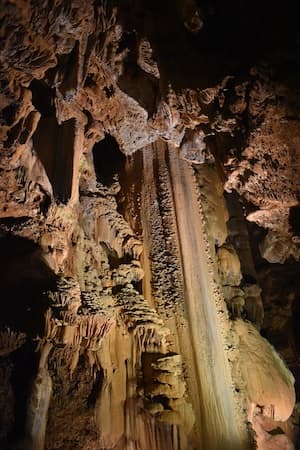
With a ceiling 94 metres high, it is often compared to an underground cathedral. The stalactites there take on extraordinary forms: thin hollow stems, sinuous draperies, shapes evoking chandeliers, cauliflowers, and even fireworks.
The walls are streaked with colours, yellow, orange and brown, due to minerals accumulated during the long passage of water through the earth and stone. The effect is striking: an eternal cathedral, sculpted not by the hand of man, but by the slow patience of water and time.
The Padirac Chasm remains one of the most spectacular natural sites in France.
Tip: The caves are open from April to November. Although the descent is made easier by elevators, you should still be prepared to face steps, rough terrain and a constant temperature of 13°C. A warm jacket is essential.
Department of Lot
Coordinates: Lat 44.858273 – Long 1.750475
Wikimedia Commons: Header by JGS25 is CC BY-SA 4.0 – Jellyfish stalactites by Thérèse Gaigé is CC BY-SA 4.0 – Column and Salle des Grands Gours and Assiettes by Tylwyth Eldar are CC BY-SA 4.0 –


