Gien and the faience industry
Gien is world-renowned for its fine tin-glazed earthenware, known as faïence in French. But what made this town the Mecca of ceramics? It all comes down to its location!
Gien is situated in the heart of the Loire Valley, nestled between the forests of Sologne and Orléans. This region lies in the southern part of the Paris Basin, an area once covered by a shallow sea. As the waters receded, the basin filled with clay and sand from the surrounding areas.

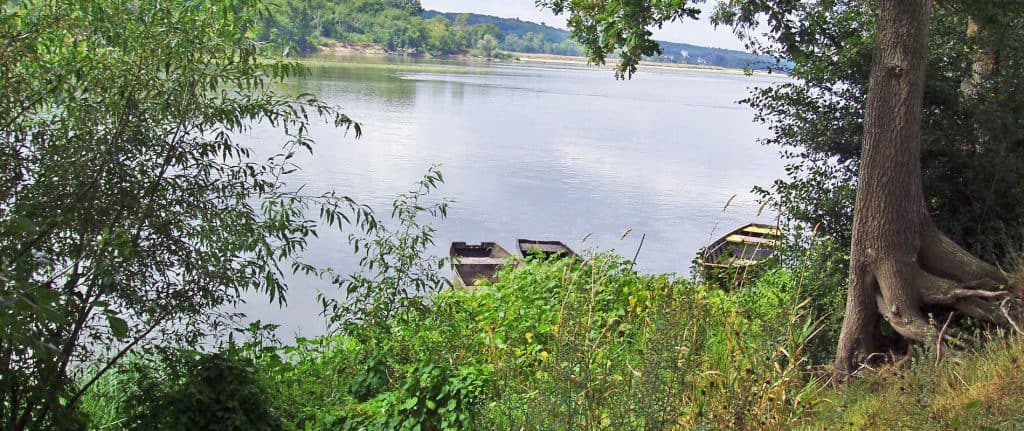
All the conditions were in place for Gien to develop a flourishing industry: the region’s abundant sand and clay deposits for pottery paste, the vast neighboring forests providing wood for the kilns, and the nearby Loire River facilitating the transport of raw materials and finished products.
However, it wasn’t until the 19th century that this industry truly took off. In 1821, Englishman Thomas Hall founded the Gien pottery works in the former buildings of the Couvent de Minimes, a 15th-century monastery located to the east of the town. This was a time ripe for innovation, and Gien, thanks to its prime location in the heart of fertile lands and on the banks of the riber, was already a major trading centre.
The Gien pottery works reached its peak in the second half of the 19th century, marking its golden age. It acquired international renown, its ceramists having developed a new technique for obtaining a deep and vibrant blue, now known as Bleu de Gien (Gien Blue). The earthenware is composed of more than 90% silica, derived from sand and crushed quartzite. An alkali, such as natron, is added, along with lime and a colorant, usually ground copper, which gives the earthenware its characteristic blue-green hue. This unique colour was combined with golden yellow decorations, creating a distinctive style.

The factory also diversified beyond everyday tableware, demonstrating greater creativity in its designs. It introduced tableware inspired by the renowned workshops of Saxony and Marseille, as well as themes from antiquity, the Renaissance, and other periods. It also collaborated with acclaimed painters and engravers to create new designs and forms. Some of its most impressive pieces were presented at the 1900 Universal Exposition in Paris. As a result, the factory not only satisfied French and international markets but also enhanced its prestige by offering bespoke services to prominent European families.
Unfortunately, the 20th century was marked by challenges. The two World Wars, along with societal changes and evolving tastes, slowed the factory’s growth. However, a revival began in 1984 with the creation of the first earthenware museum. The factory has reinvented itself, producing handcrafted, numbered pieces highly sought after by collectors of exclusive items. Another major innovation has been the partnership with renowned fashion designers such as Paco Rabanne to create new products and elevate the art of earthenware.
Today, the Faïenceries de Gien continues its artisanal tradition of working with earthenware. It produces a range of exceptional masterpieces and objets d’art, as well as everyday items such as tableware and decorative objects.
How could anyone resist?
A Brief Overview of Gien, the City of Anne de Beaujeu
Perched on a hillside overlooking the Loire River, the town of Gien has been inhabited since prehistoric times. However, the old town developed around a fortress built in the 8th century by Emperor Charlemagne. Although heavily damaged during World War II, Gien has been beautifully restored, with the ruined buildings of the old town carefully reconstructed to honour its rich past.

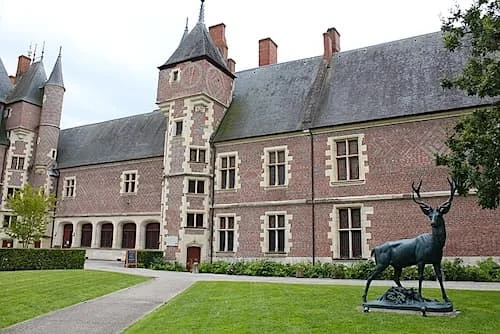
Gien is also known as the “City of Anne de Beaujeu.” Anne, the eldest daughter of King Louis XI and regent of France from 1483 to 1491, had the castle rebuilt in the 1490s. As such, the Château de Gien is a remarkable example of pre-Renaissance French architecture. Renowned for its simple yet elegant style, it is striking for its dark red brickwork, enhanced with bands of white stone and topped with a blue-gray slate roof. The Loiret region acquired it in 1823, and had it listed as a historical monument the following year.
The nearby forests of Orléans and Sologne, rich in game, provided an ideal setting for the (Musée International de la Chasse) International Hunting Museum, founded in 1952. Entirely dedicated to the art and tradition of hunting, the museum displays tapestries from renowned workshops, famous animal paintings, sculptures, porcelain, and a vast collection of hunting-related objects. It traces the history, evolution, and spirit of hunting, from prehistoric techniques to modern methods, including falconry, shooting, and hunting accessories.
The city also owes to Jeanne de Beaulieu the construction of the Vieux Pont (bridge), which has withstood centuries of conflict and the river’s floods!
Finally, let’s not forget the Côteaux du Giennois vineyard, which stretches from Gien to Cosne-Cours-sur-Loire and received its AOC (Appellation d’Origine Contrôlée) in 1998. The Romans planted the first vines there around 2,000 years ago, but the vineyard really began to prosper in the 12th century, thanks to the efforts of local abbeys, notably the powerful Abbaye de Fleury in Saint-Benoît-sur-Loire.
Department of Loiret
Photos via Wikimedia Commons: Castle and Vieux Pont by Daniel Jolivet CC BY 2.0 – Hunting Museum by Christophe.Finot CC BY-SA 3.0 – Faience museum by O.Taris CC BY-SA 4.0