
The Celts from Cornwall
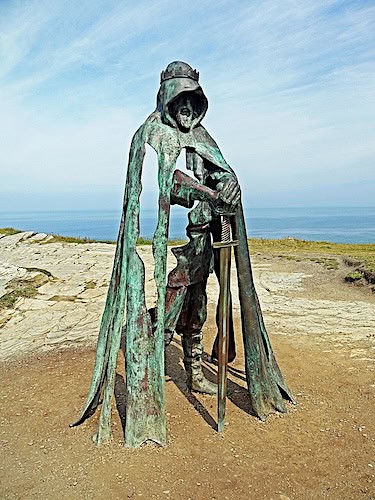
The Arthurian legend holds a central place in Breton culture and identity. When the Celts of Cornwall arrived on the rugged shores of the Armorican peninsula in the 5th century, they renamed the region Armorica, or Lesser Britannia – Little Britain, after their homeland, Greater Britannia – Great Britain. Over time, this name evolved into Britannia, then Britain, and finally Bretagne.
These newcomers had already converted to Christianity, and their leaders were officially recognised as patron saints of Brittany by the Church of Rome.
Figures such as Saint Samson, Saint Malo, Saint Brieuc, Saint Tugdal, Saint Paul, Saint Corentin, and Saint Patern played a vital role in the evangelisation of the region, establishing seven bishoprics in Dol de Bretagne, Saint-Malo, Saint-Brieuc, Tréguier, Léon, Cornouaille, and Vannetais.
Besides Christianity, the newcomers brought with them ancient Celtic traditions deeply intertwined with their Christian beliefs.
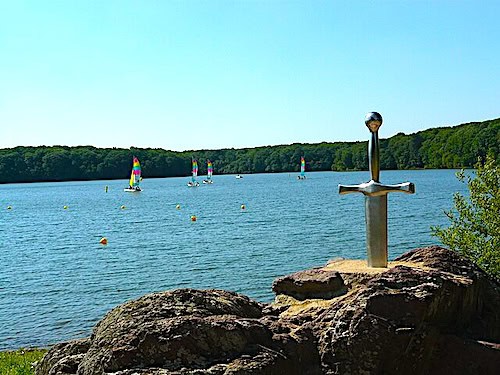
This fusion of cultures gave rise to a unique Breton identity that endures to this day. Recognising the local population’s attachment to their pagan deities, they also assimilated these deities into the local saints believed to protect, heal, and watch over the daily lives of the inhabitants. Even today, many people continue to invoke these patron saints for various reasons.
In the 8th century, the Cornish Celts, inspired by the appearance of the Archangel Michael, founded the Abbey of Mont Saint-Michel.
They chose a rocky promontory overlooking a vast bay, seeing it as an ideal location reminiscent of the St-Michael’s Mount Abbey, situated off the coast of their native Cornwall. The striking resemblance between the two abbeys is so remarkable that they are often confused with one another.
Arthurian Legend and mythical Forest of Brocéliande
The principal heroes of Celtic tradition became central figures in King Arthur’s mythical quest for the Holy Grail.

Thus was born Brocéliande, a magical forest that served as a secret refuge for Merlin the Wizard and Vivien the Fairy. Two thousand years ago, this dense forest of centuries-old oaks and beeches covered the interior of Brittany, known as Argoat.
Countless paths crisscrossed it, leading to ancient burial mounds, menhirs, and dolmens erected during the Neolithic period. The memory of these ancient builders had already faded with time, leaving behind only their enigmatic megaliths, whose purpose had long since been forgotten.
These mysterious monuments inspired the many myths and legends surrounding the magical forest of Brocéliande. Thus, the forest became the ideal setting for the Arthurian legend, where Merlin the Wizard guided King Arthur on his quest for the Holy Grail.
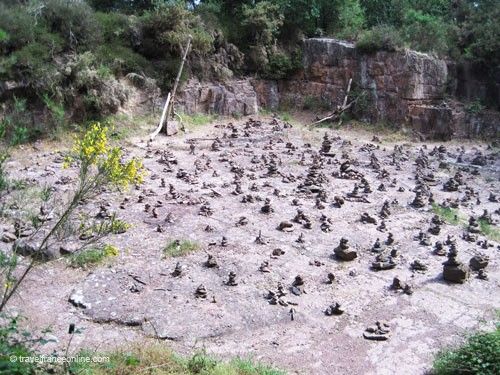
The Holy Grail was reputed to possess magical properties, granting immortality, peace, and harmony to those deemed worthy. King Arthur created his legendary Round Table, gathering around it the most valiant knights of his kingdom. Only the purest among them could bring back the Holy Grail and place it at the centre of the table.
Later, Christianity adopted the Arthurian legend and the myth of the Holy Grail, associating it with the chalice from which Jesus drank at the Last Supper. This chalice became a symbol of divine grace, accessible to those who reached the highest peaks of spirituality.
Brocéliande, also known as the Forest of Paimpont, remains a magical place, populated by fairies, magicians, and pagan deities. The Breton countryside is also dotted with ancient abbeys, churches, chapels, crosses and crucifixes, all testimonies to the rich mystical history of the region.
Discover setting of the Arthurian Legend:
Forêt de Brocéliande,Tombeau de Merlin, Fontaine de Jouvence, Chêne des Hindrés, Château de Comper, Chêne d’Eon or Chêne à Guillotin, Fontaine de Barenton, Jardin aux Moines, Eglise du Graal in Tréhorenteuc, Miroir aux Fées and Arbre d’Or in the Val Sans Retour, Hostié de Viviane or Tombeau des Druides, Tombeau des Géants ou Roche à la Vieille, Abbey of Paimpont, Forges de Paimpont and Pierres Droites
Department of Ille-et-Vilaine
Coordinates Brocéliande: Lat 48.020709 – Long -2.169766
Wikimedia Commons: King Arthur statue by Brian Henley CC BY-SA 2.0 – Excalibur by Flomacon35 CC BY-SA 3.0


