
Cistercian Abbaye de Valloires
The Cistercian Abbaye de Valloires is located in the picturesque Val d’Authie (Valley), within the commune of Argoules.
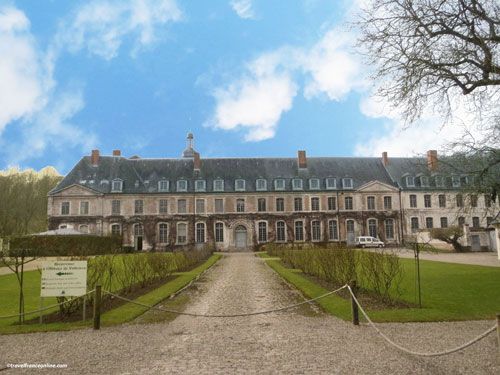
In 1137, Count Guy II of Ponthieu, accompanied by monks from the Abbey of Cîteaux, founded this abbey, the eleventh abbey of the order.
Throughout its rich history, the Abbaye de Valloires suffered considerable damage, particularly during the Hundred Years’ War, during the Battle of Crécy-en-Ponthieu, which took place nearby. The Wars of Religion in the 17th century left the abbey in ruins, but it was rebuilt in the 18th century. The new church was consecrated in 1756. The abbey narrowly escaped destruction during the French Revolution thanks to its acquisition by Ambroise-Léopold Jourdain de l’Éloge, who purchased it in 1776 and saved it from demolition. It then passed through various hands before being transformed into a Belgian military hospital in 1915.
The Abbaye de Valloires has thus retained its original architecture. Considered a jewel among the Cistercian abbeys of France, it is renowned for its classical architecture and refined Rococo interior decoration.
Abbey church
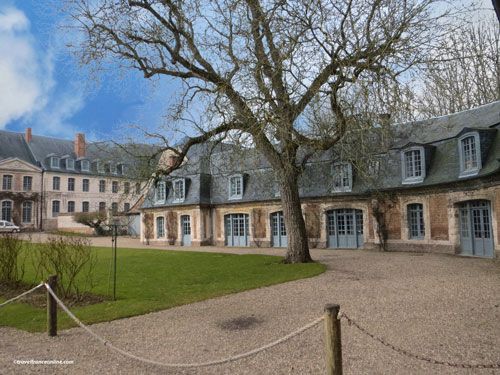
Valloires Abbey was listed as a Historical Monument in 1907. Among its notable features are the vaulted stone cloister, the 16th-century dovecote in the main courtyard, and a magnificent half-timbered barn nestled at the rear of the building.
However, the abbey’s crown jewel is undoubtedly the interior decoration of the church, a striking example of French Rocaille or Rococo style, characterised by its opulence. The renowned Austrian sculptor Simon Pfaff Paffenhofen and the ironworker Jean-Baptiste Veyren, known as Le Vivarais, were commissioned to embellish the interior of the building. The result offers a striking contrast with the sobriety of the classical exterior.
The interior of the church indeed boasts a veritable treasure trove of Rococo furniture, paintings, and sculptures, as well as a finely carved organ case. The double wrought-iron gate separating the chancel from the nave, the work of Le Vivarais, is considered a pinnacle of ironwork. Thus, the organ and the wrought-iron gate are both listed as historical monuments. The church also houses 13th-century effigies of Countess Marie of Ponthieu and her husband, Simon of Dammartin. Sadly, the abbey has a close connection to the tragic Battle of Crécy, as it hosted the wake for John I of Luxembourg, also known as John the Blind, King of Bohemia, after his death on the battlefield.
Association Valloires
In 1922, Thérèse Papillon, a nurse who had volunteered during the First World War, purchased the abbey to found the Valloires Association, an initiative officially recognised as a public benefit organisation on June 10, 1925.
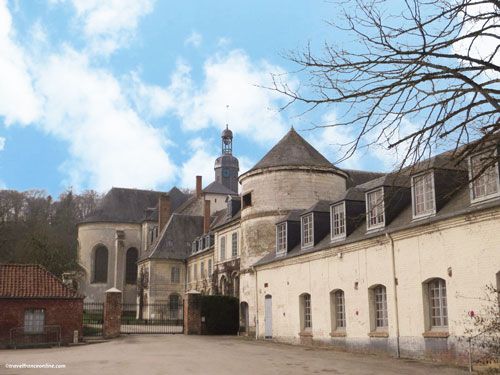
Under Thérèse’s leadership, the abbey served as a preventorium, a facility specialising in preventative healthcare, until 1974.
However, the association’s activities diversified over the years to meet the evolving needs of society. Thus, in 1964, Thérèse established a home for young people and adults in the abbey’s historic barns, which in 1991 became a temporary residence for senior citizens.
Continuing its commitment to the well-being of the community, the association subsequently created a home for at-risk youth and accommodation for visitors. Today, the association still owns the Valloires Abbey, opening most of its buildings to the public.
Terrines de Poires de l’Abbaye de Valloires
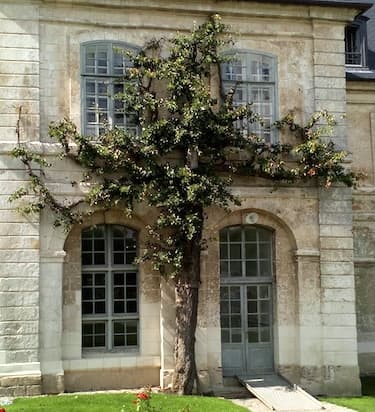
In fact, the pear terrines contributed so much to the prosperity of the abbey that the abbots adorned their coat of arms with a pear alongside the emblem of the House of Ponthieu! In recent years, the Valloires Association has revived this precious tradition, offering visitors the opportunity to taste and buy these delicious terrines after their visit to the abbey.
The Abbaye de Valloires is today nestled in the heart of a magnificent 21-hectare wooded park, created by landscape architect Gilles Clément to replace the medieval pear orchard, and opened to the public in 1989. These superb gardens are adorned with a wide variety of trees and shrubs, and punctuated by flowerbeds. But the star of this park is the majestic pear tree planted in 1756, the year the abbey church was consecrated. This tree is thus one of the oldest in France!
Department of Somme – Picardie
Coordinates: Lat 50.348083 – Long 1.819290
Wikimedia Commons: Old pear tree by Ybroc is CC BY-SA 4.0


