
Château de Villandry
Villandry was the last of the Renaissance châteaux built in the Loire Valley.

It is renowned for the splendour of its architecture and interior decoration, and for its exceptional gardens, which have earned it a place among UNESCO World Heritage sites.
Villandry was built during the reign of Francis I, the great patron of the French Renaissance.
Inspired by the elegance and refinement of the Italian Renaissance, which he discovered during his military campaigns in Italy, Francis I introduced this style to France, a style that contrasted sharply with the imposing French military architecture that had been in vogue until then.
The king thus commissioned the construction of several remarkable châteaux in the Loire Valley, of which Chambord is considered the purest example of French Renaissance architecture.

In 1532, Jean Le Breton, the king’s finance minister, followed his example and had the old feudal fortress of Villandry dismantled to build the magnificent château that stands today.
However, Le Breton chose to preserve the historic dungeon where the Peace of Colombiers had been sealed. This important treaty, signed on July 4, 1189, marked the capitulation of Henry II of England to Philip II Augustus.
Villandry remained the property of Le Breton family until 1754, when it was entrusted to the management of the Marquis de Castellane, an ambassador of Louis XV. Castellane undertook a complete renovation of Villandry to enhance its elegance and improve its comfort.
Joachim Carvallo
However, the introduction of neoclassical architectural modifications, while undeniably aesthetically pleasing and of high quality, detracted from the elegant French Renaissance identity of the building and its gardens.

Everything changed in 1906!
Dr Joachim Carvallo and his wife, Ann Coleman, heiress to a prominent American steel-making dynasty, indeed acquired Villandry at this pivotal moment.
They dedicated their lives, investing their energy and resources in the meticulous restoration of the château and its gardens to restore them to their Renaissance splendour.
Their descendants continued this work. Henri Carvallo, their great-grandson, today manages this magnificent estate, which has been open to the public since 1929.
The five gardens of Villandry
The gardens of Villandry have undergone several redesigns over the centuries.
In 1906, the château was surrounded by a landscaped garden nestled within a forest of exotic trees and shrubs planted in the 19th century. Joachim Carvallo then undertook the task of recreating the Renaissance gardens to harmonize them with the architectural elegance of the building. With the meticulousness and precision of a scientist, he set about recreating every detail, every shape, every species of a traditional Renaissance garden. Based on archaeological excavations and various land records, he reconstructed the layout of the château’s gardens dating from the Renaissance, the 18th, and the 19th centuries.

Today, his descendants perpetuate this heritage with the same passion and dedication, continuing his work of restoration and preserving the timeless beauty of Villandry.
The gardens of Villandry extend across four terraces which include Le Jardin du Soleil (Sun Garden), Jardin d’Ornement (Ornamental Garden), Jardin d’Eau (Water Garden), Le Potager Décoratif (Vegetable Garden) and Jardin des Simples (Medicinal Herbs Garden).
In 2008, Henri Carvallo commissioned the renowned landscape architect Louis Benech to create the Chambre du Soleil – Sun Garden, based on Joachim’s original design. Located on the uppermost terrace, this garden includes the La Chambre des Enfants – Children’s Garden, a play area for children; the Sun Room with its central star-shaped pool; and the La Chambre des Nuages – Cloud Room, characterized by grassy paths winding between roses and shrubs.
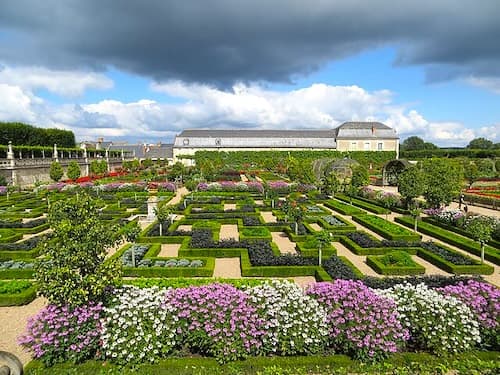
The Andalusian painter Lozano and the landscape architect Javier Winthuysen collaborated on the design of the Jardin des Ornements – Ornamental Garden, also known as the Jardin des Broderies – Embroidery Garden. This garden, inspired by Andalusian aesthetics, is divided into four Jardins de l’Amour – Gardens of Love, delineated by topiary of boxwood and yew. There you will find L’Amour Tendre (Tender Love) – L’Amour Passionné (Passionate Love) – L’Amour Volage (Fickle Love) and L’Amour Tragique (Tragic Love).
The Jardin d’Eau – Water Garden is a recreation of the traditional 18th-century garden originally designed by the Marquis de Castellane. Surrounded by a lime tree hedge, this garden adopts a classical style, with a central pool in the shape of a Louis XV mirror.
The Potager Décoratif – Decorative Kitchen Garden embodies the very essence of a Renaissance garden. Composed of nine identical squares, it harmoniously blends flowers and vegetables. Each square houses a unique selection of plants, contributing to its diverse and picturesque charm. Since 2009, the Kitchen Garden has been cultivated according to the principles of organic farming.
In 1970, Robert and Marguerite Carvallo created the Jardin des Simples – Herb Garden, a faithful recreation of a medieval garden originally designed by Joachim Carvallo.
Department of Indre-et-Loire – Touraine
Coordinates: Lat 47.339853 – Long 0.514315
Photo Wikimedia Commons: Photo1 and Potager and Chateau on river and Header by Johan Allard CC BY-SA 4.0 – Formal gardens and water piece by Zohastel CC BY-SA 3.0 – Reception room by Manfred Heyde CC0


