
Legend of Saint-Denis
Saint-Denis is one of the three patron saints of Paris, along with Sainte-Geneviève and Saint-Marcel. Little is known about the life of this Greek bishop, the first to minister in Lutetia (ancient Paris), and over time, historical facts and legends have become intertwined.
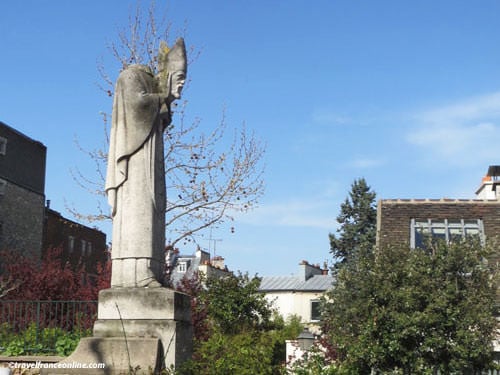
What is known is that Saint-Denis was one of the seven bishops sent to evangelise Gaul in the 3rd century and that he was executed during the reign of the Roman emperors Decius in 251 AD or Valerian in 258 AD.
Legend recounts that Saint Denis and his companions, the priest Eleutherius and the deacon Rusticus, were arrested by Roman soldiers while preaching in northern France. Imprisoned and tortured, they were ultimately condemned to beheading on the heights of Montmartre, opposite the Temple of Mercury.
Legend has it that the soldiers tasked with executing Saint Denis and his companions were too exhausted (or lazy!) to climb the steep slope of Montmartre, and instead beheaded the three men on the hillside.
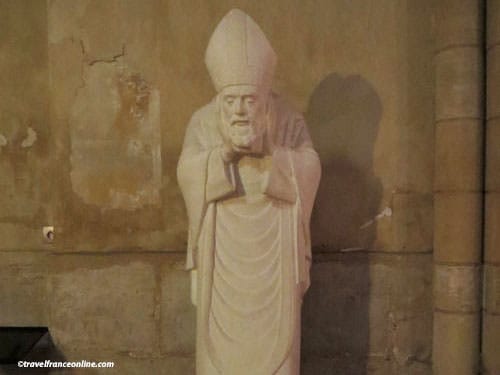
Miraculously, Saint-Denis picked up his severed head and carried it to the village of Catulliacum, now Saint-Denis, north of Paris, where he died in the place he wished to be buried. Historical sources confirm that in the 7th century, the Frank King Dagobert I founded an abbey there and transferred the relics to the basilica.
However, the exact location where Saint Denis and his two companions were executed remains controversial.
In the 16th century, construction work commissioned by the Royal Abbey of Montmartre unearthed an ancient crypt containing three sarcophagi and numerous inscriptions. The nuns decided they had discovered the site of the martyrdom of Saint-Denis and his companions, and they built the Sanctum Martyrium Chapel above the crypt, which became an important place of pilgrimage!
Legend of Dagobert and foundation of Saint-Denis Basilica
Dagobert I,, who reigned from 629 to 639, was a descendant of Clovis, the first king of France (481-511), who converted to Christianity after his marriage to Clotilde, a Christian princess from Burgundy.
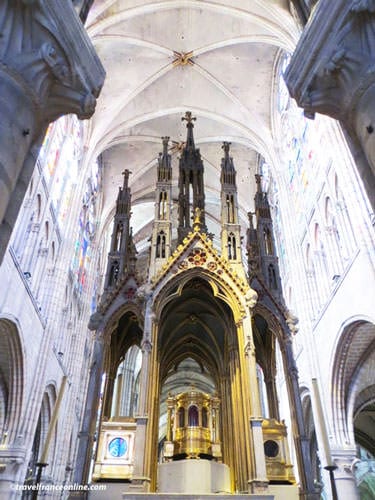
A touching anecdote recounts how Dagobert chose the site for the Abbey of Saint-Denis. In his youth, Dagobert, seeking revenge on his strict tutor, cut off his beard while he slept. But in Frankish society, this act was a grave offence, a sign of humiliation. Upon learning of his son’s transgression, Clotaire, Dagobert’s father, flew into a rage and sent men to arrest him. Dagobert took refuge in the modest chapel built over Saint-Denis’s grave.
Dagobert indeed remembered how Saint-Denis had once protected a stag he had been hunting. The distressed and exhausted stag had taken refuge in the chapel and lay down at the foot of the saint’s tomb. Legend has it that Dagobert’s hunting dogs refused to enter, stopping at the entrance as if bewitched.
Dagobert was convinced that the saint would protect him too, and he was right! Clotaire’s men tried to approach the chapel, but could not enter, as if prevented by an invisible barrier.
Meanwhile, Dagobert had fallen asleep inside the chapel and dreamed that Saint-Denis would protect him if he promised to replace the modest chapel with a grand church. After being forgiven by his father, Dagobert kept his promise and built a magnificent Basilique St-Denis and abbey.

Although the work was completed a century later, Dagobert oversaw its initial stages, and In 639, became the first Merovingian king to be buried at Saint-Denis.
His tomb, rebuilt in the 13th century and located on the site of his original burial, is now a listed historical monument. The tomb of Saint Denis was discovered in the archaeological crypt of the basilica and placed in a superb golden mausoleum near Dagobert’s.
The Benedictine Abbey of Saint-Denis became a major pilgrimage site, as well as the burial site of French kings and their queens until the French Revolution.


