
André Maginot, the politician and the soldier
André Maginot was born on February 17, 1877, in Paris, into a middle-class family originally from Révigny-sur-Ornain, in the Meuse department.
After obtaining his doctorate in law in 1897, he entered politics. Between 1903 and 1914, he held various administrative positions in the Ministries of the Interior and of Health and Security. He served as Secretary of State at the Ministry of War from December 9, 1913, to June 8, 1914. Elected deputy for the Meuse in 1910, he served until he died in 1932.
Mobilised on August 1, 1914, he enlisted as a private in the 44th Territorial Infantry Regiment in Verdun. Recognising the importance of ongoing reconnaissance, he successfully campaigned for the creation of a patrol. As a sergeant, he took command of the patrol stationed in the village of Bezonvaux. He led more than fifty reconnaissance missions behind enemy lines. His bravery earned him five citations and the Military Medal on November 8, 1914.
However, he was seriously wounded the following day. After a year of convalescence in the hospital, he was demobilised due to the severity of his injuries. He was posthumously awarded the Legion of Honour, the Military Medal, the Croix de Guerre 1914-1918, and the Médaille des Blessés Militaires (wounded servicemen). From 1917 until his death, he held important ministerial positions, dedicating his career to establishing support structures for veterans, drafting legislation for victims of the First World War, and reorganising the army. Minister of War from November 3, 1929, to February 17, 1930, he made a significant contribution to military policy.
André Maginot died in Paris on January 7, 1932. His funeral was held on January 10 at the Révigny-sur-Ornain cemetery, following a day of national mourning. A state funeral was also held at the Hôtel des Invalides in Paris. In 1956, the National Federation of Veterans Affairs decided to add his name to that of its association.
Maginot Monument
President Albert Lebrun inaugurated the monument dedicated to Maginot on August 18, 1935, delivering a moving speech that included these words:
“Il nous faut ériger un monument à la mémoire de cet homme dont la bravoure légendaire restera à jamais gravée dans les mémoires et qui lui a valu le titre de « Soldat de Verdun” – We must erect a monument to the memory of this man whose legendary bravery will forever be etched in our memories and which earned him the title of Soldier of Verdun.
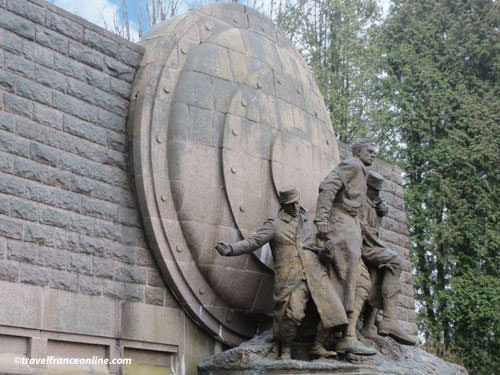
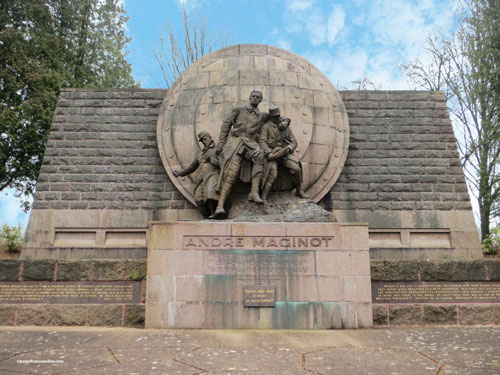
The Maginot Monument features a bronze sculpture by Gaston Bocquet and is located on the Souville plateau, the site where Maginot received the Military Medal on November 8, 1914. It depicts André Maginot and two comrades, standing before a fortified wall, with a large shield symbolising the fortifications of Verdun and the Maginot Line. As Minister of War, Maginot indeed successfully secured the public funds necessary for the construction of the Maginot Line, the line of fortifications erected between 1928 and 1940 along the French borders.
The monument’s base bears the inscription:
“André Maginot, sergent au 44e Régiment d’Infanterie Territoriale, ministre de la Guerre (1877-1932)”
A commemorative plaque on the base pays tribute to the courage of François-Joseph Jolas, who saved the seriously wounded Maginot on November 9, 1914.
Located along the D112 in Fleury-devant-Douaumont, it has a small parking area opposite for visitors.
Other sites of the Battle of Verdun:
Citadel of Verdun – Sacred Way – Douaumont Ossuary and National Cemetery – Abri320 – Bayonet Trench – Fort of Douaumont – Fleury-devant-Douaumont “Village Détruit
Department of Meuse – Lorraine region – Grand Est
Coordinates Memorial Monument on D112: Lat 49.186664 – Long 5.431784


