
Bayonet Trench’s discovery
The Bayonet Trench is located on the northern slope of the Ravin de la Dame (ravine), near the Douaumont Necropolis. This unique memorial commemorates a tragic event that took place on June 12, 1916, during the Battle of Verdun.

This memorial pays tribute to the French soldiers buried alive in their trench after a shell exploded. Their bodies were only discovered thanks to the points of their bayonets protruding from the ground. In 1919, Colonel Collet, commander of the 137th Infantry Regiment, discovered the trench by chance while visiting the battlefields where his unit had fought.
He noticed rifles, many with their bayonets intact, emerging from the ground in a heavily bombarded area. This macabre sight reminded him of the violence of the fighting that had taken place there. The discovery of the trench sparked widespread emotion and captured public attention. Moved by the tragedy, the American George Rand generously funded the construction of a memorial designed by the architect André Ventre. Initially named the Tranchée des Fusils – Trench of Rifles, it was renamed the Tranchée des Baïonnettes – Bayonet Trench in honour of the soldiers buried there. The memorial was officially inaugurated on December 8, 1920.
The controversy
The discovery of the Bayonet Trench sparked strong emotions and fueled a debate among veterans and military officers regarding the authenticity of the event.
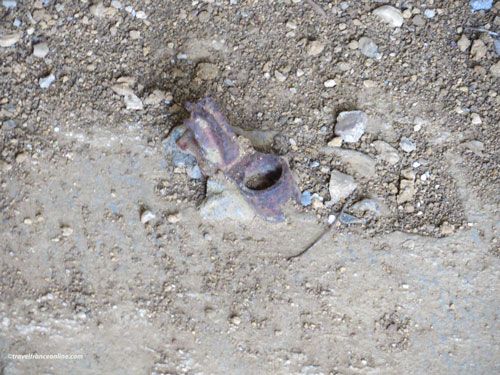
While some dismissed it as a legend born of postwar sentiment, others saw it as a symbol of the horrors of the conflict. The controversy centred on the possibility that a shell explosion could have buried an entire trench, with all its occupants.
Sceptics maintained that such an event was improbable, arguing that the soldiers were likely already dead by the time of the burial. According to their accounts, it was common practice to quickly bury the dead in abandoned trenches, leaving the bayonets visible for later identification and reburial. The lack of contemporary records mentioning the burial of an entire unit alive after a shell explosion in this area lends credence to their argument.
The events of June 12, 1916, in the Bayonet Trench may forever remain a mystery. Yet, one thing is undeniable: this battle was an unimaginable ordeal!
Bayonet Trench Memorial
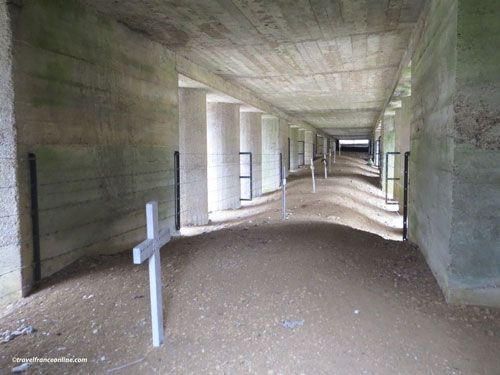
The imposing memorial, built entirely of concrete, stands alongside the road, from which a monumental entrance leads to a long staircase that climbs towards the trench.
A colossal cross, affixed to the opposite wall, immediately catches the eye.
The monument is actually a shelter consisting of a thick concrete slab supported by imposing pillars. This shelter protects the trench, where rows of white wooden crosses are aligned next to small concrete slabs.
Initially perplexed, one quickly understands the significance of the place: each small slab bears the point of a bayonet, marking the grave of a soldier who fell in battle…
Free admission
Tip: You can park in the Douaumont necropolis parking lot and walk down to the Bayonet Trench. Allow 5 to 10 minutes for the walk.
Other sites of the Battle of Verdun
Citadel of Verdun – Sacred Way – Douaumont Ossuary and National Cemetery – Abri 320 – Fort of Douaumont – Fleury-devant–Douaumont “Village Détruit – Maginot Monument in Fleury-devant-Douaumont
Department of Meuse – Lorraine region – Grand Est
Coordinates: Lat 49.214116 – Long 5.425586


