
The Fort of Douaumont – 1885 to WWI
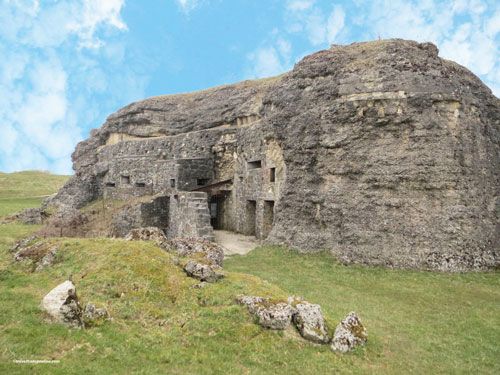
Fort Douaumont is perched on a hill 388 metres high, located just 2 kilometres west of the village of Douaumont, one of the nine villages eradicated during the war and declared a destroyed village that was never rebuilt.
It is one of the forts built in 1885 under the supervision of General Séré de Rivières to reinforce the line of defence against any potential German attacks, after France’s crushing defeat in the Franco-Prussian War of 1870-71.
Its existing stone masonry was reinforced in 1888 with several layers of concrete, and layers of sand added to absorb shocks.
A thick layer of earth, 5 metres deep, was piled on top of the fortified sections, and the perimeter was reinforced with 5-metre-high metal plates and surrounded by a 30-metre-wide barbed wire fence.

The ditches were widened and deepened to improve defensive capabilities.
Further modernisation took place between 1907 and 1909 with the installation of a 155 mm gun turret capable of firing 43 kg shells to a range of 7 kilometres, thus strengthening the fort’s defensive arsenal.
Between 1911 and 1913, the defences of Fort Douaumont were improved once again with the addition of a second turret equipped with two 75 mm guns, two machine gun turrets, and four armoured observation posts.
These improvements significantly strengthened the fort’s defensive capabilities, making it the most modern and best-equipped of the region’s defensive forts.

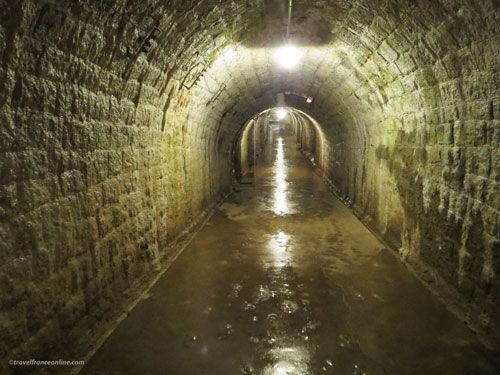
The fort could also accommodate a garrison of 500 to 800 men. It indeed had a central barracks spread over a basement, a ground floor, and two upper floors.
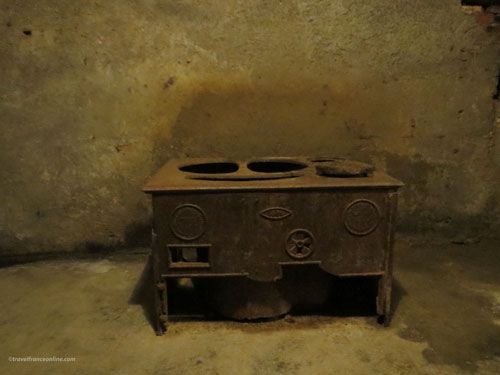
The ground floor housed essential facilities; the command post, ammunition stores, hospital, bakery, kitchen, and laundry, while the upper floor served as a water and gunpowder store.
However, the decree of August 5, 1915, ordered the disarmament of Fort Douaumont, as well as three other forts in the region, and the withdrawal of their garrisons and supplies.
The reason: the obsolescence of the forts’ defence systems in the face of modern weapons, as well as the need for a significant military presence for defence and maintenance. Everything was in place to make the task easier for the German attackers!
Fort of Douaumont seized by the Germans – February 25, 1916

Thanks to its strategic location and recent modernisation, Fort Douaumont, although disarmed, served as a secure ammunition storage, troop rest, and medical care for the wounded.
However, its unarmed state, combined with the absence of a garrison, made it a prime target for the Germans!
The ease with which the Germans seized the fort on the morning of February 25, 1916, testifies to the surprise and lack of preparation of the French.
Indeed, the Verdun front, then located a few kilometres north of the fort, had remained relatively stable for the previous eighteen months, which explains why the French garrison was caught off guard by the sudden German assault.
Despite the intensification of the bombardments in the preceding days, the rapid advance of the German troops between February 21 and 25 had left the small garrison unaware of their proximity.
May 22-24 – Dramatic failure of the French offensive
The recapture of Fort Douaumont was considered crucial!
The assault was therefore planned for May 22, after six days of preparation, however, had to be abandoned after the Germans learned of it.
They thus reinforced the fort and launched an artillery counter-attack on May 20 that overwhelmed the French barrage.
Mistakenly believing that their own artillery bombardment had inflicted significant damage on the fort, the French generals assured General Mangin, commander of the offensive, that the assault on Douaumont would proceed without incident.
Thus, without verifying this information with a reconnaissance patrol, the attack was confirmed for May 22.

The French heavy artillery opened fire at 11:40 a.m., and the first wave of French soldiers emerged from the trenches ten minutes later.
Under relentless German bombardment and heavy machine-gun fire, they tried to gain ground throughout the day, suffering heavy losses.
Unable to reach the eastern flank of Fort Douaumont, where the Germans were receiving reinforcements and supplies, French losses mounted rapidly.
By the end of the first day of fighting, casualties were already considerable. Despite this desperate situation, the French survivors were ordered to launch a new assault on the morning of May 23.
However, this attempt was once again met with an intensification of the German bombardment, resulting in further French losses. Throughout the afternoon of May 23, the French troops held their positions despite the incessant fire from German machine guns and infantry.
The German artillery barrage resumed on the morning of May 24 and continued until evening. At that point, the French soldiers were at their breaking point, exhausted by two days of fierce fighting, thirsty, hungry, and suffering from physical pain.
Their appalling situation is summed up in these words: “Tired, thirsty, hungry, suffering from physical pain, desolate, powerless, this was the hell of the Verdun combatants.”
They surrendered at the end of the day, but their courage and endurance remained undeniable, as historians have commented: “Their honour is preserved; they held firm to the very limits of their strength. In two days, they lost 72.2% of their comrades.”
The assault on Fort Douaumont ended in tragic failure, inflicting heavy losses and leaving the survivors with traumatic memories.
Historians have analysed the underlying causes of the French offensive of May 1916:
First, the Germans were aware of the impending attack, which made its prospects bleak from the outset. Second, artillery preparation proved inadequate. The bombardment of the German lines indeed began only two days before the assault, instead of the planned six, making it difficult to neutralise or adequately weaken the German defences.
Finally, it was concluded that the troops mobilised were insufficient to launch an attack of such magnitude.
16 September-15 October 1916 – Capture of the Fort of Douaumont

Following the tragic defeat in May, the French generals began meticulous preparations in September for a new offensive on Fort Douaumont.
An impressive force was mobilised for the assault. Batteries and ammunition, including two 400 mm howitzers, were deployed to target Forts Douaumont and Vaux.
A staggering 500,000 tons of equipment and projectiles were transported by rail to Verdun, at a rate of four to five trains per day.
The French air force played a crucial role in this preparation. For weeks, pilots and several balloon units crisscrossed the skies, diligently scanning German positions.

Covering a front 7 km wide and 3 km deep, they meticulously mapped every detail, from the location of batteries and trenches to barbed wire entanglements and machine-gun nests, neglecting no aspect of the enemy defences.
Thanks to this invaluable intelligence, the French artillery was able to precisely target key sectors of the enemy defences.
Simultaneously, significant efforts were made to fortify the French positions. Trenches were deepened, blockhouses rebuilt, and new shelters were erected or excavated to serve as future command posts.
To ensure effective communication, cables were buried between these shelters and the front lines, establishing reliable telephone links. Strategic roads and routes were rebuilt to facilitate the movement of assault troops and optimise their combat readiness.
Every day, soldiers trained relentlessly on terrain that would soon become the battlefield. Those chosen to lead the assault on Fort Douaumont meticulously studied its layout, memorising every detail using maps. This painstaking preparation aimed to guarantee a swift and decisive advance at the crucial moment.
The artillery was quickly deployed on October 20 and 21, immediately beginning a relentless barrage. The primary targets were Fort Douaumont and Fort de Vaux.
On October 23, the devastating impact of French 400 mm shells, fired at 15-minute intervals, obliterated essential ammunition and grenade depots deep within Fort Douaumont releasing toxic fumes that claimed the lives of 800 German soldiers.
Unable to provide a proper burial for the dead, they were interred in a gallery within the fort, a vast mortuary chamber that was subsequently sealed forever.
Conditions inside the fort deteriorated rapidly, prompting a significant number of German soldiers to evacuate, taking their wounded comrades to safety. Encouraged by the success of this offensive, Marshal Petain, General Nivelle, and General Mangin decided to launch the decisive assault on Fort Douaumont the following day, October 24.

In the early hours, a small German reconnaissance patrol cautiously ventured into the fort to assess the extent of the damage. However, despite the German commander’s conviction that the fort could still be defended with significant reinforcements armed with machine guns, time was running out.
At 11:40 a.m., as a thick fog enveloped the area, thousands of French soldiers emerged from their trenches and advanced rapidly.
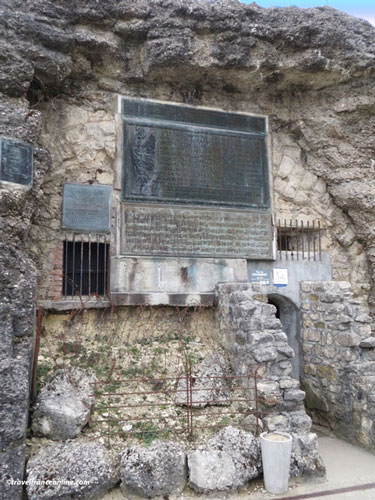
By the afternoon, they had captured Fort Douaumont. Today, the ruined fort lies in the heart of the woods; the vegetation has obscured the scale of the deadly fighting that took place there in 1916.
Other sites of the Battle of Verdun:
Citadel of Verdun – Sacred Way – Douaumont Ossuary and National Cemetery – Abri 320 – Bayonet Trench – Fleury-devant-Douaumont “Village Détruit – Maginot Monument in Fleury-devant-Douaumont
Department of Meuse – Lorraine region – Grand Est
Coordinates: Lat 49.217423 – Long 5.438763


