
Colline Notre Dame de Lorette
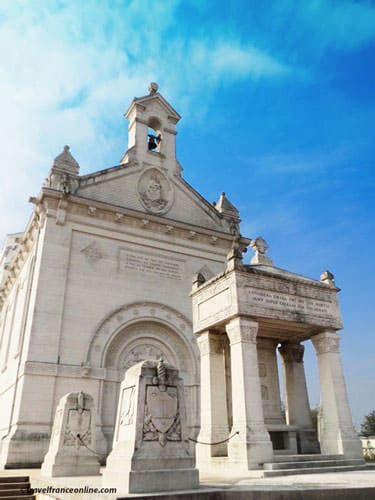
The Notre Dame de Lorette National Military Cemetery is located in the commune of Ablains-Saint-Nazaire. It was inaugurated in 1925 and listed as a historical monument on December 27, 1928.
It covers 25 hectares atop Notre-Dame de Lorette Hill and comprises the Notre-Dame de Lorette Basilica, the Lanterne des Morts (Lantern of the Dead), and the necropolis.
It contains the remains of more than 40,000 French soldiers, killed during the 1st and 2nd Battle of Artois, and buried individually and in one of eight ossuaries.
Today, the Notre Dame de Lorette National Military Cemetery overlooks vast cultivated fields stretching as far as the eye can see.
However, from October 1914 to September 1915, the view was very different, as these fields were the scene of fierce and devastating fights during the Great War!
The Battles of Artois
Notre-Dame de Lorette Hill, known by the code name Hill 165, was located in the sector encompassed within the towns of Liévin, Lens, and Arras. The fighting, which raged throughout October 1914, resulted in a German victory, triggering the beginning of a series of deadly attacks.
The Germans indeed fortified the hill with five lines of trenches, reinforced by a dense network of barbed wire and obstacles along what is now the D937 road. This road, linking Ablains-Saint-Nazaire to Neuville-Saint-Vaast via La Targette, was a vital communication route in the region.
Their elaborate defensive system, which encompassed Neuville-Saint-Vaast, was nicknamed “the Labyrinth” due to its complex and extensive layout.
On May 9, 1915, French troops formed a 10-kilometre front stretching from Arras in the south to Lens in the north, launching an assault against the German positions. The engagement on May 10 resulted in heavy losses, with many dead and seriously wounded.
Forcing their way through this labyrinth of defences, barriers, and redoubts, the French troops nevertheless made significant progress in the following days. They recaptured key positions, such as La Targette, Neuville-Saint-Vaast, Carency, Ablains-Saint-Nazaire, and the Souchez sugar refinery.
On May 22, they seized Notre-Dame de Lorette Hill, and finally, the Labyrinth on June 17. Operations ceased on June 25. At this point, however, 102,500 combatants from both sides were killed, missing, or taken prisoner in the 20 square kilometres recaptured between May 9 and June 25.
Marshal Joffre launched the Third Battle of Artois on September 25, supported by troops of the British First Army.
National Military Cemetery Notre Dame de Lorette
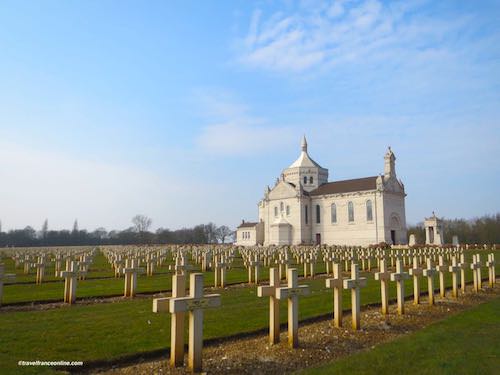
The cemetery was opened on the battlefield in 1915 and then expanded in 1920 to receive the remains of French soldiers recovered from field cemeteries scattered throughout Artois and Flanders.
Inaugurated in 1925, the Notre Dame de Lorette National Military Cemetery is sadly the largest French military necropolis.
It contains the remains of 40,058 soldiers, buried in individual graves.
This rectangular plot, 646 metres in length and 208 metres in width, is bordered to the northwest by a hedge marking the location of former German positions.
Each grave is marked with a simple white cement cross, which replaced the original wooden crosses in 1933.
The cemetery also includes eight ossuaries containing the remains of unidentified soldiers from the battlefields of Artois. A Muslim section houses the graves of 576 soldiers from the French colonial troops.
Notre Dame de Lorette National Military Cemetery Lantern of the Dead
The architect Louis-Marie Cordonnier designed the Neo-Byzantine Lanterne des Morts, and Marshal Pétain laid the foundation stone on June 19, 1921.
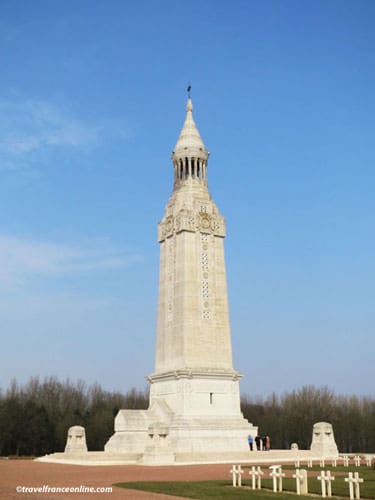
Standing 52 metres high on a 12-metre square base, the tower is topped by a lantern that rotates five times per minute, casting its light by night for miles around.
At its base are a chapel of rest and an ossuary. This ossuary houses the remains of nearly 6,000 unknown soldiers who died on Notre-Dame de Lorette Hill during the First World War. The chapel of rest contains 32 tombs, 29 of which hold the remains of unknown soldiers from the First World War.
In 1950, the remains of an Unknown Soldier from the Second World War were interred in an individual grave in the chapel, and in 1955, the ashes of victims of Nazi camps.
In 1977, the remains of an Unknown Soldier from the Algerian War, and in 1980 those an Unknown Soldier from the Indochina War were interred to the chapel.
Notre Dame de Lorette National Military Cemetery Basilica
The painter Nicolas-Florent Guillebert built the first chapel of Our Lady of Loreto in 1727 on the hilltop. This modest chapel was destroyed during the French Revolution but rebuilt in 1815. Dedicated to the Virgin Mary, it became, like its predecessor, a place of pilgrimage, attracting the faithful on September 8th, the presumed date of the Virgin Mary’s birth. It was once again destroyed during the First World War.
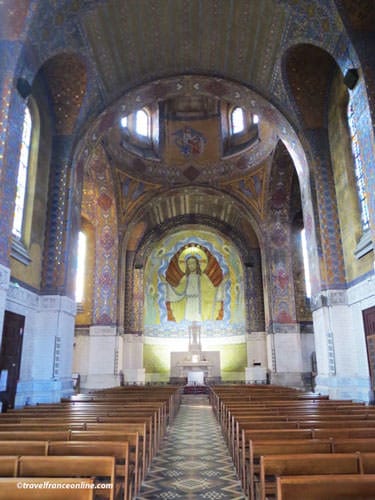
Louis-Marie Cordonnier, the architect of the neo-Byzantine Lantern of the Dead, was commissioned to rebuild the chapel, the foundation stone of which was laid on June 19, 1921. On May 27, 1927, the Bishop of Arras blessed the Basilique Notre Dame de Lorette.
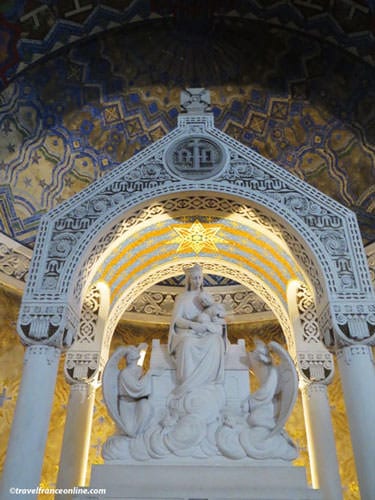
The chapel of Notre Dame de Lorette National Military Cemetery boasts a wealth of commemorative artefact and symbolic decorations:
The interior walls are adorned with intricate mosaics, their warm hues beautifully complemented by superb stained-glass windows created by master glass-maker Lorin based on designs by Henri Pinta, winner of the Prix de Rome.
Hundreds of commemorative plaques, each placed by bereaved families in tribute to their loved ones, cover the walls.
A small display case houses the wooden cross from the grave of Louise de Bettignies, who directed an intelligence network for the British from Lille. She was tragically captured in October 1915 and subjected to forced labour before dying in 1918 while imprisoned in Cologne.
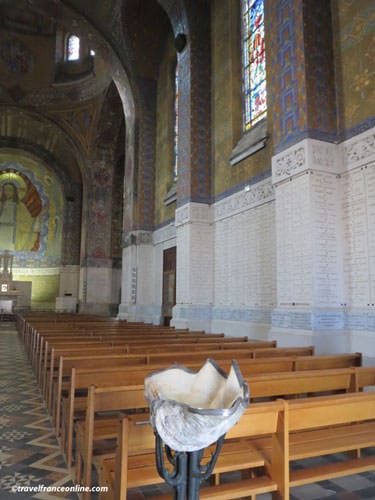
The designs of six magnificent stained-glass windows in the transept, a gift from England, created by the artist Payne, pay homage to the soldiers buried in the Notre Dame de Lorette National Military Cemetery.
Each of the two chapels located at either end of the transept has historical significance. One houses the tomb of Bishop Julien of Arras, while the other is dedicated to Notre Dame de Lorette, and contains a second altar adorned with a triptych depicting Our Lady of Częstochowa, a gift from the Polish mining community of Pas-de-Calais.
The chancel vault shelters the Chapelle de Notre-Dame de la Paix (Our Lady of Peace), which features a mosaic depicting the resurrected Christ, haloed in glory, his arms outstretched in welcome to the world, and the inscription “Pax Hominibus” (Peace for People).
Finally, set against one of the exterior walls of the basilica stands the Calvaire de Carency. This cross is all that remains of the village of Carency.
Department of Pas-de-Calais – Ablains-St-Nazaire
Coordinates: Lat 50.400120 – Long 2.719331


