
Père Lachaise cemetery on Mont Louis

Père Lachaise cemetery was established in the grounds of a private mansion built by the Jesuits for Father Lachaise d’Aix, Louis XIV‘s personal confessor. This mansion replaced the Folie Régnault, a former country residence built in the 14th century by Régnault de Vendôme, a wealthy spice merchant. The Jesuits renamed the property Mont-Louis in honour of the king.
The City of Paris acquired Mont-Louis in 1764, after the dissolution of the Jesuit Order. The estate was developed and transformed into a cemetery in 1802. Père Lachaise Cemetery covers 50 hectares and is the largest cemetery in Paris.
It was expanded in 1850, and comprises two distinct sections.
The older section, designed by Brongniart, the architect of Paris historic Bourse (Stock Exchange), features pathways that follow the contours of the land, winding between tombs and ancient trees, creating a picturesque atmosphere conducive to contemplation. The newer section, on the other hand, follows a grid plan. Both sections offer an attractive and peaceful setting. Several buildings are listed as historical monuments, including the main entrance gate, the chapel, the Federalist Wall, the Bartholomew War Memorial, the crematorium, and the columbarium.
Who is buried in the Père Lachaise cemetery?
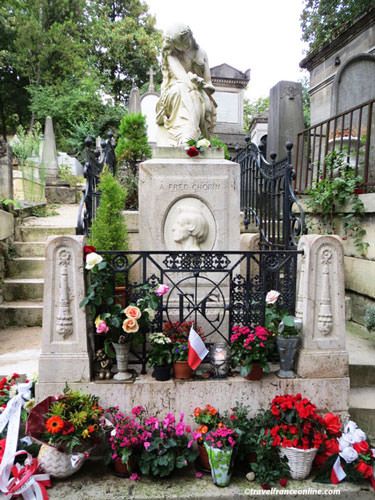
It is impossible to list all the people buried in Père Lachaise cemetery, but here are a few.
Among the writers, musicians, sculptors, and singers, you will recognize:
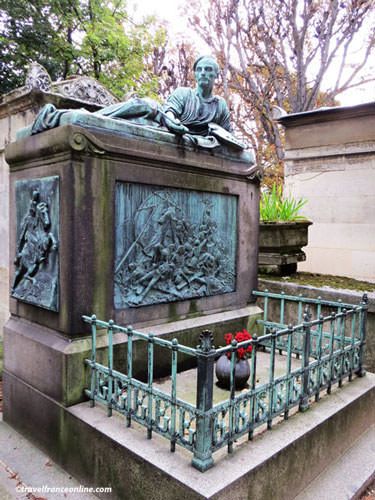
Apollinaire, Balzac, Beaumarchais, Bizet, Champollion, Chopin, Jean-Baptiste Clément, David, David d’Angers, Delacroix, Édith Piaf, and the painter Géricault.
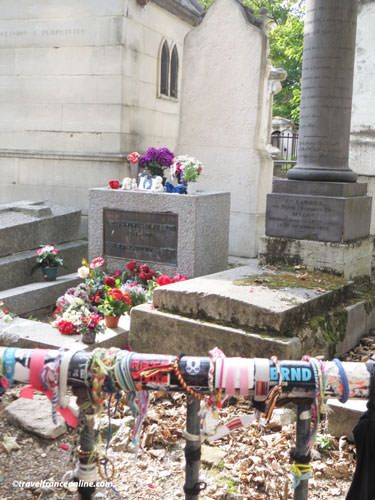
You will also discover the Hugo family vault (Victor Hugo is the Pantheon) and those of Jim Morrison, La Fontaine, Oscar Wilde, Marshal Ney, Murat, and Caroline Bonaparte (brother-in-law and sister of Napoleon I).
Strolling along the shaded paths, you will also discover the tombs of Modigliani, Molière, Proust, Rossini, Sarah Bernhardt, and Yves Montand among others…
Mur des Fédérés
You will find the Mur des Fédérés – Communards’ Wall to the east of Père Lachaise cemetery. The Communards, or Fédérés, were the Parisians who participated in the Paris Commune of 1871. This uprising lasted several weeks and culminated in fierce fighting that ended in the cemetery.

The last 147 Communards retreated to Père Lachaise cemetery and were captured at dawn on May 28, 1871. They were executed on the spot and buried in a mass grave along the wall, which has since been known as the Communards’ Wall in their honour.
This section of the cemetery is dedicated to war victims, with several monuments commemorating the victims of World War II.
Père Lachaise Cemetery, the grave of Héloise and Abélard
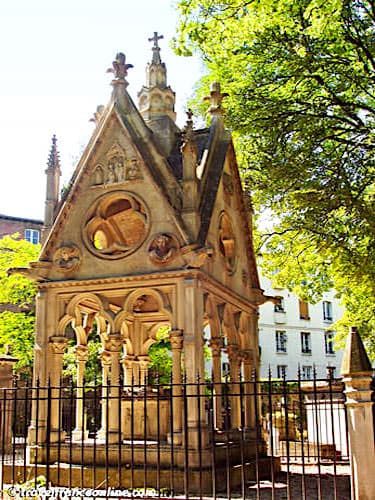
More than a million people are buried in Père Lachaise cemetery, but the first to be interred there were Héloïse and Abélard, the lovers immortalized by one of the most beautiful love stories in French history. Their unwavering love has symbolized eternal fidelity throughout the centuries.
Pierre Abélard (1079-1142) was a renowned theologian and scholar, considered one of the greatest minds of his time. His teachings, often deemed controversial, earned him frequent accusations of heresy. Among his most famous works is Sic et Non, a collection of 158 philosophical and theological questions.
Abélard taught in the cloister of Notre-Dame Cathedral, where he fell in love with one of his students, Héloïse.
Cultured, determined, and gifted, Héloïse was fluent in Latin, Greek, and Hebrew. Now, Héloïse was not only 22 years younger than Abélard, but she was also the niece of Fulbert, a canon of Notre-Dame!
Their romance took a tragic turn when Fulbert discovered their secret marriage and her pregnancy. In the rigid moral context of the early 12th century, such transgressions were severely condemned. Fulbert, thirsting for revenge, orchestrated a brutal attack against Abélard, who was castrated!
Despite this terrible ordeal, Abélard retired to the priory of Saint-Marcel, near Châlon-sur-Saône, where he spent the rest of his life as abbot until his death in 1142.
Héloïse, for her part, undeterred by the separation, remained faithful to her love for Abélard. Refusing all attempts to annul their marriage, she devoted herself to religious life and eventually became abbess of the Paraclet Convent.
Throughout their lives, physically separated but united in spirit, Héloïse and Abélard maintained their profound bond through a series of passionate letters, a testament to the enduring strength of their love in the face of adversity.
Extracts of a letters by Héloise and Abélard
Héloïse:
“But if I lose you, what have I left to hope for?
Why continue on life’s pilgrimage, for which I have no support but you, and none in you save the knowledge that you are alive, now that I am forbidden all other pleasures in you and denied even the joy of your presence which from time to time could restore me to myself?”
Abélard’s last letter to Héloise:
“To love Heloise truly is to leave her to that quiet which retirement and virtue afford.
I have resolved it: this letter shall be my last fault.
Adieu.
If I die here I will give orders that my body be carried to the House of the Paraclet.
You shall see me in that condition, to demand tears from you, for it will be too late; weep rather for me now and extinguish the fire which burns me.
You shall see me in order that your piety may be strengthened by horror of this carcass, and my death be eloquent to tell you what you brave when you love a man.
I hope you will be willing, when you have finished this mortal life, to be buried near me.
Your cold ashes need then fear nothing, and my tomb shall be the more rich and renowned.”
The remains of Héloïse and Abélard were transferred to Père Lachaise cemetery in 1817 and reunited in the same tomb, considered a masterpiece of the Flamboyant or High Gothic style.
Directions: 20th District
Metro stations: Père Lachaise, Gambetta, Philippe-Auguste on Lines 2, 3
Coordinates: Lat 48.862787 – Long 2.392809
Père Lachaise Cemetery opening hours:
From November 6 to March 15:
Mon-Fri: 8am to 5.30pm
Sat: 8.30am to 5.30pm
Sun and holidays: 9am to 5.30pm
From March 16 to November 5:
Mon-Fri: 8am to 6pm
Sat: 8:30am to 6pm
Sun and holidays: 9am to 6pm


