
Evergreen Holly in the Celtic mythology
Holly, an evergreen tree, is one of the four flowers traditionally used during Christmas celebrations in France. Its use has its roots in ancient Celtic traditions linked to the winter solstice.
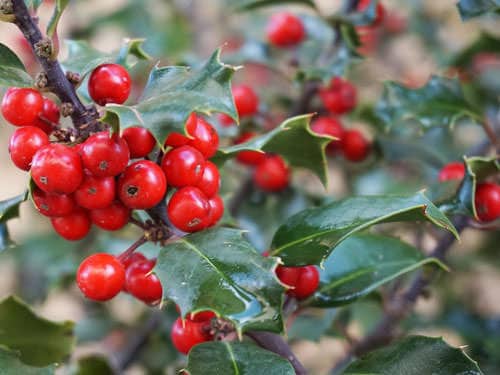
Revered by our ancestors as a powerful symbol of Death and Rebirth, this tree played a central role in rituals marking the change of seasons. During the winter solstice celebrations, when sunlight declined to its lowest point before rising again, holly symbolised the cyclical nature of life and the promise of renewal. Associated with the sacred oak, revered as the “king of trees” for its majestic stature and nourishing acorns, holly was considered its counterpart.
In Celtic belief, the sacred deciduous oak and the evergreen tree were seen as twins, each embodying the essence of the other. As winter settled in and the sacred oak lost its leaves, the holly stood, unperturbed, its bright green foliage and purple berries embellishing the desolate landscape.
However, with the arrival of the Summer Solstice, the evergreen tree gave way to the majestic oak, its thick foliage casting its shadow over the smaller conifer. Thus, the Holly reigned supreme during the winter solstice, while the Oak came to power with the arrival of summer, symbolising the eternal dance of light and darkness, of life and death, inherent in the natural world.
Roman mythology
The Romans used a lot of it during the Saturnalia, festivals dedicated to Saturn, the God of Harvests and Fertility, where people exchanged holly wreaths adorned with representations of Saturn.
Early Christians adapted the tradition for Christmas celebrations, decorating their homes with the branches to protect themselves from persecution while secretly commemorating the Nativity of Jesus.
For them, the plant’s thorny leaves symbolised Christ’s crown of thorns, the red berries represented his blood, and the evergreen foliage eternal life.
Much of the complex symbolism associated with this plant has probably faded over time, giving way to a more spontaneous and sincere celebration of Christmas.

The enduring popularity of the plant is also due to its natural beauty and radiance.
As one of the few plants to bear fruit in winter, it brings a touch of colour to the holiday season.
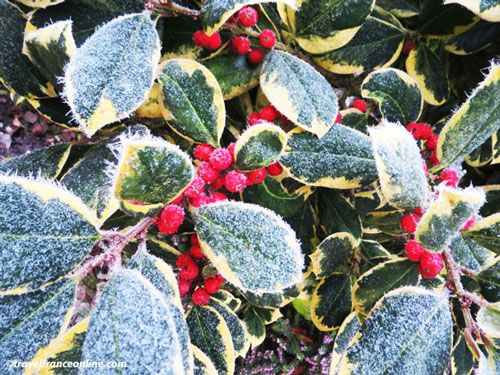
In addition, the availability of variegated hybrids with smooth leaves has expanded decorative possibilities, allowing for magnificent and original compositions!
Discover the other traditional Christmas plants: the poinsettia, the ivy and the mistletoe.


