
Passage des Panoramas – Grands Boulevards

The Passage des Panoramas is one of the last remaining covered passages in Paris, and also one of the oldest and most beautiful. It was listed as a Historical Monument on July 7, 1974.
This 130m-long and 3.20m-wide passage has four entrances: No.11 Boulevard Montmartre, No.10 Rue Saint-Marc, No. 38 Rue Vivienne, and No.158 Rue Montmartre.
Boulevard Montmartre is one of the Grands Boulevards, originally called the Nouveaux Cours (new avenues) and commissioned in 1670 by Louis XIV to replace the ramparts built a few decades earlier by Louis XIII.
The Nouveaux Cours were wide, tree-lined avenues that quickly became popular promenades for Parisians. A plethora of cabarets, inns, restaurants, theatres, and open-air dance halls soon sprang up along the avenues, gradually transforming them into the vibrant Parisian centre of entertainment and leisure.
Robert Fulton, the founder of the Passage des Panoramas
The growing popularity of the Grands Boulevards did not escape the notice of an American engineer.
In 1799, Robert Fulton thus built two rotundas on the grounds of the Hôtel de Montmorency-Luxembourg, a private mansion whose main entrance faced Boulevard Montmartre.
In these rotundas, Fulton offered a novel attraction: 360-degree panoramic views of Paris and Toulon, Jerusalem, as well as the Italian cities of Rome and Naples, to spectators seated on a central platform. Fulton’s panoramas became an immediate success!
To provide shelter from the elements for his clientele, Fulton built a covered passageway to connect the rotundas to the nearby Palais-Royal. The popularity of the panoramas, along with direct access to the Grands Boulevards and its proximity to the Bourse, and Opéra Garnier, made the Passage des Panoramas one of the most frequented places in Paris.
The arrival of the Théâtre des Variétés in 1807, right next door, further increased its popularity. This success reached its peak in 1816 when the passage became one of the first covered arcades in Paris to be lit by gaslight!
Passage des Panoramas, a listed covered gallery
Unfortunately, interest in the Panoramas gradually waned, and the rotundas were demolished in 1831 due to a lack of profitability.

However, the Passage des Panoramas continued to thrive thanks to the diverse shops that had opened there.
Given the passage’s enduring popularity, the architect Grisard built four new galleries in 1834 to compete with the neighbouring shopping arcades, the Galerie Vivienne and the Galerie Colbert.
Thus, the Galerie Saint-Marc, the Galerie des Variétés (which housed the artists’ entrance), the Galerie Feydeau, and the Galerie Montmartre were added.
The Passage des Panoramas’ popularity was cemented when the famous composer Jacques Offenbach took up residence at the next door Théâtre des Variétés.
His productions indeed attracted the Parisian elite.
The renowned novelist, Emile Zola, contributed to the notoriety of the passage bu making it the setting for his novel “Nana,” one of the books in his celebrated Rougon-Macquart series.
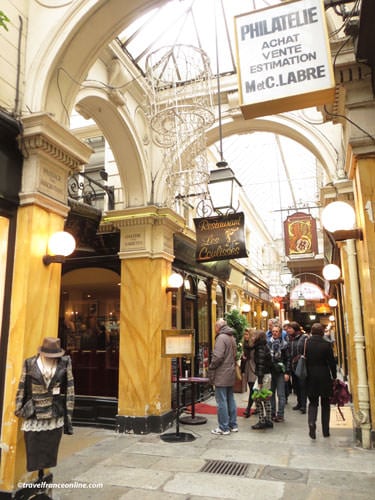
The Passage des Panoramas has changed little since its opening and still boasts a wealth of charming boutiques.
Although most of the shops have changed hands over the years, they have managed to preserve their original decor, thanks to the passage’s classification as a historical monument.
Strict regulations indeed govern any alterations or restorations, thus guaranteeing the preservation of its authentic character and atmosphere.
Most shops, including several philatelic shops, some of the oldest in the passage, still exude an old-world charm that invites passersby to enter.
The Stern engraver’s shop opened its doors in 1824 and is one of the oldest in the passage.
Although its premises are no longer in operation, they have been the Stern family’s property since its establishment.
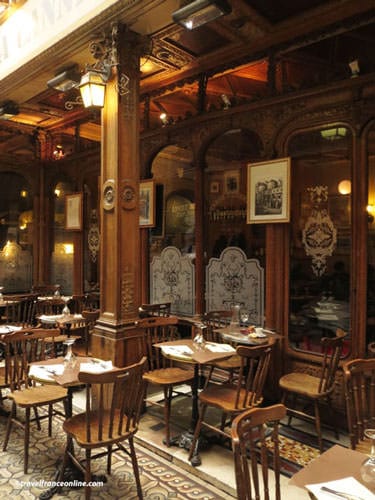
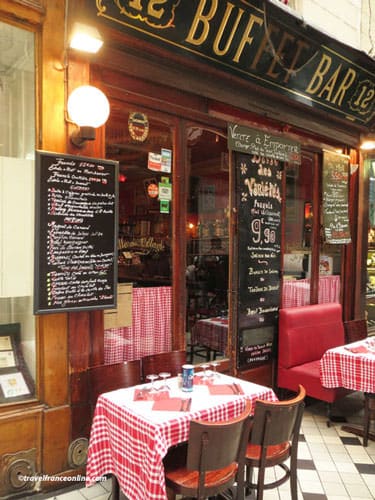
Beyond its architectural appeal, the Passage des Panoramas offers a peaceful haven away from the hustle and bustle of the boulevard, making it an ideal spot for a relaxing lunch.
You can choose from a wide selection of Parisian restaurants, bistros, and cafés.
While strolling through the galleries of the Passage des Panoramas, you’ll discover the charming tea room and restaurant L’Arbre à Cannelle, housed in the former Chocolaterie Marquis shop.
Stepping inside is a must, if only to admire its splendid decor!
You’ll also discover a wealth of original architectural details and decorations adorning the walls and ceilings of the passage.
Beauty is everywhere! The Passage des Panoramas offers indeed a glimpse into the elegance and charm of old Paris.
Opening hours: Everyday – 6am to midnight – Free access
Directions: 2nd district – no11 Boulevard Montmartre
Metro: Grands Boulevards on Lines 8, 9 or Bourse on Line 3
Bus: 20, 39, 48, 67, 74, et 85
Coordinates: Lat 48.871538 – Long 2.341821


