
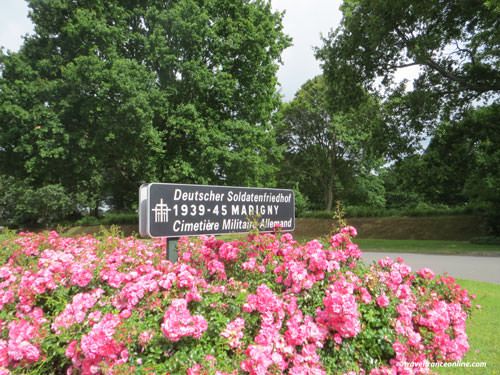
Marigny German Cemetery – Cimetière Militaire Allemand – Deutscher Soldatenfriedhof – 1939-45
The Marigny German Cemetery bears witness to the fierce fighting that raged during the Battle of Saint-Lô and Operation Cobra-La Percée. Located on the outskirts of La Chapelle-en-Juger, west of Saint-Lô, this cemetery houses the remains of more than 11,000 soldiers, many of whom belonged to the Panzer-Lehr Division.
On July 25, 1944, during the Battle of Saint-Lô, Allied forces launched a massive air raid, mobilising more than 2,000 bombers, to break through the German lines between Saint-Lô and Périers. Despite the fierce resistance of the Panzer-Lehr Division, the American infantry units managed to dismantle the first German defences and advance towards La Chapelle-en-Juger, where they joined up with other regiments.
The German survivors retreated to Marigny, where they continued their fierce defence. However, the combined assault of the tanks and infantry of the 3rd Armoured Division proved decisive, leading to the defeat of the German forces the following day.
Although La Chapelle-en-Juger lay in ruins following the fierce fighting, it had been liberated from German occupation. This decisive attack was part of Operation Cobra, an Allied strategic offensive aimed at breaking through the Cotentin Peninsula and advancing deeper into enemy territory.
Marigny, a temporary American war cemetery
The Americans’ decision to establish a temporary cemetery at Marigny demonstrates their desire to offer a dignified burial to their soldiers who fell on the filed in the Norman bocage (countryside), particularly during the decisive battle of Saint-Lô.
In the late 1940s, they transferred the remains of 3,070 soldiers buried in Marigny to larger military cemeteries they had created in Normandy.
Among these, the military cemetery of Coleville-St-Laurent-sur-Mer, near Omaha Beach, and the cemetery of Saint-James, farther south, near Brittany, are the largest.
Once the transfer was completed, they erected a commemorative stelae at the entrance to the Marigny German Cemetery as a lasting tribute to the soldiers of the VII American Corps who fought under the command of General Collins.
Marigny German Cemetery – A permanent German war cemetery
The cemetery was then entrusted to the German government to ensure a dignified burial for the German soldiers who fell during the Battle of Normandy.

Like their French and Allied counterparts, many German soldiers were initially buried in mass graves and small cemeteries scattered across the Cotentin peninsula.
Between 1959 and 1961, their remains were respectfully exhumed and re-interred in the Marigny German Cemetery.
The Volksbund Deutsche Kriegsgräberfürsorge (German War Graves Commission), established in 1919, plays an essential role in the maintenance of the graves of German soldiers who died in foreign territory.
The German Service for the Maintenance of Military Graves (SESS) maintains the German military cemetery in Marigny.
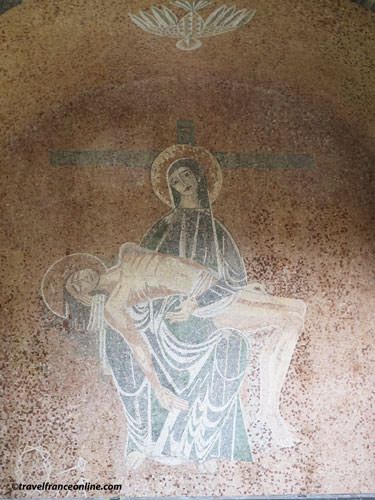
Virgin supporting the Christ in his Descent from the Cross
A Norman chapel marks the entrance-exit of the Marigny German Cemetery.
The inscription engraved on the information panel near the entrance reads as follows:
Les morts de ce cimetière exhortent à la paix!
The Dead of the Cemetery urge us to reflect on Peace!
Die Toten in diesem Friedhof Drang nach Frieden!
It invites contemplation, but also Mercy and Forgiveness.
Inside the chapel, located on the ground floor of the tower, a mosaic depicting The Virgin supporting Christ during his Descent from the Cross adorns the back wall.
Next to the chapel, a vast windowless corridor serves as an information room. There is a Book of Remembrance and a panel illustrating the cemetery’s plan.
Rigor and simplicity of the cemetery
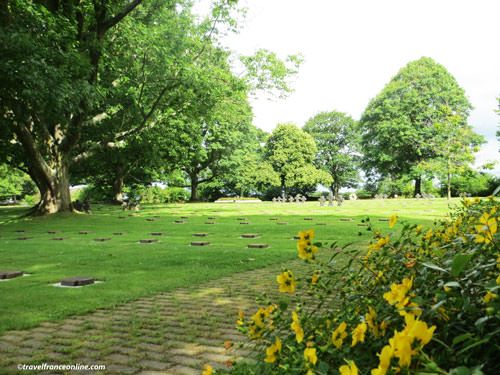
Upon entering the Marigny German Cemetery, you are immediately struck by the site’s meticulousness, simplicity and elegance. It consists of a vast lawn planted with oak trees, inspiring serenity and solemnity.

This natural landscape has deep cultural significance, rooted in Germanic mythology, and more specifically in the cult of the Dead. Traditionally, the tombs of warriors were located on the edge of the forest to offer them the shade necessary for eternal rest and to facilitate their passage to the Warriors’ Paradise.
The cemetery is laid out with crisscrossing paths, dividing its four hectares into small square plots. Each double grave is marked with a terracotta slab bearing the names, ranks, and dates of birth and death of two soldiers.
Germany regularly sends young soldiers to replace the ageing paving slabs, which were originally laid directly on the ground. The new, raised tombstones create a harmonious perspective.
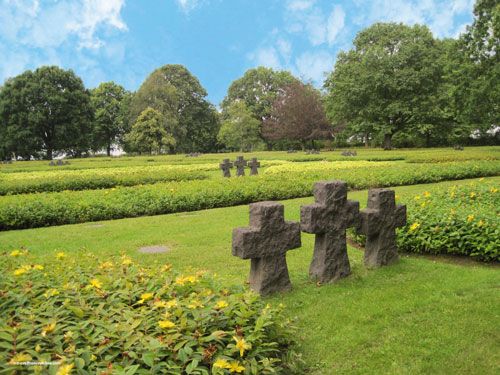
The graves are meticulously aligned in double rows, once bordered by clumps of St. John’s wort whose golden flowers contrasted beautifully with the lush greenery of the lawns and trees. Sadly, these plants succumbed to a disease and have since been uprooted.
Each tenth grave is marked by three crosses carved from local grey schist, with two smaller crosses framing the central cross. This austere simplicity seems to symbolise the quest for forgiveness of those who fought valiantly to the end and now rest in this cemetery.
Reading the inscriptions on the slabs is deeply moving, because the soldiers buried there were, on average, barely twenty years old. Unfortunately, this sacred place attracts too few visitors, perhaps due to its isolation, far from the busy landing beaches.
Marigny German Cemetery – Putting a face on a name

Among the orderly rows of graves, small gestures of remembrance remind us that these soldiers had families who remembered them: a potted flower, a faded bouquet, a candle, or a wreath.
One of the most poignant moments comes when we discover the photograph of a young soldier who fell decades ago.
Suddenly, the anonymity of a name and dates of birth and death fades away, giving way to a tangible presence.
Now, a face is emerging from the name engraved on the slab.

Like all the other soldiers here, he was someone’s son, husband, father, brother, lover, companion or friend, a loss from which those left behind probably never truly recovered.
At the Marigny German Cemetery, soldiers of all ranks and ages rest side by side, united in death.
The youngest of them wasn’t even fifteen years old.
Many others remain unidentified, their graves bearing simply the sober inscription: Zwei Deutsche Soldaten (Two German Soldiers).
Among those whose names are known is Wilhelm Lubrich, a Polish soldier forced to fight in the German army.
General Erich Marcks’ grave in Marigny German Cemetery

The story of General Erich Marcks is both remarkable and tragic.
An experienced commander, and a shrewd strategist and leader, he was convinced that the Allies would land not on the northern coast of France, as German intelligence believed, but on the Normandy Coast.
D-Day ended with the reconquest of the territories by France and its allies, a conquest that came, though, at a heavy price (on both sides!).
General Marcks was killed a few days after his 53rd birthday. He rests alongside his soldiers in a simple grave.
Here is a war poem by Seigfried Sassoon
Reconciliation
When you are standing at your hero’s grave,

Or near some homeless village where he died,
Remember, through your heart’s rekindling pride,
The German soldiers who were loyal and brave.
Men fought like brutes; and hideous things were done;
And you have nourished hatred harsh and blind.
But in that Golgotha perhaps you’ll find
The mothers of the men who killed your son.
Department of Manche – La Chapelle-en-Juger – Marigny German Cemetery – D341 – Rue du Cimetière Allemand
Coordinates: Lat 49.112809 – Long -1.234783


