Villa Ephrussi de Rothschild, a dream mansion
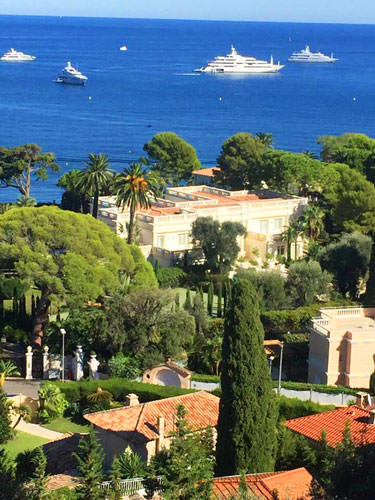
The Villa Ephrussi de Rothschild, also known as Villa Île de France, stands like a dream residence on the heights of the magnificent landscape of Saint-Jean-Cap-Ferrat.

Perched on a promontory, this rose-red marvel offers exceptional panoramic views of the Mediterranean Sea and the bustling port of Cap-Ferrat below.
Designed by the architect Aaron Messiah, this Venetian-style villa was commissioned by Béatrice de Rothschild, wife of the banker Maurice de Ephrussi.
A passionate collector of art and period furniture, Béatrice particularly enjoyed 18th-century pieces. With her immense wealth, she adorned her home with a rich collection of period furniture, sculptures, objets d’art, and masterpieces by renowned artists. Her extensive collection also included rare porcelain and meticulously landscaped gardens, which she generously bequeathed to the Académie des Beaux-Arts in 1933, a year before her death.
Designated a historic monument in 1996, the Villa Ephrussi de Rothschild is open to the public and welcomes visitors from around the world.
Who was Baroness Beatrice de Rothschild?
Let’s travel back in time to meet Béatrice, daughter of Baron Alphonse de Rothschild.

Born in 1864, she grew up surrounded by the vast and extraordinary art collections amassed by her father. At 19, she married Maurice Ephrussi, but this union proved unhappy and ultimately ended in divorce 21 years later.
The couple’s inability to have children was attributed to the alleged “shameful disease” that Maurice supposedly transmitted to Béatrice.
So, perhaps as compensation, Béatrice devoted her life to amassing a remarkable art collection. Her passion for art blossomed during her childhood. Her father instilled in her not only a profound appreciation but also the knowledge necessary to acquire exceptional collections over the years.
Upon her father’s death in 1905, Béatrice inherited a vast fortune and the title of baroness. She embarked on building her dream house on the isthmus of Cap Ferrat, a place she had fallen in love with.
However, this land, despite its breathtaking sea views, presented a major challenge: it was a steep and wild promontory, difficult to access.
The Jardin à la Française
Despite the obstacles, Béatrice pursued her dream with unwavering determination, bolstered by her fortune.
The first step was to transform the rugged terrain into a buildable site. Béatrice spared no expense on the landscaping, enlisting the renowned landscape architect Achille Duchêne, who transformed the windswept, rocky promontory into a magnificent French formal garden (Jardin à la Française).
Considerable work was undertaken, including blasting rocks and importing large quantities of topsoil to enrich the arid ground. In a stroke of genius, Duchêne shaped the French formal garden in the image of a ship, allowing Béatrice to admire its beauty from the loggia of her future villa.
Inspired by her experience on a cruise aboard the steamship Île de France, Béatrice designed her villa as a tribute to the vessel, hence its name: Villa Île de France. Her creative spirit extended even to the attire of her gardeners, whom she had dressed in sailor uniforms, topped with berets adorned with red pom-poms, echoing the maritime theme that permeated her beloved villa.
Finally, the loggia was designed to mimic the deck of a ship, creating a harmonious transition between the sea and the landscaped gardens.
Construction of Villa Ephrussi de Rothschild

Construction of the Villa Ephrussi de Rothschild began in 1907.
With a clear vision, Béatrice remained demanding in her choice of architects, rejecting numerous proposals.
Ultimately, she opted for the design by Jacques-Marcel Auburtin, assisted by Aaron Messiah.
In the winter of 1912, Béatrice moved into her newly completed villa, where she would spend the next decade.
Béatrice shared her time between her properties in Paris, Monaco, and Deauville, and spent considerable time in her beloved Villa Ephrussi, which she enriched over the years with a remarkable art collection.
Béatrice selected the pieces destined for her villa, while the others were shipped to her Monaco estate.Train cars laden with furniture and objets d’art indeed became a common sight, arriving regularly at the Beaulieu train station.
Thematic gardens
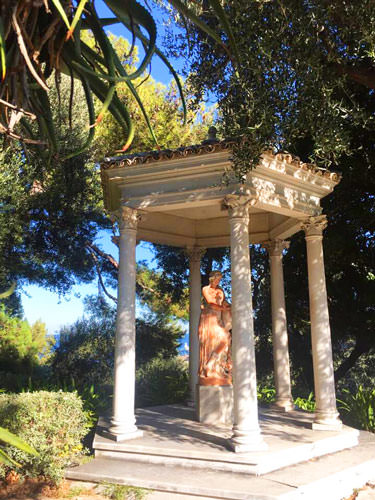
In her later years, Beatrice retired to Davos, Switzerland, where she succumbed to tuberculosis in 1934.
However, the previous year she had bequeathed her villa, gardens, and art collections to the Academy of Fine Arts.
Landscape architect Louis Marchand restored these gardens to their former splendour after the devastation of the Second World War.
Marchand immediately undertook the restoration of the formal French garden and the creation of themed gardens, including Spanish, Florentine, rock, Japanese, Mexican (now called Exotic), Provençal, and rose gardens.
The house was also renovated: its ocher-yellow facade was repainted in a vibrant pinkish-red hue, reminiscent of Venetian architecture.
The Villa Ephrussi de Rothschild and its meticulously landscaped gardens continued to fascinate visitors until the harsh winter of 1985, when freezing temperatures caused severe damage, destroying trees and plants adapted to the generally mild Mediterranean climate.
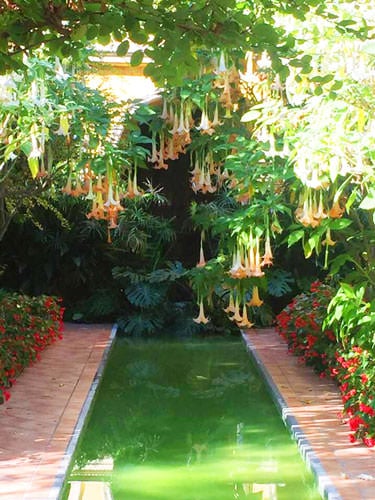
Fortunately, a neighbouring family, renowned for its extensive collection of exotic plants, generously offered its assistance in restoring the garden. They donated cacti and other exotic species, thus enabling the recreation of the Mexican garden, which became the Exotic Garden.
In 1991, aware of the importance of preserving this cultural treasure, the Academy of Fine Arts entrusted the management of the Villa Ephrussi de Rothschild and its gardens to Culturespaces.
The foundation undertook the major renovation project of the interior of the villa and the gardens.
The Villa Ephrussi de Rothschild and its meticulously landscaped gardens were also awarded the prestigious label Remarkable Gardens of France.
Photo via Wikimedia Commons: Header by Daderot Public Domain – Other photos are copyrighted to SheldonMcBride