Vénasque in Vaucluse
The picturesque village of Vénasque is perched on a rocky promontory offering breathtaking panoramic views of the Nesque Gorge, the vast Carpentras plain, the majestic Vaucluse Mountains and the iconic Mont Ventoux.
Thanks to its privileged location, it is no wonder that Vénasque has been continuously inhabited since the Palaeolithic era.
Archaeological excavations of the numerous rock shelters that dot the landscape along the Nesque River have indeed unearthed a wealth of objects and tools, demonstrating that human activity reached its peak during the Neolithic period.
Since the 17th century, the fertile plains surrounding the village have been dedicated to cherry cultivation.These cherries, known as Cerises de Vénasque, are prized for their exceptional quality, unique flavour, and vibrant colour, earning them the nickname “Red Diamond of Provence” and the “Cerises des Monts de Vénasque” label in 1978.
Vénasque, the capital of Comtat Venaissin
Let’s go back to the time when Vénasque was known as Vindasca, and was the stronghold of the Memini tribe, a Celtic people whose capital was Carpentras.
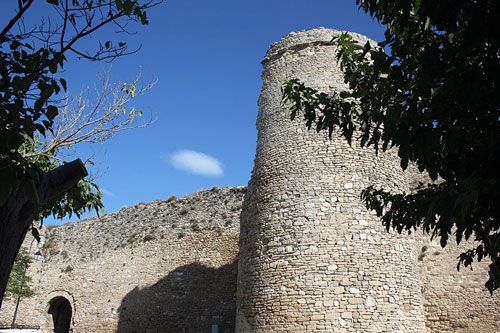
The fortifications they built around their oppidum were reinforced during the Gallo-Roman period. Among the numerous remains from this era was the tombstone of Bohetius, Bishop of Carpentras in the 6th century, which was discovered near the Notre-Dame-de-Vie church. The church stands in the original part of the village. Its name evolved from, “vicus,” meaning town, which became “vic” and then “vie.”
The Romans renamed the stronghold Comitatus Vendacensis, or County of Venasque, which eventually gave its name, Comtat Venaissin, to the region.
In 1125, the County of Venasque came under the rule of the Counts of Toulouse. However, a century later, Raymond VII of Toulouse’s involvement in the Albigensian rebellion led to the County of Venaissin to be transferred to the papacy after his defeat in 1219.
The County of Venaissin remained under the jurisdiction of the Holy See until the French Revolution in 1791, when it was annexed to France. With this transition, the fortress of Venasque lost its strategic importance and fell into disuse.
One of the most beautiful French villages
Venasque is one of the many Provençal villages that were fully restored in the 1960s. It has thus preserved its authentic charm and exceptional medieval architecture.
Venasque is therefore listed among the Les Plus Beaux Villages de France – Most Beautiful Villages of France. Furthermore, a protection order, promulgated in 1967, prohibits any exterior alterations to existing buildings and mandates the restoration of ruined structures according to their original plans!

Its steep, narrow streets are lined with picturesque Provençal houses and mansions, built between the 14th and 17th centuries. The Esplanade des Tours, where the Tours Sarasines (Saracen Towers) stand, offers a breathtaking view of the Dentelles de Montmirail and Mont Ventoux. These fortifications, along with the three towers, are listed as historical monuments.
The Planette fountain was erected in 1891 in the Place de la Planette to commemorate the centenary of the integration of the County of Venaissin into France.
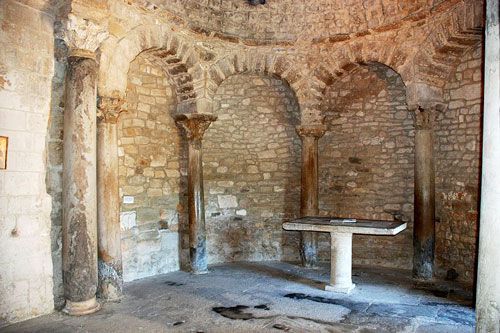
Finally, you will come across the Baptistère de Venasque (Baptistery), which was listed as a historical monument in 1840. Built in the 6th century, it is indeed one of the oldest religious buildings in France and possesses ancient columns believed to have originated from Roman temples!
Department of Vaucluse
Coordinates: Lat 43.995641 – Long 5.146846
Photos via Wikimedia Creative Commons: Cherry trees by Véronique PAGNIER CC BY-SA 3.0 – Roman fortifications by Reinhardhauke CC BY-SA 3.0 – Baptistere by EmDee CC BY-SA 3.0