
Auvers-sur-Oise, Van Gogh’s final abode

Auvers-sur-Oise is a picturesque village on the banks of the Oise River where Van Gogh spent the last 70 days of his life and painted 78 canvases. This is also where he died on July 29, 1890, and was buried in the municipal cemetery.
Van Gogh’s mental state remained fragile upon his arrival in Auvers, after a year spent (voluntarily) at the Saint-Rémy-de-Provence asylum.
After leaving Saint-Rémy, Vincent spent two days with his brother Théo and his family in Paris. Worried about Vincent, Theo sought a peaceful place where he could continue painting. He arranged for Vincent to stay in Auvers-sur-Oise, under the care of Dr Gachet, a specialist in mental illness and a fervent supporter of the arts.
Van Gogh arrived in Auvers on May 20, 1890, and settled at the Auberge Ravoux. Tragically, on July 27, during one of his walks in the countryside, he shot himself in the abdomen. Upon hearing the news, Théo rushed to Auvers and stayed with Vincent until his death two days later.
The spiritual legacy of Van Gogh in Auvers-sur-Oise
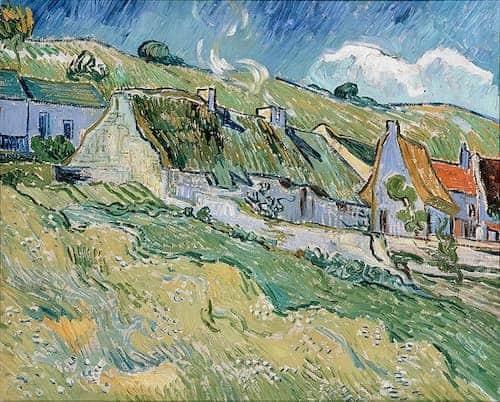
While strolling through Auvers and its picturesque countryside, you will discover many landscapes immortalised by Van Gogh on his canvases.
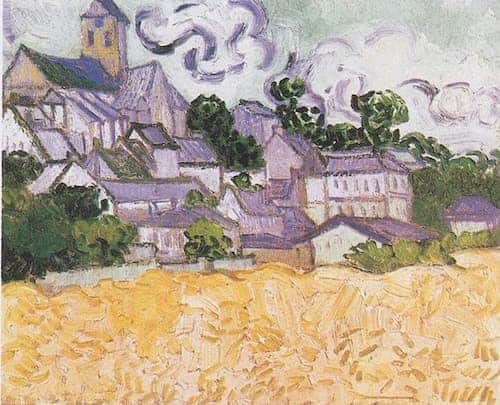
His daily walks through cultivated fields, orchards, meadows, and along country lanes or the banks of the Oise River were an inexhaustible source of inspiration.
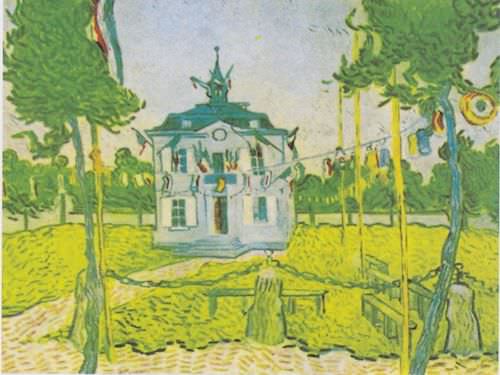
While it is impossible to list them all, among the most recognisable are “Wheatfield with Crows,” “Portrait of Dr Gachet,” the iconic “Church at Auvers and its famous purple sky,” and “The Town Hall at Auvers,” the original of which is housed in the Musée d’Orsay in Paris.
The sculptor Zadkine depicted Van Gogh with his easel and painting supplies slung over his shoulder. This sculpture, located near the Auvers-sur-Oise Tourist Office, captures the very essence of the artist in the throes of creation.
Auberge Ravoux – Van Gogh’s residence
Van Gogh spent the last 70 days of his life at the Auberge Ravoux.

It was also in the modest attic room, lit only by a small skylight, that this great artist spent his final moments with his faithful brother Theo at his side.
This room has been preserved exactly as it was after Van Gogh’s death. An old tradition dictates that a room where a suicide has taken place can no longer be let. Consequently, the room remains unfurnished, except for a single chair.
The inn and restaurant were fully restaured in 1986 to preserve their authenticity and the atmosphere of the 1890s.
You will find the Auberge Ravoux opposite the town hall in Auvers.
Van Gogh was buried in the small municipal cemetery, where his artist friends came to pay their last respects alongside many villagers who had come to appreciate the kindness tinged with harshness of this tormented artist.

Tragically, Theo died six months later in the Netherlands.
In 1914, Theo’s wife had his remains transferred to Auvers so that he could rest beside Vincent.
Today, ivy from Dr Gachet’s garden adorns their adjacent graves, a symbol of a fraternal bond and unparalleled devotion.
Auvers-sur-Oise, a haven for Impressionist painters
Throughout the 19th century, many landscape painters, particularly Impressionists, were drawn to Auvers for its tranquillity, picturesque scenery, soft light, and idyllic atmosphere.
The inauguration of the railway line in 1846, connecting the Gare du Nord to Lille in the Pas de Calais, placed Auvers just an hour from the capital. This accessibility appealed to Parisians seeking rural charm and nautical pleasures.
In 1860, the painter Charles-Francois Daubigny established his studio-barge, Le Botin, on the banks of the Seine in Auvers, thus confirming the village’s reputation as a haven for artists.
This pioneer of Impressionism founded an artistic circle that attracted luminaries such as Corot, Daumier, Berthe Morisot, Cézanne, Pissarro, and Monet. Each of these artists succumbed to the charm of Auvers and created some of their most famous works there.
In 1860, Daubigny built a house-studio to gather his work and that of his painter friends. The Maison d’Aubigny and its garden were listed as a historical monument in 1993 and designated a Maison des Illustres (House of the Illustrious) by the Ministry of Culture in 2014.
The Maison du Docteur Gachet and its garden, where the doctor received Pissarro, Guillaumin, and Cézanne, are also open to the public, offering a more comprehensive overview of the artistic heritage of Auvers-sur-Oise.
Passionate about art and engraving, Dr Gachet was not only Van Gogh’s doctor but also a friend. Van Gogh often visited him and painted three famous portraits of him. The doctor’s house has been a listed historical monument since 1991.
Auvers-sur-Oise continued to attract artists throughout the 20th century.
Among them was the Impressionist painter Emile Boggio, who arrived in Auvers in 1910 and founded the Les Ateliers Boggio – Boggio Workshops, which are still in operation today under the direction of his great-grandnephew, Xavier.
Château d’Auvers-sur-Oise
No visit to Auvers would be complete without mentioning its château, built in the 17th century by an Italian financier who held a position at the court of Queen Marie de Medici. The château was remodelled in the French Renaissance style a few decades later, then renovated at the end of the 18th century.

The Val-d’Oise General Council acquired it in 1987. Today, the château hosts permanent and temporary exhibitions dedicated to Impressionism, from its origins to the present day.
Despite some changes, Auvers-sur-Oise has retained much of its old-world charm, allowing visitors to recognise the places immortalised in the paintings of the era. While most recent construction has taken place on the outskirts, Auvers has grown from a village into a small town.
How to get to Auvers-sur-Oise from Paris?
Department of Oise
Coordinates: Lat 49.070545 – Long 2.171393
By car: 34kms – about 50mn – A1 – A86 and A115 – Exit onto D928 at Sognolles towards Auvers
By train – Transilien about 1h10 Gare du Nord-Auvers station with 1 connection and several stops
Photos via Wikimedia Commons: Header and village cottages Domaine public – Church Source Musée d’Orsay: 755 Public Domain – Town hall Public Domain – Auvers-sur-Oise and church by VG Source vangoghgallery.com Rhode Island School of Design Domaine public – All by VG – Graves by Héric SAMSON CC BY-SA 3.0 – Auberge Ravoux by Yannbee Public Domain – Château by P.poschadel CC BY-SA 2.0 fr


