
Uzerche, ranked among the 100 Most Beautiful Detours in France
Uzerche is located in the Limousin region, between Brive and Limoges.
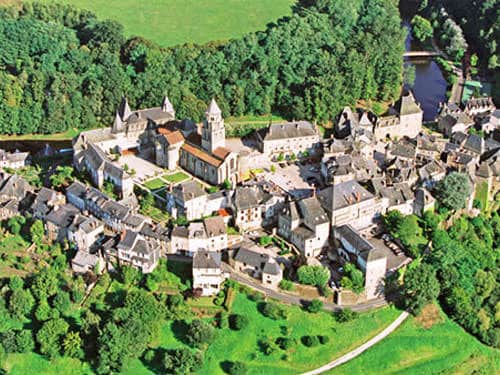
Perched on a 342-meter-high rocky promontory overlooking a bend in the river Vézère, Uzerche is often compared to an eagle’s nest, a fitting metaphor.
This natural depression was named the Col d’Eulalie after the chapel erected there in the early Middle Ages in honour of Saint Eulalia. The small community that grew up around the chapel gave rise to the vibrant, modern-day Sainte-Eulalie district.
The former ford across the Vézère was a crossroads for ancient communication routes, making Uzerche an essential transit point. One route connected western France to the Mediterranean, while another, a vital north-south axis, crossed the Vézère at a ford.
Is Uzerche the Gallic Uxellodunum?
Uzerche’s exceptional location has attracted people since antiquity. Over two millennia ago, the Gauls established their fortified settlement, or oppidum, on the rocky spur.
However, the origin of this fort remains a subject of debate to this day. Many claim that this stronghold was the legendary Uxellodunum, the last Gallic stronghold conquered by Julius Caesar’s troops during the conquest of Gaul. Others refute this claim, believing that Capdenac-le-Haut, another Gallic stronghold located in the Lot Valley was the true Uxellodunum.
Unfortunately, no conclusive evidence exists to definitively settle the matter between these two claims. What we do know, however, is that the Romans expanded and reinforced the Gallic oppidum of Uzerche approximately 2,000 years ago. Yet, the Visigoths managed to seize it before pillaging and razing it in the 6th century. The fortress was nevertheless rebuilt and fortified a century later, and in the 8th century, the Frankish king Pepin the Short reinforced its defenses once again. But once more, the citadel fell to Viking invaders during their raids along the Vézère River in the 9th century.
Abbey d’Uzerches
After the invasions, Uzerche developed around the influential Benedictine abbey that was founded in the 10th century.
The abbey’s authority, and by extension the seigneury of Uzerche, stretched for miles.
One of the monks, Maurice Bourdin, even rose to the position of antipope Gregory VIII at the beginning of the 13th century.
The abbey was unfortunately destroyed during the Wars of Religion in the 16th century.
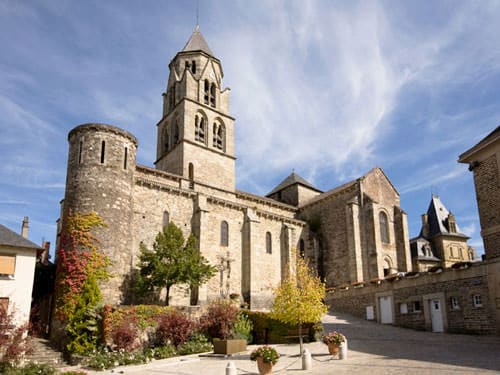
Today, only two buildings remain: the Church of Saint Pierre, a superb example of Limousin Romanesque architecture, and the Crypte des Corps (Crypt of the Holy Bodies), which once housed the relics of two Breton saints, St-Léon and St-Coronat; the church and its crypt were listed as historical monuments in 1840.
Uzerche, an influential medieval town
Uzerche experienced a period of remarkable prosperity when the region came under English rule during the Middle Ages. The marriage of Eleanor of Aquitaine to Henry II brought the Limousin, then part of the Duchy of Aquitaine, under English control. The Limousin was not re-attached to France until the 14th century.
Uzerche, thanks to its exceptional strategic location, received visits from prestigious figures of the time: Eleanor, Henry II of England and their son Richard the Lionheart, who died in battle at Châlus; the Duke of Burgundy, the Count of Toulouse, Louis IX of France (Saint Louis), Philip the Bold, Charles the Fair, and Pope Clement VI.
However, Uzerche was not only a fortress, but also an important administrative, financial, and judicial centre. In the 15th century, it indeed became the seat of a prominent seneschal’s court (bailiwick) and the capital of Lower Limousin.
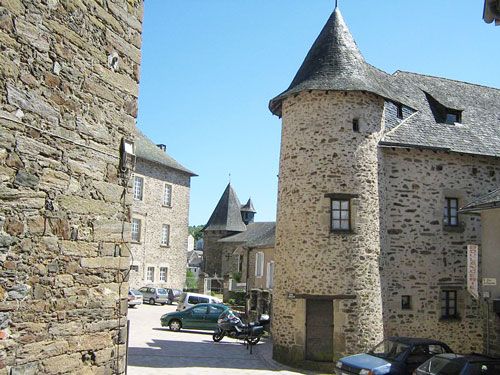
This period of prosperity saw the emergence of a local nobility that commissioned the town’s numerous manor houses and stately homes, many of which are now listed as historical monuments, including the Château de Bécharie, the Maison Eyssatier, and the Hôtel du Sénéchal, to name a few. However, in 1575, Protestant troops, led by the Viscount of Turenne, besieged and not only destroyed the abbey but also sacked the town. Although rebuilt, Uzerche unfortunately never fully regained its former influence.
Uzerche, Perle du Limousin
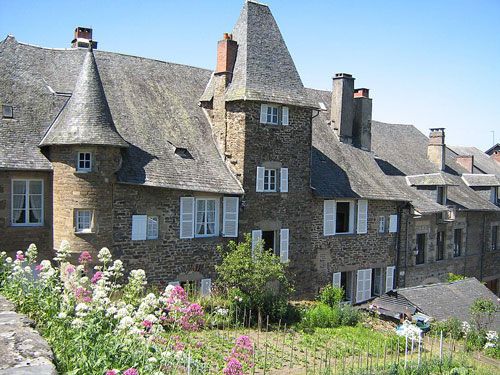
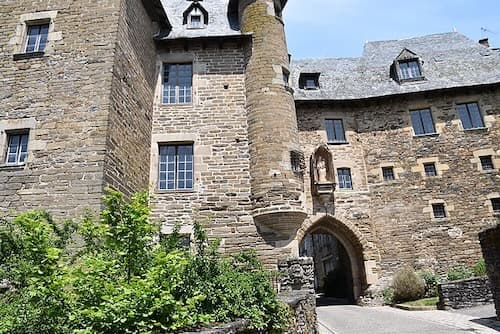
The Porte Bécharie (gate) is one of the few remaining vestiges of the 16th-century fortifications, the rest having been demolished in the 17th century. The origin of the name of the Tour du Prince Noir (Black Prince’s Tower), another building dating from the 16th century, remains a mystery. It was listed as a historical monument in 1933.
Uzerche may no longer exert the same influence as it once did, but it remains one of the most picturesque towns in France.
Nicknamed the Pearl of the Limousin – Pearl of the Limousin, it received the Ville Étape (Stopover Town) label in 1996 and was listed among the 100 Plus Beaux Détours en France (100 Most Beautiful Detours in France) in 2010.
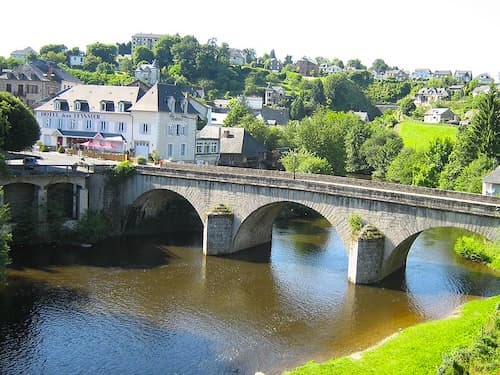
Its exceptional architectural heritage has even given rise to a famous saying: “Qui a maison à Uzerche a château en Limousin – “He who has a house in Uzerche has a castle in the Limousin.”
The medieval town is centred around the Rue de la Justice, a street lined with private mansions and charming half-timbered houses.
The parts of the town built on the hillside, are also renowned for their hanging gardens, terraces, and courtyards enclosed by stone walls.
Finally, the Pont Turgot (bridge), one of the landmarks of Uzerche, was built in 1753 to connect the medieval town to the historic Sainte-Eulalie district and is a listed historical monument.
Department of Corrèze – Limousin region
Coordinates: Lat 45.424066 – Long 1.563457
Photos via Wikimedia Commons: Porte Bécharie by René Hourdry CC BY-SA 4.0 – Seen from the sky and Pont Turgot by Franklinmelis CC BY-SA 3.0 – Tour du Prince Noir and Maison de Tayac by francois lavie CC BY-SA 3.0 – Eglise St-Pierre by PMRMaeyaert CC BY-SA 3.0


