
Châlus, an ancient crossroads
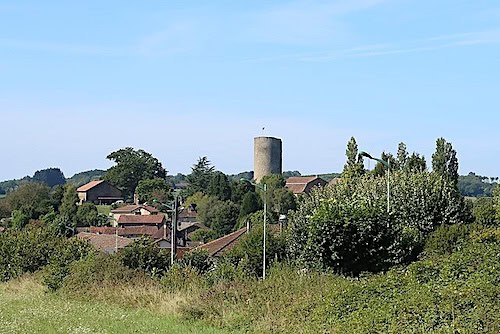
The small town of Châlus is located approximately 36 km southwest of Limoges, the capital of Limousin region. Perched on a promontory along the Tardoire River, in the heart of the Monts de Châlus, in the foothills of the Massif Central, this medieval town overlooks a landscape of hills and chestnut groves, known locally as the Pays de Feuillardiers (Land of chestnut hoop makers).
This region, situated within the Périgord-Limousin Regional Nature Park, has been inhabited since ancients times.
Archaeological excavations have indeed unearthed the remains of a Neolithic settlement already established at the crossroads of six ancient roads. These routes connected southern France and Spain to northern regions, notably Danish Jutland, a hub for the amber trade in antiquity.
Archaeological excavations have also unearthed vestiges dating to Gallo-Roman and Merovingian eras, which attest of the importance of the stronghold of Châlus as a key stop on the Roman road linking Limoges to Périgueux.

Indeed, Châlus was not only a crossroads of ancient routes, but also marked the border between rival territories, the Limousin, domain of the Counts of Limoges and vassals of the King of France, and the Duchy of Aquitaine, historical and rival territories. With the marriage of Eleanor of Aquitaine to Henry II of England, the Duchy of Aquitaine indeed passed into the hands of the Plantagenêts dynasty.
Thus, in the 11th century, the Viscounts of Limoges erected the fortress of Châlus Chabrol to control the Limoges-Périgueux road and to compete with the Bourges-Bordeaux road.
The increase in traffic on these roads stimulated the growth of the medieval Ville Haute (Upper Town), as well as the construction of the Abbaye de l’Abeille, which fell under the jurisdiction of the Augustinian Abbey of Limoges.
Richard the Lionheart died in the Castle of Chalus Chabrol
The strategic location of Châlus Chabrol meant it was besieged many times throughout its history!
The first siege occurred in 1193, when mercenaries, in conflict with the Bishop of Limoges, besieged the fortress.
However, the most significant siege took place on March 26, 1199. During this siege, Richard the Lionheart, King of England, was mortally wounded by an arrow. He succumbed to his injuries on April 6 at the fortress of Châlus Chabrol, in the presence of his mother, Eleanor of Aquitaine, who rushed from Fontevraud Abbey to be at his bedside. In memory of this event, a recumbent statue of Richard the Lionheart was later placed in the castle. This English defeat marked a turning point that allowed King Philip II of France (Philip-Augustus) to consolidate the French kingdom’s possessions.
The third siege occurred in 1265 when Bozon de Bourdeilles contested Adémar de Maulmont‘s claim to the fortress. Ten years later, the Maulmont family built the Château de Châlus-Maulmont on the opposite bank of the Tardoire River.
The fourth siege took place in 1406, during the Hundred Years’ War, when the English once again attempted to seize the fortress!
The fifth siege took place in 1569, during the Wars of Religion. Under the command of Admiral Coligny, a Protestant army, including the young Henry of Navarre (the future King Henry IV), captured Châlus. The Protestants defeated the troops of the King of France on 25 June of the same year, and advanced into Périgord to spread the Protestant faith. Despite the signing of the Edict of Nantes in 1598, which officially ended the Wars of Religion, sporadic conflicts between Huguenots and Catholics persisted locally until 1592.
Vestiges of the fortress
The fortress became the property of the French state during the French Revolution and was dismantled and used as a stone quarry.
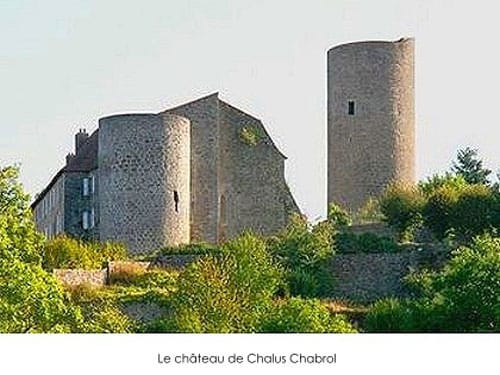
All that remains of the castle are a round tower, which once housed private apartments, as well as the circular keep. Local legend recounts that the arrow that fatally struck Richard the Lionheart was fired from this keep. The Count of Bourbon-Châlus, who had reclaimed the Château de Châlus Chabrol, undertook partial restoration work in the mid-19th century. The fortress remained in his family until 1995. Despite its dilapidated state, the Château de Châlus Chabrol is listed as a historical monument.
Chalus Chabrol, a major market town
The medieval fortified town of Châlus Chabrol not only marked the boundary of historical territories but also flourished in a region primarily dedicated to cattle breeding. It thus became a bustling market town, renowned for its fairs and thriving trade.
The introduction of the chestnut tree to the Limousin region In the 18th century fostered the growth of chestnut wood processing. Skilled craftsmen, known as Feuillardiers (hoop makers), played a vital role in this industry. Taking their name from the feuillards (young chestnut shoots), these artisans transformed the wood into various products; barrel hoops, shellfish baskets, plant supports, and laths. This traditional craft has unfortunately disappeared.
Department of Haute-Vienne – Limousin region
Coordinates Chalus: Lat 45.658391 – Long 0.982319
Photos via Wikimedia Commons: Header by Château Châlus-Chabrol CC BY-SA 4.0 – Round donjon and round tower and Round tower by Fonquebure CC BY-SA 3.0 – Castle and village by Polymagou CC BY-SA 4.0


