
St Nicholas – Père Noël – Santa – St Nicholas
Saint Nicholas has many names: Père Noël, Father Christmas, Santa Claus, or Saint Nicholas.
Some French regions even give him specific name: In Savoy, he is called Chalande; in Burgundy, Père Janvier; in the Basque Country, Olentzaro; and in Normandy, Barbassionné.

We all recognise Santa Claus by his round belly, his long white beard and his red coat trimmed with white fur.
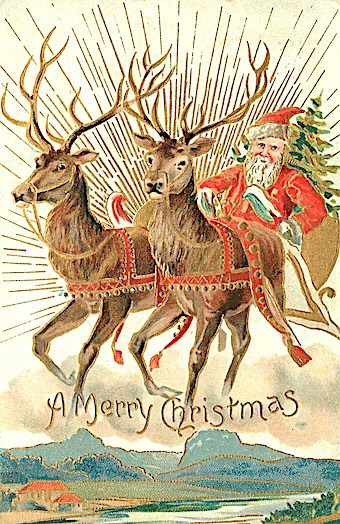
We all believed that he resides at the North Pole and arrives in a flying sleigh pulled by eight reindeer. The tradition of Saint Nicholas indeed originated in Scandinavia and then spread throughout Europe and beyond. The Dutch settlers who landed in New York in the 17th century brought with them the legend of Sinter Klaas, which gave birth to the American Santa Claus.
Curiously, Santa Claus’s iconic round belly and white beard only date back to the beginning of the 20th century. His image is inspired by Julenisse, the Nordic elf with a white beard, wearing a hat and dressed in fur, who brought gifts to children during the winter solstice, Midtvinterblot.
Santa Claus also finds his origins in the Celtic God Gargan and the Viking God Odin, who were said to come to Earth at the winter solstice to distribute presents to children.
Santa’s reindeer
Reindeer, however, made their appearance in 1823 after the popularisation of the poem A Visit from St. Nicholas, attributed either to Clement Clarke Moore or to Henry Livingston Jr. Their names are: Dasher, Dancer, Prancer, Vixen, Comet, Cupid, Donder (or Donner) and Blitzen. Rudolph, the red-nosed reindeer, made his debut in 1939 with the song Rudolph the Red-Nosed Reindeer, written by Johnny Marks.
French Père Fouettard and Père Noël
We all wrote letters to Santa Claus (Père Noël) to tell him how good we had been during the year! We knew that he would come down the chimney on the night of December 24th and leave presents in the stockings that we (children and parents) had hung by the fireplace mantelpiece. According to French tradition, Père Noël originally had a companion named Père Fouettard. This frightening character whipped children who had misbehaved during the year.
St Nicholas of Myra and Bari
Does Santa Claus – Père Noël really exist, or is he a figment of our imagination?
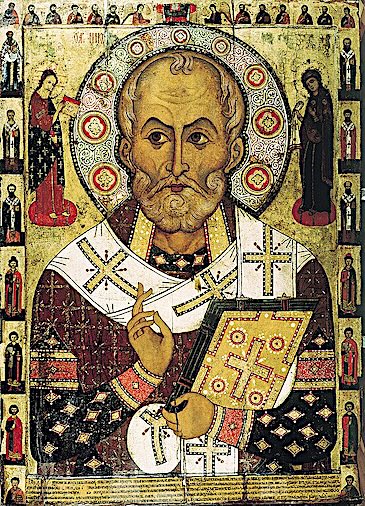
The Church of Rome played an important role in the amalgamation of pagan beliefs with the story of St Nicolas of Myra, a 4th-century Christian bishop. Born into a wealthy Christian family in Patara, a Roman town north of Bethlehem, St Nicholas later became Bishop of Smyrna, now Izmir in Türkiye.
His relics were considered miraculous because of the “holy oil” they produced and were kept in Smyrna until the 6th century. Italian sailors from Bari seized these relics in 1087 and brought them back to Italy, where they were placed in a basilica built for this purpose.
St Nicholas, henceforth known as St Nicholas of Bari, became highly venerated, and fragments of his relics were dispersed to other places, notably to the Basilica of Saint-Nicolas-de-Port in Lorraine, France.
Thus, St Nicholas is celebrated as the region’s patron saint on December 6th.
St Nicholas’ miracles and legends
The Church of Rome attributes many miracles to St Nicholas, a figure known for his faith and kindness.
Legend describes him as a rich and generous man who used all his wealth to buy gifts for the poor children of his diocese, distributing them by throwing them out of their windows.
Another, more macabre story tells how he resurrected three children who had been killed, dismembered and salted by a butcher. Years later, when St Nicholas visited the same butcher and ordered salted meat for seven years, the butcher fled in terror, and the saint brought the children back to life.
Saint Nicholas has thus become the patron saint of children and butchers!
At the beginning of the 20th century, the role of the butcher in this legend was attributed to Père Fouettard, a frightening character forced to accompany Santa Claus on his rounds as penance.
A third, more heartwarming legend tells how St Nicholas offered a dowry to a poor young woman by secretly leaving bags of gold in her house for two nights. When her father caught St Nicholas in the act on the third night, the saint begged him to keep it a secret, but news of his generosity eventually spread.
After St Nicholas died on December 6, wealthy people continued the tradition of making anonymous donations to the poor, leading many to believe that the spirit of the generous saint lived on.
Similarities between St Nicholas and Père Noël
‘Bishop Nicholas travelled on a donkey, while Santa Claus travels in a sleigh pulled by reindeer. Saint Nicholas was depicted with a long white beard, wearing a mitre and dressed in a red amaranth bishop’s cloak. Similarly, Santa Claus sports a long white beard and wears a large red coat with a fur-trimmed hood. In some regions of France, children leave a glass of wine for Saint Nicholas and a carrot for his donkey at the foot of the Christmas tree. Elsewhere, they leave a glass of milk for Santa Claus and a carrot for the reindeer!
Père Noël at Christmas
The Roman Catholic Church has associated St Nicholas with Christmas celebrations, moving his feast day to December 25th to coincide with the Nativity of Jesus. Santa Claus, that jolly fellow with a round belly and a white beard, has become the very emblem of Christmas! However, in some regions of northern and eastern France, St Nicholas is still celebrated on December 6, although this celebration is less widespread elsewhere.
Photos via Wikimedia Commons: St Nicolas 1294 by Aleksa Petrov Public domain – Father Christmas and his reindeer by Pre-1923 Public domain – Header by Paul Kauffmann Public domain


