
Bishopric of Dol de Bretagne
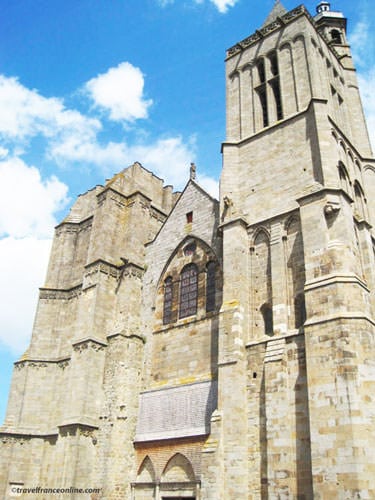
Saint-Samson Cathedral is located in Dol-de-Bretagne, a picturesque medieval town nestled 7 km inland, not far from the bay of Baie du Mont Saint-Michel.
Dol is one of the seven bishoprics of Brittany, founded in the 5th century by Celts who came from Cornwall.
Fleeing Anglo-Saxon invasions of their homeland, they indeed found refuge on the Breton shores, where they settled and left their mark on the region’s nomenclature and cultural identity, today deeply rooted in Breton culture.
They brought their Christian faith with them, having already converted to Christianity. Their preachers evangelised the region and were recognised by the Church of Rome as patron saints of Britain.
They renamed the Armor – The land by the sea as the region was then known, to Little Britain (to differentiate it from Great Britain). The name evolved into Britannia and finally Brittany – Bretagne.
The establishment of the seven bishoprics, Dol de Bretagne, Saint-Malo, Saint-Brieuc, Tréguier, Léon, Cornouaille and Vannetais, by the preachers Saint-Samson, St-Malo, Saint-Brieuc, Saint-Tugdal, Saint-Paul, Saint-Corentin and Saint-Patern promoted the spread of Christianity.
However, rather than attempting to eradicate these deeply rooted pagan beliefs outright, they ingeniously transformed the pagan deities into local saints.
These “hybrid” deities, now venerated as saints, were believed to protect, heal, and watch over the daily lives of the inhabitants. Even today, many Bretons invoke these saints against illness and bad weather!
St. Samson’s Well
Saint-Samson Cathedral is dedicated to the Welsh monk who founded the bishopric of Dol-de-Bretagne in the 6th century.
Samson first left his native Wales for Ireland, where he studied under Saint-Patrick. He traveled to Brittany around 555, where he devoted himself to evangelising the local populations.
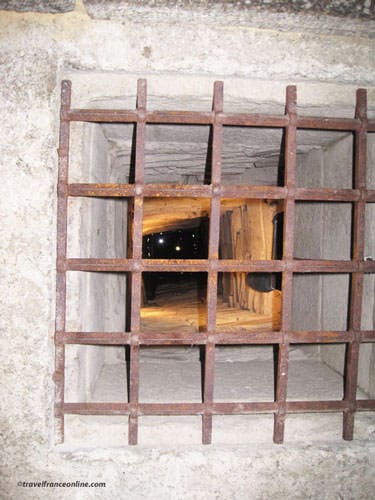
Samson immediately founded the monastery of Dol-de-Bretagne on the top of a hill, near a spring, and had a well dug.
This spring, located outside the cathedral, provided essential resources to the monks and the flourishing community that developed around the monastery over the centuries.
However, the spring eventually fell into disuse; it was finally filled in and gradually forgotten. It was only in 1996, during archaeological excavations, that it was rediscovered.
These excavations also led to another important discovery: a subterranean corridor connecting the original well to a second well located beneath the Chapel of the Crucifix, formerly known as the Chapelle du Puits (Chapel of the Well).
Although there is no formal proof, it is widely accepted that this second well is none other than Samson’s well.
Saint-Samson Cathedral – Architecture
Construction of the cathedral began in the 12th and 13th centuries, and it was enlarged and embellished over the following three centuries, yet remained unfinished.
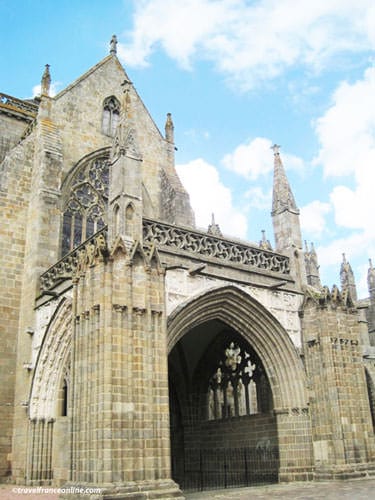
Amazingly, work on the south facade, the magnificent main entrance, continued into the 19th century, giving rise to an extraordinary mix of architectural elements.
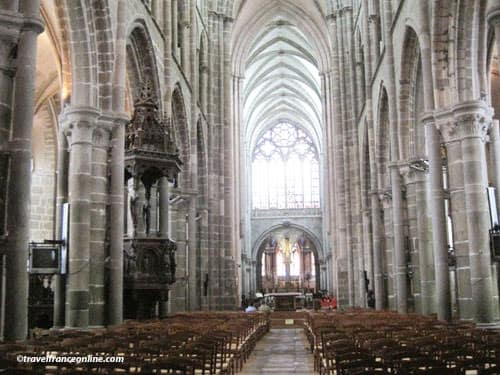
The richly decorated galleries of the nave, the stained-glass window of the apse and the ancient pews of the chancel are among the remarkable features of the interior.
The buiding escaped demolition during the French Revolution because it was used as a barn and suffered relatively little damage.
Today, Saint-Samson Cathedral is one of the most renowned churches in Brittany and was classified as a historical monument in 1840.
Department of Ille et Vilaine
Coordinates: Lat 48.550712 – Long -1.756305


