
Saint Malo Church – Magnolia
The Flamboyant Gothic church of Saint-Malo is located on the Grand-Rue that leads to the historic centre of Dinan.

If you have the chance to visit Dinan at the beginning of spring, a surprise awaits you: the magnificent white magnolia in full bloom, which stands in front of the church.
Louis de Lorgeril, an agronomist and then mayor of Rennes, gifted this Magnolia Soulangeana to the city of Dinan in 1850. The tree has now reached an impressive height of 13 merers above street level and has become one of Dinan’s emblems.
The United Nations listed it as a National Heritage Site under the title “Most Beautiful Trees” in 2011. In early 2013, the Côtes d’Armor General Council also recognised it as one of the Three Remarkable Trees of Dinan.
Dinan indeed boasts two other remarkable listed trees: a superb araucaria located in the city cemetery and a ginkgo biloba in the Jardin Anglais, near the Saint-Sauveur Basilica.
Saint Malo Church’s construction
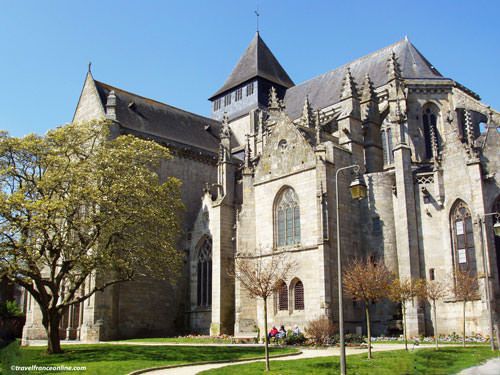
Olivier I of Dinan founded the Saint-Malo Church around 1066 on the site of a chapel outside the city walls. The Duke of Brittany ordered the demolition of the church during the War of the Breton Succession, in the 14th century to prevent the French from using it as a defensive stronghold.
The reconstruction of the current church began on May 17, 1490, when Pierre Laval, Bishop of Saint-Malo, laid the first stone. These works were partly financed thanks to the generosity of the inhabitants of Dinan and Queen Anne of Brittany. At that time, the site was located inside the city walls.
Unfortunately, due to recurring financial difficulties, the work was interrupted after the completion of the imposing portal and the laying of the nave’s foundations.
At the end of the 16th century, the nave remained unfinished and was covered with a simple thatched roof.
In 1670, the Bishop of Saint-Malo had the relics of Saint Malo transferred to the church to attract pilgrims.
Unfortunately, the original religious furniture and artwork were destroyed, melted down or sold a century later, during the French Revolution. The church was then converted to various uses: stable, forge, and theatre, among others, and a fire eventually destroyed the nave and the bell tower.
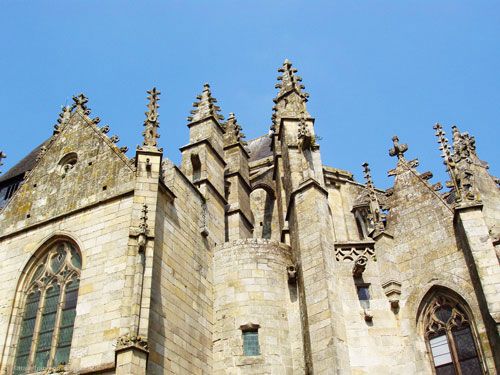
The inhabitants of Dinan financed the reconstruction of the nave, aisles, and gargoyles, and the church was reconsecrated in 1803. The architects Alphonse Guépin of Saint-Brieuc and Charles Aubry of Dinan oversaw the restoration work, which took place from 1808 to 1818.
On February 23, 1851, a relic of Saint Malo was returned to the church.
Saint Malo Church – Exterior
The Saint Malo Church in Dinan is unique as it has a very understated bell tower.
The funds initially intended for its bell tower were, in fact, diverted to the city of Saint-Malo, which explains the modest quadrangular roof housing four bells.
The largest bell, affectionately nicknamed Gros Malo, weighs 2,980 kg. The second bell, Mélanie Clémentine, was cast in 1835 in the famous foundry of Villedieu-les-Poëles in Normandy, the foundry that produced Emmanuel, the new bourdon of Notre-Dame Cathedra.
The third bell, Marie-Henriette-Anne, was installed in 1929 to replace Marie-Louise, which had been financed by the sister of the famous writer François-René de Chateaubriand in 1846. The fourth bell, not motorised, was formerly used to sound the alarm.
Saint Malo Church – Interior
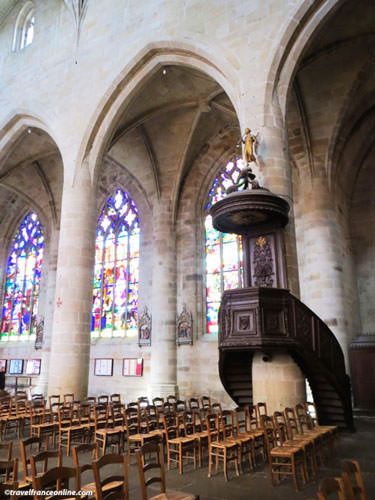
The Saint Malo Church is a splendid example of Flamboyant Gothic architecture, particularly visible in its 15th-century choir, apse and transept. Bright and colourful stained-glass windows, created by a master glassmaker in 1854, cast a wonderful light. The themes of these stained-glass windows represent the inhabitants, the city’s history and various religious events.
Amazingly, the altar, completed in 1955, remarkably stands at the highest point in the city. Although the original pulpit is a listed historical monument, it was replaced with a modern one in 2011.
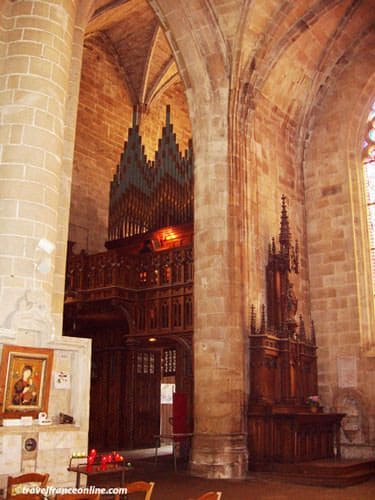
The Saint Malo Church is also renowned for its acoustics, making it a prime venue for organ concerts. It houses two remarkable organs:
1-Grand Organ, built in 1889 by the renowned organ builder Alfred Oldknow. This organ is considered his masterpiece and the only one of his four instruments still present in Brittany. The instrumental section was classified as a historical monument on May 23, 1980, and the gallery in the carved chestnut received the same honour on June 25, 1990. The Grand Organ was re-tuned in 1984 and occupies a central place in the many concerts given during the Summer Organ Festival. It is located in a side chapel near the altar.
2-Choir Organ was once owned by the Polish pianist Henri Kowalski. The Saint Malo Church is itself a listed historical monument, recognised not only for its architectural beauty, but also for its historical and cultural importance. The combination of its Gothic splendour, historical remains and musical heritage makes it an iconic place in Dinan.
The Saint-Malo church is a listed historical monument, recognised not only for its architectural beauty, but also for its historical and cultural importance. Its blend of Gothic splendour, historical artefacts, and musical heritage makes it an iconic location in Dinan.
Department of Côtes d’Or – Dinan
Coordinates: Lat 48.454543 – Long -2.046067


