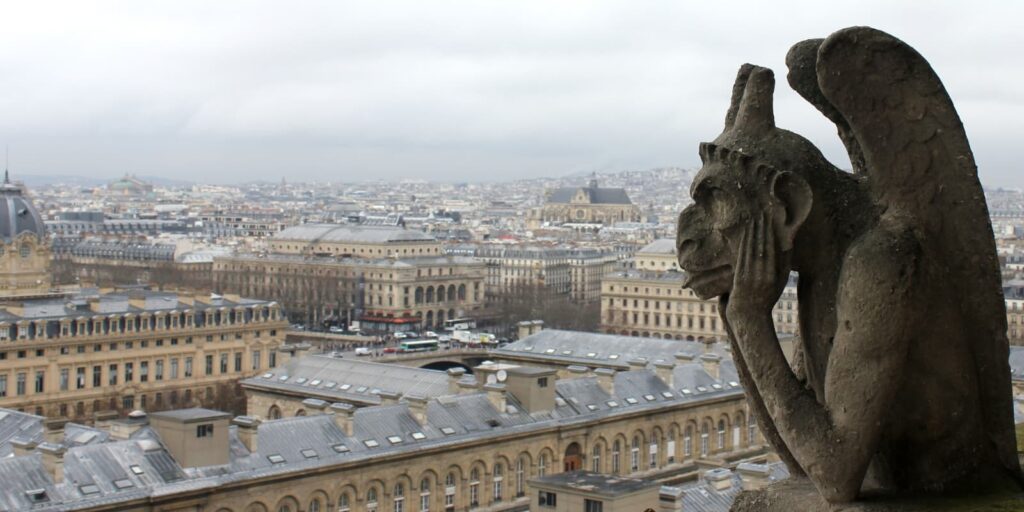
Porte Saint-Martin, Louis XIV’s triumphal arch
The monumental Porte Saint-Martin stands on the Grands Boulevards, at the intersection of Rue Saint-Martin with Boulevard Saint-Martin and Boulevard Saint-Denis.

Despite its appearance, the Porte Saint-Martin is not a former fortified gate, but one of two triumphal arches commissioned by Louis XIV to commemorate his victorious military campaigns on the Rhine and in Franche-Comté.
However, it shares its name with the three former fortified gates that were once part of the successive medieval ramparts of Paris. As Paris kept expanding, these gates were built further and further from the city centre. Thus, the third Porte Saint-Martin was located at the intersection of Rue Saint-Martin, Rue Blondel, and Rue Apolline, just 60 meters south of the current triumphal “Porte Saint-Martin”.
The construction of this triumphal arch began in 1674 under the direction of the architect Pierre Bullet.
The 18-meter high Porte Saint-Martin was built primarily of limestone, with its upper section in marble.
Allegorical bas-reliefs adorn the upper corners of its central arch on both facades.
Porte Saint-Martin north facade
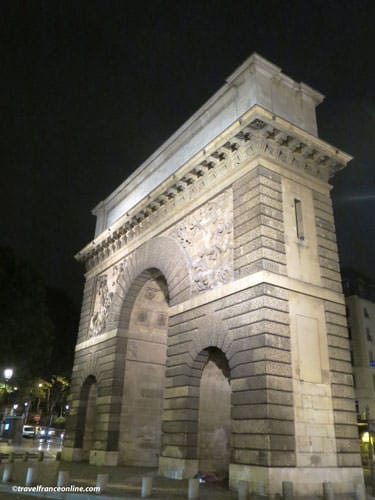
On the north facade, Pierre Legros I sculpted a seated woman near a reclining lion, symbolising the Conquest of Limburg.
Gaspard Marsay immortalised Louis XIV as the god Mars, bearing the coat of arms of the Kingdom of France and triumphantly repelling the Germanic eagle, symbolising the Defeat of the Germans.
At the top of the facade is inscribed the following dedication:
LUDDOVICO MAGNO QUOD LIMBURGO CAPTO IMPOTENT HOSTIUM MINAS UBIC REPRESSIT. Praef. AND AEDIL. P.C.C. ANN. R. S. MDCLXXV
“Louis the Great, who, after the conquest of Limburg, repelled all his powerless and threatening enemies. Prefect of merchants and alderman of Paris in 1675.”
Porte Saint-Martin south facade
Étienne Le Hongre created the bas-relief depicting the Breaking of the Triple Alliance. In this symbolic representation, Louis XIV embodies Hercules, portrayed half-naked, wearing his emblematic wig, and brandishing his club. With an imposing presence, the Sun King triumphantly tramples Achelous and Geryon underfoot.
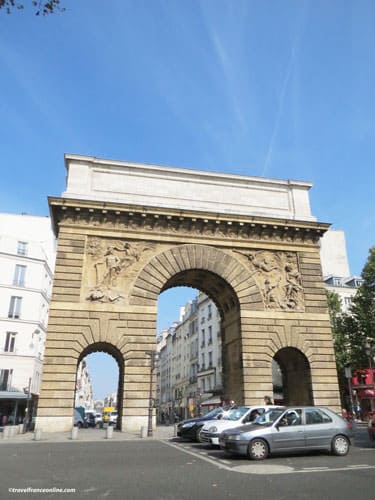
Finally, Martin van de Bogaert immortalised the Capture of Besançon.
Louis XIV stands here under the gaze of Fame, before a backdrop of palm and olive trees. A woman, kneeling humbly, presents him with the keys to the city.
The inscription above reads as follows:
LUDOVICO MAGNO VESONTIONE SEQUANISQUE BIS CAPTIS AND FRACTIS GERMANORUM HISPABORUM BATAVORUMQUE EXERCITIBUS. Praef. AND AEDIL. P.C.C. ANN. R. S. MDCLXXIV
“Louis the Great, who twice captured Besançon and the territory of the Sequani and defeated the armies of the Germans, the Spanish, and the Batavians. Prefect of the Merchants and Alderman of Paris in 1674”
The Saint-Martin Gate was listed as a Historical Monument in 1862 and underwent a complete restoration in 1988.
Directions: 10th district
Metro: Strasbourg-Saint-Denis on Lines 4, 8, 9
Coordinates: Lat 48.869148 – Long 2.355682