Pont Alexandre III, a bridge to celebrate the Franco-Russian Alliance
The Pont Alexandre III spans the Seine, aligned with the Hôtel des Invalides on the Left Bank, and provides access to the Grand Palais, the Petit Palais, and the Champs-Élysées on the Right Bank.

Lavishly decorated, it is among the most beautiful bridges in Paris!
Architects Resal and Alby built it in two years for the 1900 Universal Exposition.
This magnificent structure was erected to commemorate the Franco-Russian Alliance, an important peace treaty concluded in August 1897, and was unveiled by French President Émile Loubet.
The previous French president, Félix Faure, had laid the foundation stone of the Pont de la Trinité, designed by Gustave Eiffel, in Saint Petersburg.
At 154 metres long and 40 metres wide, the Pont Alexandre III is also the widest and lowest bridge in Paris.
Pont Alexandre III, a masterpiece of metal architecture
The Pont Alexandre III is a masterpiece of metal architecture.
Its unique three-hinged arch is supported by four cast steel beams and two masonry viaducts anchored to the riverbanks.
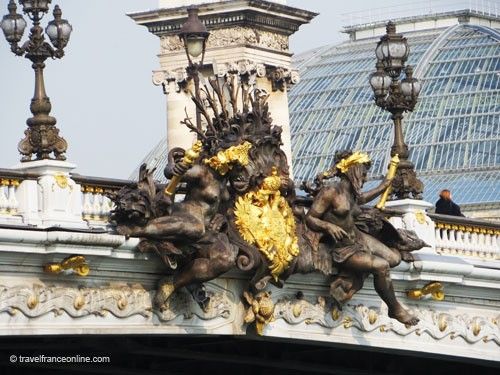
Its opulent, exquisitely detailed decoration and magnificent architecture are perfect illustrations of the Belle Epoque‘s lavish style.
However, the bridge initially attracted criticism, with some even dubbing it the “exhibition bridge.”
The Pont Alexandre III became widely recognised for its exceptional beauty and architecture as aesthetic standards evolved throughout the years, and was designated a historical monument.
Pont Alexandre III’s lavish decoration
Two monumental 17-m-high pillars frame the bridge entrance on each bank. Each pillar is surmounted by a Renommée (Fame restraining Pegasus) sculpture, which serves not only a decorative function but also counterweights the single arch.

Emmanuel Frémiet sculpted The Glory of Science and The Glory of the Arts on the Right Bank, while Pierre Granet sculpted The Glory of Commerce and The Glory of Industry on the Left Bank.
The marble sculptural groups at the base of the pillars represent four distinct periods of French history and art:
Modern France by Gustave Michel and Medieval France by Alfred Lenoir, on the Right Bank, and Renaissance France by Jules Coutan and the France of Louis XIV by Laurent Marqueste, on the Left Bank.
Finally, majestic lions led by children, sculpted by Jules Dalou and Georges Gardet, guard the entrances to the Pont Alexandre III.
Georges Récipon created the hammered copper sculptures that adorn the keystones and pay homage to the Franco-Russian alliance.
The sculpted group on the upstream keystone depicts the Nymphs of the Seine and the coat of arms of the City of Paris. The sculpted group on the downstream keystone depicts the Nymphs of the Neva and the coat of arms of Imperial Russia.

Léopold Morice and A. Massoule sculpted the copper ornaments representing water spirits and seashells that adorn the central parapets.
Finally, thirty-two small lampposts placed along the parapets illuminate the bridge in the evening.
Henri Gauquic created the four candelabras adorned with intricate motifs of cupids and sea monsters that complete the bridge’s decoration.
The Pont Alexandre III has sported different colours over the decades, but it has recently been restored to its superb original pearl-grey hue.
You will get the best photos of this iconic bridge from the riverbanks.
Directions: Links 7th/8th district
Metro station: Invalides on Lines 8 and 13
Coordinates: Lat 48.863593 – Long 2.313588