Parc de la Villette, Paris’ largest urban cultural park
The Parc de la Villette is the largest cultural park in Paris.
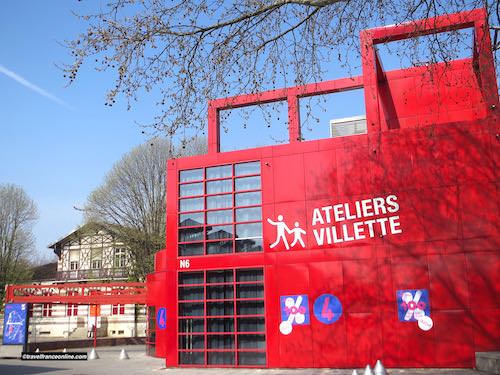
It indeed offers a wide range of cultural and leisure facilities, including several concert and exhibition halls, cultural and leisure centres, music and science museums, and restaurants.
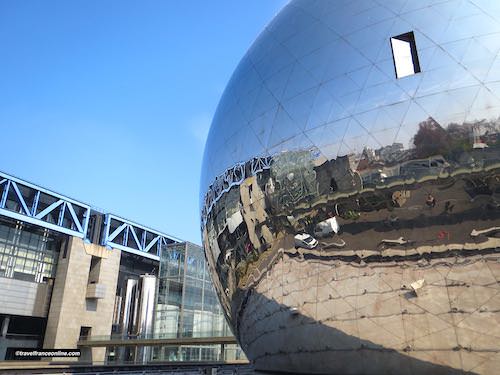
Science enthusiasts: visit the Cité des Sciences et de l’Industrie (City of Science and Industry), and the Géode , and the decommissioned submarine Argonaute.
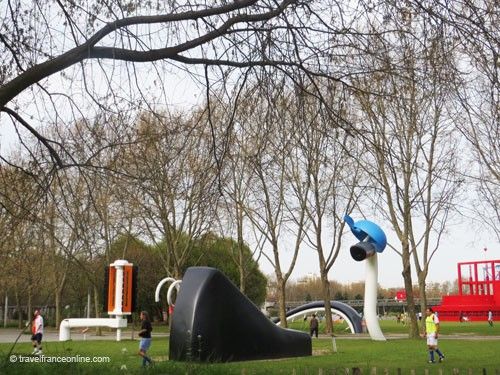
If you’re a fan of music, dance, and contemporary art: discover the Cité de la Musique (City of Music), also known as the Philharmonie 2, the WIP (a center primarily dedicated to urban dance), Le Zénith concert hall, and an unusual work of art: the Bicyclette Ensevelie (Buried Bicycle), a giant bicycle partially buried underground.
Sports enthusiasts: visit the equestrian and nautical centre or the Vélib’ Autumn velodrome.

The Grande Halle, a former livestock market, has been transformed into a multi-purpose cultural space.
You will find it between the Pavillon de Janvier and the Théâtre Paris-Villette. These two venues are housed in 19th-century stone buildings formerly used by the Bourse aux Cuirs (Leather Exchange) and the administrative offices of the Paris slaughterhouse.
These buildings overlook the park’s main entrance on Rue Jean-Jaurès and the Fontaine aux Lions de Nubie (Nubian Lion Fountain).
The Pavillon Paul Delouvier, near Avenue Corentin Cariou, hosts temporary exhibitions. Finally, the Maison de la Villette recounts the complete history of the slaughterhouse and the surrounding neighbourhood.
The icing on the cake: the Parc de la Villette is open 24/7, and admission is free!
How to read the colour-coded Parc de la Villette
The Parc de la Villette does not stand out only for its vast green spaces but also for its thoughtful design.

Its central axis, the Canal de l’Ourcq, is spanned by a magnificent suspension bridge that harmoniously connects the two parts of the park.
However, what makes the Parc de la Villette truly unique is its attention to detail: each themed area is associated with a colour!
Green represents the lush meadows and themed gardens, while blue evokes the sky and water, elements omnipresent in the park. White is reserved for the buildings, offering a clean and modern aesthetic.
However, it is the vibrant red of the metal structures, the Folies, that brings a touch of dynamism and energy to the park. This bold colour choice indeed symbolises vitality and enthusiasm.
La Villette, from a leper hospital to an industrial zone
The origins of La Villette date back to the 12th century, when it was a small community that developed near the Saint-Lazare-Saint-Ladre leper colony. First known as Petite-Ville-de-Saint-Ladre, then as Villette-Saint-Ladre-lez-Paris, it spread between Rue de Flandre and Rue Jean-Jaurès.
However, despite its ideal geographical location, it remained somewhat isolated due to the presence of the leper colony and the gallows of Paris.
La Villette began to develop only at the end of the 18th century with the construction of the General Farmers Wall (Farmers’ Wall). Numerous guinguettes, cafés, restaurants, ballrooms, and open-air cafes sprang up near the toll gates built in the village.
Yet, wealthy Parisians remained reluctant to invest in the neighborhood!
However, the development of the Bassin de la Villette in the 19th century transformed the village and its surroundings into a vast industrial zone that included a basin, a goods depot, docks, and a large reservoir. A slaughterhouse and a live animal market were also established in the 1860s.
La Villette thus evolved from a small town on the outskirts of Paris into a dynamic industrial center.
La Villette district’s rehabilitation
The industrialisation and development of the Bassin de la Villette led to a fivefold increase in population. As a result, La Villette and the neighbouring village of Belleville were annexed to Paris during the territorial reform of 1860.
The industrial infrastructure and high population density made La Villette a dynamic working-class neighbourhood until the slaughterhouses closed in 1974.
In 1979, the City of Paris launched a vast rehabilitation program aimed at revitalising the area. The architect Bernard Tschumi was commissioned to lead this project in 1982.
In fifteen years, Tschumi transformed these 55 hectares into the Parc de la Villette, the largest urban cultural park in the capital, breathing new life into a neighbourhood once neglected by Parisians.
Directions: 19th district
Metro stations: Porte de Pantin on Line 5 and Corentin Cariou, Porte de la Villette on Line 7
Coordinates: Lat 48.893849 – Long 2.390260