Chateau and Parc de Bercy
The banks of the Seine, where Bercy Park is located today, have been inhabited since ancient times.
During the redevelopment of the park in the 1970s, archaeologists indeed unearthed the remains of a village dating back to around 4500 BC.
Among the discoveries were significant quantities of objects that offered insights into the daily life in the Neolithic period. Three canoes, or pirogues, uncovered during the excavation, are now displayed in the Carnavalet Museum.
Medieval texts later mention the existence of the manor-house of Insula Bercillis, then of an estate known as Turrim Berciaco, which was owned by the Abbey of Montmartre.
These two properties merged during the 17th century to form a larger domain.
The transformation of the old fortified manor into a lavish mansion was entrusted to architects Le Vau and Mansart. Under their direction, the Château de Bercy became renowned for its opulent decorations, including lavish woodwork, paintings, and art objects.
The mansion miraculously escaped destruction durng the French Revolution.
It was eventually demolished in the 19th century to cosntruct the Gare de Lyon railway station, a section of Thiers’ defensive wall, and various outbuildings, train lines, and wine warehouses.
The Wine Warehouses
The village of Bercy, which had developed around the medieval manor house, began attracting Parisians as early as the 16th century, thanks to its location outside the city boundaries.
Wealthy individuals indeed constructed country mansions, while others enjoyed the many guingettes that sprang up along the riverbank.
The construction of the General Farmers’ fiscal wall in the 1770s divided Bercy in two.
A section of the village remained outside Paris’s boundaries, exempt from taxes on goods.
This exemption was crucial for the wine trade, as wines and spirits were transported to Paris by barges and stored in warehouses on the Quai de la Râpée.
These warehouses were eventually purchased by investors who expanded the wine trade, leading to the development of related industries such as cooperage and trucking.
Bercy became a thriving “village” and the most affluent wholesale wine market in France and Europe.
Despite its prosperity, the territorial reform of 1860 incorporated Bercy into Paris, ending its tax-exempt status. However, the wine merchants’ federation negotiated a ten-year transition period to adapt to the new tax regulations.
A little anecdote: The nearby Quai de la Râpée was named after Le Clos de la Râpée, a rural estate seized during the French Revolution. A shoemaker acquired the land and the building to establish his workshop.
The thriving district that developed in the vicinity remained known as La Râpée.
Entrepôts de Bercy
Between 1878 and 1885, the City of Paris acquired the land and commissioned architect Viollet-Leduc to design the official wine warehouses of Paris, known as the Entrepôts de Bercy. These warehouses formed a self-contained village enclosed within their perimeter walls.
A network of cobbled streets, named after various wines such as Rue de Macôn and Rue des Sauternes, crisscrossed the area, but access to the site was restricted to vintners and winemakers.
Indeed, despite being deemed of public utility, the warehouses were not open to the general public.
Over time, changes in transportation methods and storage technology, as well as the demolition of Thiers’ fortifications after World War I, led to their gradual decline.
By the 1960s, all of Bercy’s warehouses were no longer in use, and the once-thriving district fell in oblivion until the 1970s, when it underwent extensive redevelopment and rehabilitation.
The Parc de Bercy
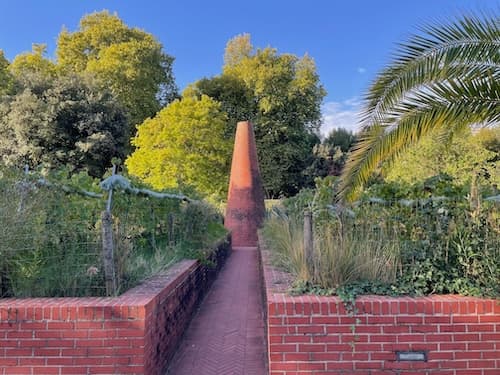
The 14-hectare Parc de Bercy still bears traces of its industrial past, with the layout of its ancient cobbled lanes and the presence of around 200 ancient trees.
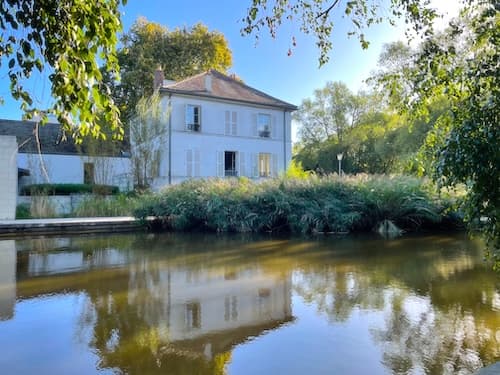
However, little remains of the warehouses except for a cellar known as the Chai de Bercy, as well as two houses named Maison du Jardinage and Maison du Lac.
The park is divided into three distinct gardens:
La Grande Prairie
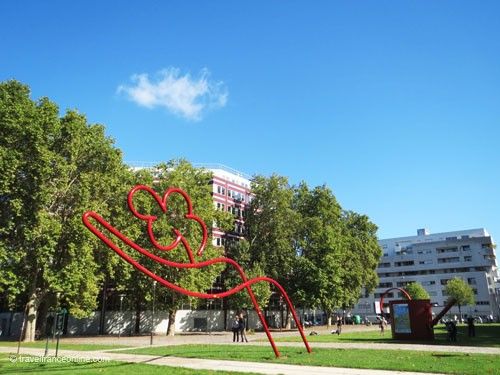
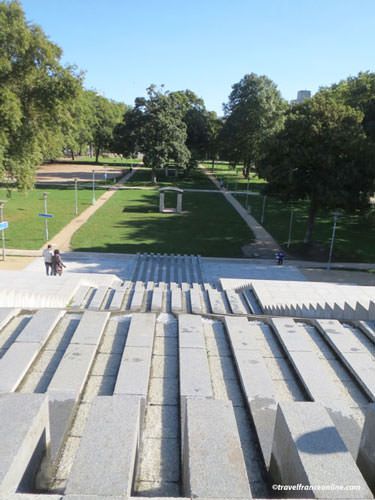
This vast lawn shaded by century-old trees, is near the Bercy Arena (Parc Omnisports). It features a sculpted fountain known as Canyoneaustrate and an impressive waterfall cascading down the steps leading to the waterside promenade.
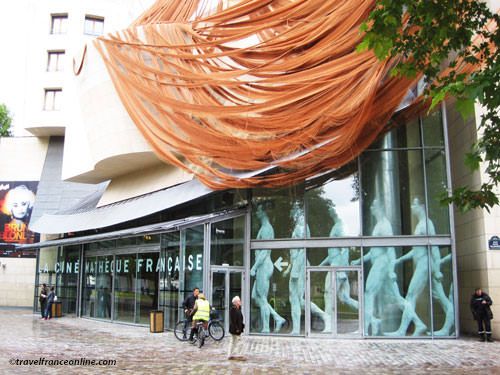
The Jardin Yitzhak Rabin, opposite the Cinémathèque Française (Film Library), was inaugurated on November 5, 2000, in the presence of Shimon Peres.
Les Parterres
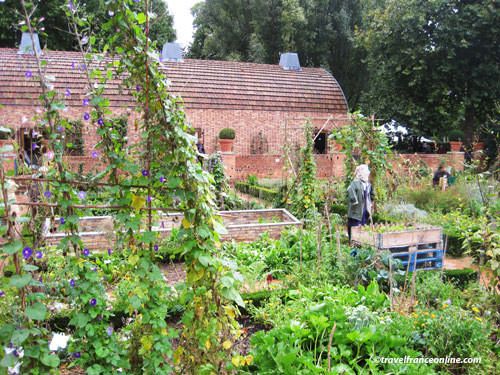
You will find the Parterres near the Grande Prairie, in a section delineated by a brick wall. They comprise nine smaller gardens:
- The Kitchen Garden (Potager) is planted with a variety of edible plants are cultivated.
- The Orchard (Verger) features a variety of fruit-bearing trees.
- The Flower Bulbs Garden (Jardin des Bulbes) as it names implies is dedicated to the cultivation of flowering bulbs.
- The Fragrance Garden (Jardin des Senteurs) is filled with aromatic plants and flowers.
- The Maze (Labyrinthe) is a fun and engaging labyrinthine pathway.
- The Rose Garden (Roseraie) is home to a vast collection of roses.
- The Vineyard (Les Treilles) is reminiscent of Bercy’s wine-producing heritage
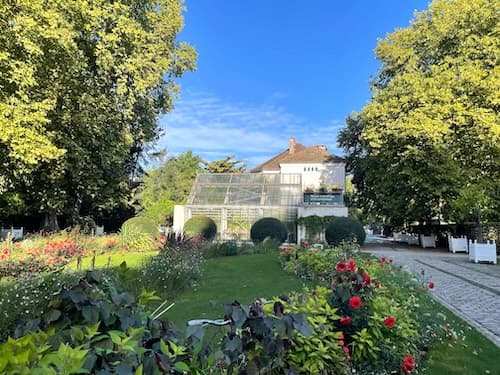
This is also where you will find the Maison du Jardinage, one of the former caretakers’s lodges, and its greenhouse dedicated to the art of gardening.
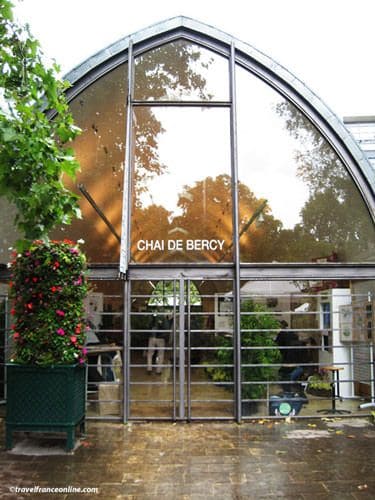
The Chai de Bercy is an authentic wine cellar that survived demolition. It has been beautifully restored and transformed into a venue for temporary exhibitions.
Jardin Romantique

This garden is accessed via two footbridges within the Parc de Bercy, and offers an escape from the noise of the city. A series of winding pathways meander through secluded gardens, sandy dunes, and pools teeming with fish.
You will find the Maison du Lac, the park’s second caretaker’s lodge, on a small island. From its vantage point, you will discover the intriguing sculpture known as Demeure X which depicts a Mayan head.
Demeure X sits at the centre of a water lilies pond. This striking piece of art was created by Etienne Martin, when he taught at the Ecole des Beaux-Arts in Paris (1968 to 1993).
From Bercy Village to Bercy Arena
Bercy Village is situated a stone’s throw away from the Jardin Romantique, and shielded from the hustle and bustle of the riverside traffic by a tall wall. It boasts several shops and restaurants installed along a lane shaded by ancient trees.
The elevated walkway located above this area offers good views of the park.
From there, you can clearly see the Bibliothèque Nationale de France (BNF), on the opposite riverbank, which is linked to the Parc de Bercy by the Passerelle Simone-de-Beauvoir.
This footbridge start near a double lawn adorned with twenty-one sculptures titled Children of the World.
Finally, the nearby Pont de Bercy delineates the Parc de Bercy from the Ministry of Economy and Finance.
The Parc de Bercy is considered the most successful urban rehabilitation project of the late 20th century; it indeed revitalized a once-neglected district while preserving the memory of the old Entrepôts, cherished by Parisians.
Despite initial controversy, modern additions, such as the Arena and the Cinémathèque have seamlessly integrated into the lush surroundings of this superb public park.
Directions: 12th District
Metro: Bercy, Cour Saint-Emilion on Line 6
Coordinates: Lat 48.837533 – Long 2.379817