The lavish Palais de l’Elysée

The lavish Palais de L’Élysée has been the official residence of the President of the French Republic since 1871.
It comprises a main building flanked by two wings. Its main entrance, at No. 55 Rue du Faubourg-St-Honoré, leads to the Cour d’Honneur (Court of Honour).
The Grille du Coq (Rooster Gate), a magnificent Belle Époque cast-iron gate, connects the gardens to Avenue Gabriel, and then to the Avenue des Champs-Élysées.
One of the palace’s exceptional features is that all the rooms overlook the landscaped gardens, except the Vestibule d’Honneur (Main Hall), which opens onto the Cour d’Honneur.
A brief tour of the Palais de l’Elysée
1- The SALON D’ARGENT (Silver Room) is the formal entrance to the private apartments in the east wing.
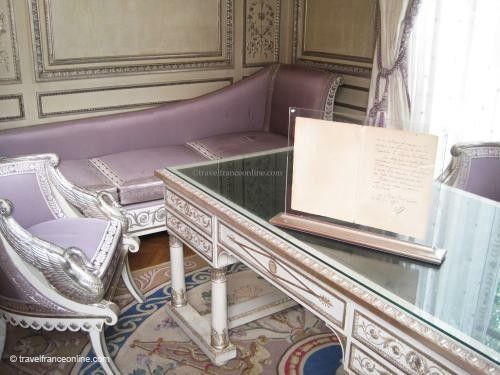
This refined room is decorated in lilac and silver tones, the colours chosen by Caroline Murat, one of Napoleon’s sisters. The fabrics date from 1813 but have retained their soft and delicate hues. They harmonise perfectly with the white gold and silver tones of the woodwork and furniture, creating a peaceful and welcoming atmosphere. The renowned cabinetmaker Jacob Desmalter produced the exquisite woodwork and furniture.
The Salon d’Argent was the setting for a historic event: Napoleon’s signing of his second abdication on June 22, 1815, after his defeat at Waterloo. The original document rests on the desk!
The emperor had signed his first abdication at the Château de Fontainebleau. The Salon d’Argent is also the room where Louis-Napoléon Bonaparte, the future Napoleon III, plotted his coup d’état on December 2, 1851.
2- The SALLE A MANGER PAULIN (dining room) was originally part of Napoleon III’s private apartments.

Designer Pierre Paulin drastically transformed it in 1972 at the request of President Georges Pompidou, a fervent supporter of contemporary art.
Paulin indeed clad the walls with moulded polyester and the ceilings with anodised aluminium panels, and installed two round tables with tinted glass tops and central cast aluminium legs.
This gave the room a clean, futuristic aesthetic that is not to everyone’s taste, and for good reason! Its radical break with the conventional elegance of the other rooms has astonished both critics and admirers.
3- The present-day BIBLIOTHÈQUE (library) was set up in the former bedroom of the Duchess of Bourbon, Caroline Murat, Napoleon I, the Duke of Berry, and finally Napoleon III. The room has retained its characteristic curved wall and is the only original room remaining from Napoleon III’s private apartments. The presidents of the Fourth Republic used it as a study. However, President Giscard d’Estaing, recognising its potential, transformed it into a library.
4- The lavish SALLE DES FÊTES (Banquet Hall), in the west wing of the Palais de l’Élysée Palace, has long been the setting for official ceremonies, important state dinners, and receptions.

In 1896, the artist Guillaume Dubufe was commissioned to paint the panels of the coffered ceiling, and the walls were adorned with 18th-century tapestries woven by the renowned Manufacture Nationale des Gobelins.
The Salle des Fêtes was officially inaugurated by President Carnot in 1889, on the occasion of the Universal Exhibition, to promote French prestige and cultural heritage.
The room was modernised and embellished under the late President Mitterrand. Ten French doors were added along the south and east walls, allowing natural light to flood in.
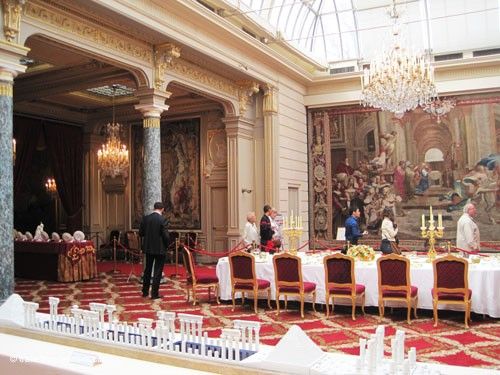
5- The Salle des Fêtes provides a seamless transition to the JARDIN D’HIVER (Winter Garden), a greenhouse built in 1881 for the cultivation of exotic plants, then modernised and converted in 1976 and 1984.
A magnificent tapestry depicting a biblical scene adorns the west wall.
The room is illuminated by sumptuous 19th-century crystal chandeliers, similar to those in the Salle des Fêtes and the Napoleon III Salon.
Today, the Winter Garden hosts official receptions and occasional business meetings. Its refined decor, and natural light offer a serene and elegant setting for diplomatic encounters and social events.
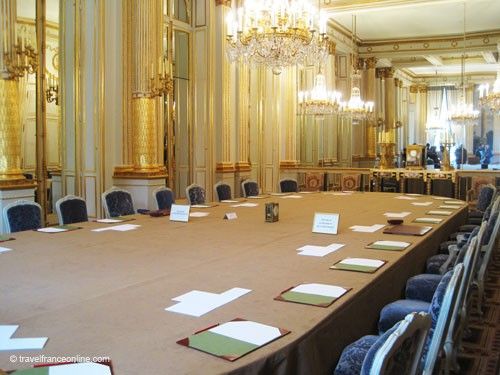
6- The SALON MURAT has hosted the meetings of the Council of Ministers since the presidency of Georges Pompidou.
These meetings are held every Wednesday morning at a large table that fills the entire room, with the President seated in the centre, facing the Prime Minister.
The Salon Murat was originally furnished for Joachim Murat, Napoleon I’s brother-in-law.
It is thus decorated with two portraits of Murat by Horace Vernet, as well as a representation of Trajan’s Column in Rome.

A console table adorned with porcelain, made in 1819 by the prestigious Sèvres National Porcelain Manufactory, completes the decoration.
7- In the 1870s, the architect Joseph-Eugène Lacroix transformed the former orangery of the Palais de l’Élysée Palace into a sumptuous room known as the SALON NAPOLEON III.
Each corner of the ceiling is surmounted by an imperial eagle and the monogram RF (République Française), surrounded by an olive branch.
Today, the Salon Napoléon III is used for press conferences.

8- The SALON DES AMBASSADEURS (Ambassadors), formerly known as Salle de Bal Murat (Ballroom), has been redesigned for meetings with foreign diplomats.
Renowned for its exceptional furnishings, it is one of the most prestigious rooms in the palace. It features a magnificent clock above the fireplace; the dial displays the month, the phases of the moon, and the signs of the zodiac.
It also boasts a bronze statuette of the Roman Emperor Marcus Aurelius and a chandelier dating from the Bourbon Restoration period.
The room’s opulent atmosphere is enhanced by a luxurious carpet woven in 1990 at the Manufacture Nationale de la Savonnerie (National Manufactory).

9- The SALON POMPADOUR originally served as the state bedroom of the Marquise de Pompadour, and later as Napoleon I’s bedroom.
It boasts a portrait of the Marquise and is adorned with sumptuous 17th-century tapestries.
Furniture from the reigns of Louis XV and Louis XVI contributes to its regal ambience.
The current President of the Republic uses the Pompadour Salon to receive distinguished guests.
10- The SALON CLEOPÂTRE was meticulously renovated in 1992.
It initially served as a dressing room for the Marquise de Pompadour and was transformed into a study for Napoleon III in the mid-19th century.
It owes its name to the famous Gobelins tapestry “The Meeting of Antony and Cleopatra,” which adorns it and serves as a focal point, while adding a touch of exoticism to the room.

11- The SALON DES PORTRAITS opens directly onto the terrace.
This inviting room takes its name from the remarkable collection of eight portraits that adorn the upper part of its walls:
Pope Pius IX, Emperor Franz Joseph of Austria, King Victor Emmanuel II of Italy, Tsar Nicholas I of Russia, Queen Victoria of England, King Frederick William of Prussia, Queen Isabella II of Spain, and King William I of Württemberg.
This room, with its contemporary desk designed by Chaix and Morel, was President Sarkozy’s private study.
12- The SALON DES AIDES DE CAMP hosts official lunches and dinners.
It features a carpet from the long-gone Château des Tuileries and a replica of the fireplace from Louis XIV’s bedroom at the Palace of Versailles.

13- The SALON DORÉ (Golden Room), so named for its lavish display of gilded decorations, is the president of the French Republic’s official office.
The renowned painter Jean-Louis Gogon decorated the room in 1861 for Empress Eugénie.
Located at the heart of the mansion, the Salon Doré boasts a wealth of exceptional features:
A remarkable Louis XV-style desk, a masterpiece created in the 18th century by the celebrated cabinetmaker Charles Cressen.
Magnificent Gobelins tapestries and carpets from the Savonnerie National Manufactory.
An opulent Napoleon III crystal chandelier, and a commode by André Boulle.
14- The Salon Doré connects directly to the SALON VERT (Green), which serves as a meeting room for the president and his close advisors.

15- Ministers, heads of state, and distinguished guests arrive at the Palais de l’Élysée Palace through the COUR D’HONNEUR (Court of Honour), and the President greet them in the VESTIBULE D’HONNEUR.
This magnificent entrance hall is adorned with Doric pilasters, elegant white-red marble tiles, and an unusual sculpture titled “Homage to the French Revolution,” a work by the renowned artist Arman.
This work, commissioned by President François Mitterrand, is made of two hundred white marble flags, which apparently symbolise the revolutionary spirit.
It is framed by two candelabras in crystal, gilt bronze, and Italian marble, designed by the talented Chagot brothers, who won a prestigious prize at the 1819 Exhibition of Products of French Industry.

16- The SALON DES TAPISSERIES houses a copy of the French Constitution, and owes its name to the luxurious tapestries that decorate it.
17- The ESCALIER MURAT (staircase) boasts elegant railings decorated with gilded palm fronds. It was built in 1806 to connect the Hall of Honour to the first floor, as the Hôtel d’Evreux did not have a formal staircase.
It leads to a landing where you will find La Défense, a bronze statue by Auguste Rodin, standing before L’Europe, painted by Dubois in 1811.
18- Finally, the landing leads to two ANTI-CHAMBRES (antechambers) adorned with portraits of former Presidents of the Republic and furnished in the Empire style.
Note: The Palais de l’Élysée Palace is only open to the public during European Heritage Days. It gets very crowded, so it is recommended to arrive before 7:00 a.m. Yet, still expect a 4- to 5-hour wait.
Directions: 8th district – Palais de l’Elysée – No.55 Rue du Faubourg-Saint-Honoré
Metro: Champs-Elysées-Clémenceau on Lines 1,13
Coordinates: Lat 48.870416 – Long 2.316754