
Paimpont Abbey founded by Judicaël, King of Brittany

Paimpont Abbey stands in the heart of the Forêt de Brocéliande, now known as the Forêt de Paimpont.
The abbey began as a modest monastery founded in the 7th century on the shores of a peaceful lake by Judicael, King of Brittany.
In the 5th century, the Celts of Cornwall played a key role in the evangelisation of Brittany.
Fleeing the advance of the Angles and Saxons, they took refuge on the shores of Armorica, a coastal region inhabited since 450 BC by Celtic tribes.
They had named their territory Armor, “the land by the sea”. The newcomers named it “Little Brittany“.
The Celts of Cornwall, already deeply Christian, founded seven bishoprics, each bearing the name of a patron saint.
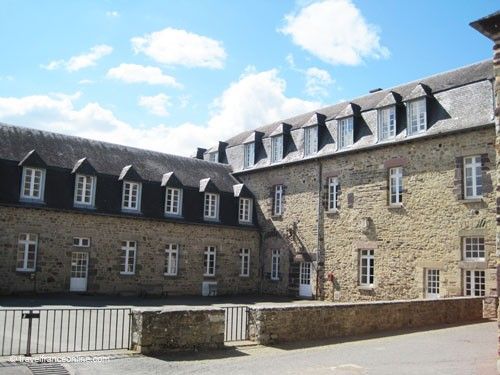
The Church of Rome officially recognised Saint Brieuc, Saint Corentin, Saint Malo, Saint Patern, Saint Paul, Saint Samson and Saint Tugdal..
The Breton landscape today is marked by the legacy of this early Christianization: abbeys, churches, chapels, and wayside crosses dot the countryside.
Here, pagan traditions and Christian faith intertwined, adapting legends and customs to create the rich Breton culture.
The Breton saints occupied a unique place, at the crossroads between pagan deities and Christian saints, and people invoked them daily.
Abbaye Notre-Dame de Paimpont
Judicael converted to Christianity at the beginning of the 7th century.
In 645, he laid the first stone of a Benedictine monastery on the shores of Lac de Paimpont.
The Normans destroyed this monastery during their 9th-century raids, but the monks rebuilt it a century later.
However, the old monastery was demolished in the 13th century to make way for the current Our-Lady of Paimpont Abbey.
Over the centuries, the abbey underwent many expansions and renovations, with the most significant transformations occurring in the 17th century, when the country was temporarily under Protestant rule.
New convent buildings and a cloister were constructed, while the church was redecorated in the opulent style of the Counter-Reformation.
This lavish decoration served not only to mask the austere Protestant influences but also to erase all traces of the religion introduced by King Henry IV.
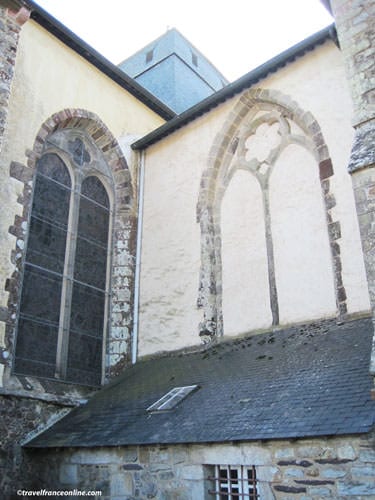
The abbey church, however, still retains visible traces of these transformations in its exterior walls, where the outline of its former architecture is clearly visible.
Classified as a historical monument, Paimpont Abbey was thus completely restored between 2001 and 2004, restoring its former splendour.
The abbey’s grounds and gardens extend to the surrounding woods, where the Croix de Judicael (Cross) stands guard near an ancestral spring.
Discover the magical Forêt de Brocéliande other sites
Tombeau de Merlin, Fontaine de Jouvence, Chêne des Hindrés, Château de Comper, Chêne d’Eon or Chêne à Guillotin, Fontaine de Barenton, Jardin aux Moines, Eglise du Graal in Tréhorenteuc, Miroir aux Fées and Arbre d’Or in the Val Sans Retour, Hostié de Viviane or Tombeau des Druides, Tombeau des Géants ou Roche à la Vieille, Forges de Paimpont and Pierres Droites and the Arthurian Legend
Department of Ille-et-Vilaine
Coordinates: Lat 48.019661 – Long -2.172296


