Nicolas Flamel, alchemist or philanthropist?
The Nicolas Flamel House, formerly known as La Maison au Grand Pignon because of its prominent gable, was built in 1407 and is the oldest known house in Paris. Nicolas Flamel, a wealthy Parisian bourgeois, and his wife Pernelle, had it built on a previously barren plot of land stretching between the old rampart of King Philip-Augustus and the rampart newly erected by Charles V.

Born around 1340 in Pontoise, north of Paris, Flamel settled in the capital where he prospered in various activities: copyist, writer, and sworn bookseller. Sworn booksellers, after taking an oath, obtained clerical status, exempting them from the control of the provost of merchants and from tax obligations.
Flamel’s fortune increased even further during his marriage to Pernelle, a rich widow. As the owner of numerous properties in Paris and its surroundings, he benefited from additional income derived from these assets. However, his extraordinary wealth gave rise to intrigue and speculation. Many indeed believed that Flamel was an alchemist who had unlocked the enigmatic secrets of the philosopher’s stone, capable of transmuting base metals into gold. His fame was such that many books relating to his life were published posthumously, testifying to the persistent fascination exerted on Flamel and his alleged alchemical research.
Nicolas Flamel House, an almshouse
After Pernelle’s death, and without children, Nicolas Flamel devoted a significant portion of his fortune to philanthropy, working tirelessly to help the most destitute.
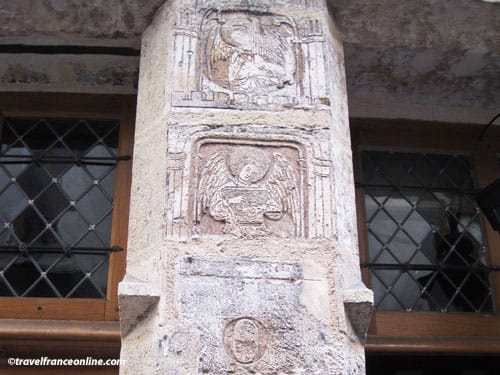
He founded numerous religious institutions, contributed to the beautification of churches and cemeteries, and had hospices built. Among these charitable works was this house on Rue de Montmorency, designated as one of Flamel’s hospices, although he never resided there.
The ground floor was rented out as a shop. The upper floors served as accommodation for the workers and gardeners who maintained the vegetable gardens nestled between the two ramparts. In exchange for room and board, these destitute people were required to recite daily prayers for the deceased, a duty inscribed on the six pillars of the façade, a lasting testament to Flamel’s generosity:
« Nous homes et femes laboureurs demourans ou porche de ceste maison qui fut faite en l’an de grâce mil quatre cens et sept somes tenus chascun en droit soy dire tous les jours une paternostre et un ave maria en priant Dieu que sa grâce face pardon aus povres pescheurs trespasses Amen – We, men and women laborers residing in the porch of this house, which was built in the year of grace one thousand four hundred and seven, are each bound by right to say every day one Our Father and one Hail Mary, praying to God that His grace may grant pardon to poor sinners departed. Amen»

The house boasts a resplendent facade, adorned with sculpted angels singing celestial melodies. Nicolas Flamel’s legacy is intimately linked to the architecture of his hospice, where his initials, “N” and “F,” are engraved among the prayers, the “N” on the second pillar and the “F” on the fifth.
Flamel bequeathed the hospice to the Church of Saint-Jacques-de-la-Boucherie, where he was buried. The church was destroyed during the Revolution, except for the Tour Saint-Jacques (tower), and Flamel’s tomb was recovered and is now in the Cluny Museum.
The plaster that masked the facade was removed during restoration work in 1900, thus revealing its architectural beauty. The magnificent facade of the Maison Nicolas Flamel was officially classified as a historical monument on September 23, 1911.
Directions: 3rd district – Nicolas Flamel House – No51 Rue de Montmorency
Metro: Rambuteau on Line 11
Coordinates: Lat 48.863578 – Long 2.353169