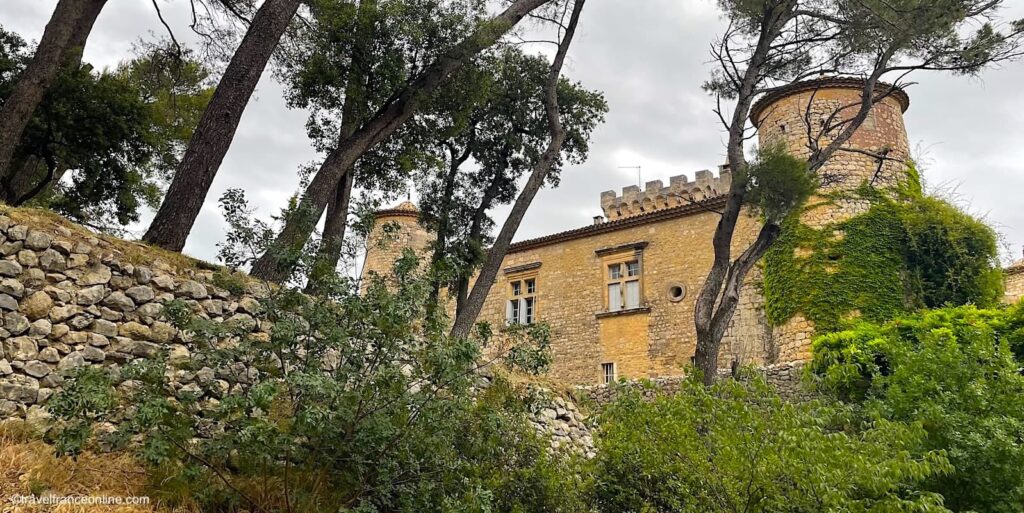
Najac, the invincible fortress of the Counts of Toulouse

The picturesque medieval village of Najac unfolds at the foot of its imposing fortress, which is perched on a steep promontory overlooking the Aveyron Valley.
While little is known of the village’s origins, traces of mineral mining dating back to Roman times (approximately two millennia ago), have been discovered.
The Counts of Toulouse erected the first keep in 1100, at a time when they were as powerful as the French kings. Alphonse of Poitiers, the brother of King Louis IX, built the impressive fortress in the 1250s and 1260s.
Throughout the Middle Ages, the Château de Najac remained impregnable, entrenched behind its solid ramparts, and thus withstood attacks the Hundred Years’ War and later the Wars of Religion.
Fortifications of Najac

The fortifications of Najac encompassed the village, creating a veritable stronghold divided into several distinct quarters, each separated by fifteen fortified gates.
This ingenious configuration contained attacks, limiting fighting to smaller, therefore more easily defended areas.
The massive Porte Pique, erected in the 13th century, formed the last bastion before reaching the castle.
The 40-metres-high keep stood as a symbol of the power of the Counts of Toulouse, and was a true marvel of medieval military architecture!
First, the walkway leading to it could be easily dismantled.
However, if attackers managed to penetrate the keep, they had to ascend a spiral staircase of 115 steps positioned clockwise around a central stone pillar.
This ingenious architectural design made it nearly impossible for right-handed swordsmen to fight effectively, as the narrowness of the spiral allowed only one person to climb at a time.
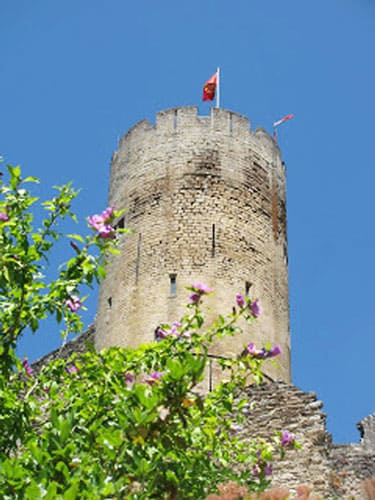
This keep had four floors, each of which could be isolated and defended independently, giving the defenders a tactical advantage in the event of a siege.
The ground floor housed the guardroom, and the first floor the chapel.
A second guardroom, located on the third level, provided additional defence to the apartments of the Counts of Toulouse on the upper floor.
The walls were pierced with narrow loopholes, from which several archers could be positioned.
The crenellated upper terrace of the keep offered a 360-degree view of the surrounding area, allowing the watchmen to sound the alarm with the bell installed in 1596. This bell is still in use, but is now connected to a clockwork mechanism.
A detailed model of the Najac fortress offers a glimpse into the intricacies of its formidable defensive system.
Richard the Lionheart in Najac
The fortress of Najac was the site of the alliance that Richard the Lionheart sealed with the king of Aragon and Count of Provence Alfonso of Aragon in 1185.

Richard the Lionheart, who would become King of England in 1189 as Richard I, was indeed the son of Henry II Plantagenêt, King of England, and Eleanor of Aquitaine. When Eleanor married Henry Plantagenêt, Duke of Normandy, Count of Maine and Anjou, in 1152, she brought as her dowry the entire Duchy of Aquitaine.
Thus, when Henry became King of England in 1154, his domain, combined with Eleanor’s, was far larger than the domain of the French crown! This, of course, triggered territorial wars that lasted for several centuries.
The treaty, signed between Richard and Alfonso, consolidated Richard’s hold on the Duchy of Aquitaine, where he spent most of his life. Surprisingly, despite his future status as King of England, Richard did not speak English language. He was, however, fluent in the Langue d’Oc spoken in the Duchy of Aquitaine.
It is also said that Richard did not much like England, whose climate he found gloomy and inhospitable compared to the warmth and dynamism of France!
Najac, saved by the Cibiel family
Fortunately, the fortress of Najac was not destroyed during the French Revolution, yet it was declared national property and sold.
It initially served as a prison and then as a stone quarry until 1906, when Alfred Cibiel acquired the fortress, thus putting an end to the incessant dismantling of its ramparts.
Cibiel undertook an ambitious restoration project that spanned several generations, restoring the old fortress to its former grandeur.
Thus, the castle of Najac was officially recognised in 1925 and classified as a historical monument, opening it to the public in the 1970s.
Department of Aveyron
Coordinates: Lat 44.219530 – Long 1.978425
Credits: Photos © Melanged Magic by Evelyn Jackson – Photo via Wikimedia Commons: Header and photo1 by Krzysztof Golik CC BY-SA 4.0