
Gallic federations in the 1st century AD
The Battle of Gergovie represents a decisive turning point in the history of Gaul. It took place in 52 BC, on the site of the present-day village of La Roche-Blanche, near Clermont-Ferrand.
From the 1st century AD onward, Gaul had established itself as a vast region populated by various peoples of Celtic origin who, despite their dialectal differences, cultivated a strong sense of unity.
These Gallic tribes were organised into large federations, such as the Arverni and the Aedui. These federations were themselves structured into territorial entities called civitates, themselves divided into pagi (which gave rise to the modern term pays) and vicus. This ancient organisational framework served as the basis for the administrative and territorial structure of modern France.
The 1st century BC was also marked by the expansion of the Roman Empire towards the West. From 58 BC to 50 BC, Julius Caesar undertook a campaign of conquest known as the Gallic Wars, marking an important chapter in the history of Gaul.
Vercingetorix, the leader of the Gallic rebellion
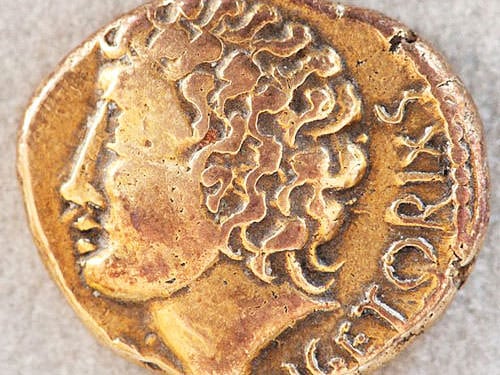
Celtillos, the leader of the Arverni, the Gallic tribes from central France (hence the name Auvergne), named his son Vercingetorix king around 52 BC. Vercingetorix quickly united all the Gallic tribes into a formidable federation and led them in rebellion against Julius Caesar and his Roman troops.
The Gaulish rebellion was initially successful. The Gauls indeed inflicted heavy losses on the Roman legions at the Battle of Gergovie, forcing them to retreat.
However, internal political conflicts within the Gallic tribes, as well as the opportunistic manoeuvres of some and the quest for independence of others, constantly altered the balance of power between Gauls and Romans. Many Gallic chiefs also contested Vercingetorix’s legitimacy, thus weakening their unity against the Romans.
The Aedui, a Gallic tribe established in modern Burgundy, had allied with Rome well before the start of the Gallic Wars. This historical link accentuated the divisions within the Gallic people, particularly after the crushing defeat at Avaricum (now Bourges), where thousands of warriors perished.
Faced with the prospect of imminent annihilation, some Gallic tribes chose to ally with the Romans, seeing it as a way to escape the horrors of war. Thus, despite Vercingetorix’s courageous efforts, the Gauls gradually succumbed to the inexorable advance of the Roman forces.
Their final resistance took place in the fortified city of Alesia, where they endured a long siege and eventually ran out of supplies.
Faced with inevitable defeat, Vercingetorix chose to surrender to Julius Caesar to spare his people greater suffering. He was then taken prisoner and brought to Rome, where he languished for six years before being executed during Julius Caesar’s triumph.
Battle of Gergovie, a Gallic victory
The Battle of Avaricum resulted in an important number of casualties among the Gallic warriors.
However, despite this loss, new Gallic tribes rallied under the leadership of Vercingetorix and entrenched themselves at Gergovie, an important Gallic oppidum.
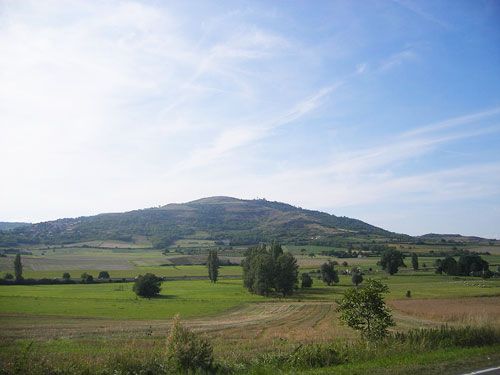
Perched at an altitude of 744 metres, the Gergovie Plateau commanded the vast plain of the Limagne.
In the autumn of 52 BC, Julius Caesar began the siege of Gergovie with his 30,000 men, divided into six legions
The Gauls were positioned on the terraces below the fortified camp and on the surrounding hills of La Roche Blanche and the Plateau d’Orcet, to the east.

However, the Romans captured La Roche Blanche and established a main camp on the Plateau d’Orcet and a smaller annex camp on La Roche Blanche, linking them by a wide ditch.
While the Gauls rushed to fortify the vulnerable western part of their oppidum, three Roman legions, totalling 1,500 men, advanced on the eastern sector, breaking through the Gallic defence lines and reaching the walls of Gergovie.
However, the Aeduan cavalry, allies of the Romans, stationed to the north, created confusion, as the Roman legionaries mistook them for enemies. This allowed Vercingetorix’s warriors, led by their cavalry, to regroup quickly and repel the Romans.
Observing the heavy losses suffered by his legions and the difficult topography which favoured the Gauls, Caesar ordered the withdrawal of his troops. The Battle of Gergovie thus resulted in a Gallic victory, and many Aeduan warriors pledged allegiance to Vercingetorix.
Plateau de Gergovie
Although historians have confirmed the exact location of the Battle of Gergovie, the position of the Gallic and Roman armies remains a subject of debate.
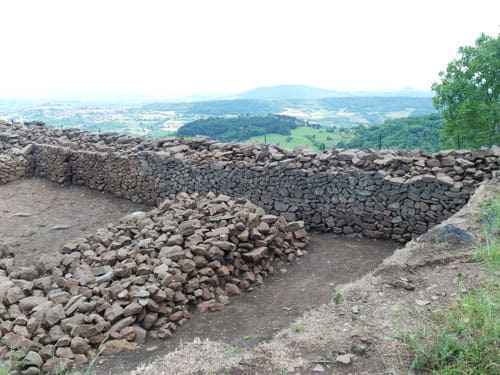
Archaeological excavations carried out at the end of the 19th and the 20th century revealed that the oppidum of Gergovie covered an area of approximately 70 hectares and was densely populated. These excavations have also uncovered Roman fortifications at the base of the oppidum and sections of the rampart, as well as Roman military equipment, including iron catapult components.
These remains support the hypothesis that the Roman annex camp was located at La Roche Blanche and the main camp on the Orcet plateau. However, the scarcity of remains discovered so far suggests that further excavations would be useful.
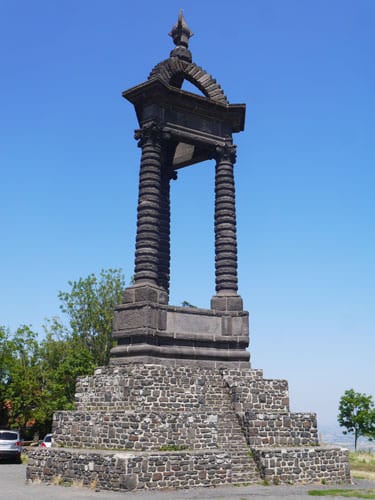
In 1903, Jean Teilhard used volcanic stone from Volvic to erect a memorial in honour of Vercingetorix on the site of the battle. In 1942, soil from different regions of France was collected and placed at the base of the memorial, symbolising national unity. Finally, in 2007, a sculpture by Yves Guérin was installed on the site, further commemorating this major historical event.
Department of Puy-de-Dôme – La Roche Blanche
Coordinates: Lat 45.712950 – Long 3.124440
Photos via Wikimedia Commons: Statue of Vercingetorix header by Carole Raddato CC BY-SA 2.0 – Vercingetorix strater by Siren-Com CC BY-SA 3.0 – Contemporary sculpture by Nimbus08 CC BY-SA 2.5 – Plateau de Gergovie by Szeder László CC BY-SA 4.0 – Memorial by Simon de l’Ouest CC BY-SA 4.0 – Foundations of rampart by Romary CC BY-SA 3.0


