
Alesia – Summer of 52BC

Alesia marks one of the darkest chapters in the history of Gaul, a decisive battle that forever affected the destiny of the country!
Let’s travel back to the summer of 52 BC, when Julius Caesar, after a long siege, defeated the Gallic chieftain Vercingetorix and his troops entrenched in the fortress of Alesia.
Since 58 BC, Caesar had been waging a relentless campaign to conquer Gaul.
He indeed perceived the warlike Gauls as a threat to Rome and saw conquest as the only way to subdue them.
However, the Gallic tribes, united under the command of Vercingetorix, thwarted him time and again.
The Gauls possessed not only an in-depth knowledge of the terrain but also demonstrated remarkable cavalry skill.
The Battle of Alesia took place in the summer of 52 BC.
Caesar, defeated at Gergovia, was retreating with his legions towards the Roman Province (modern-day Provence), and then towards Rome.
Seizing the opportunity, Vercingetorix and his cavalry launched an attack against the Romans, unaware that Caesar had enlisted Germanic cavalry.
These men, as skilled as the Gauls, successfully repelled the Gallic forces.
Caesar besieges Alesia
Vercingetorix and his troops retreated to the nearest fortified settlement, Alesia.
In his Commentaries on the Gallic War (Commentarii de Bello Gallico), Caesar claims that the Gauls numbered 80,000, twice the size of his own army.
However, these figures are not corroborated by other historical sources.
Given Caesar’s propensity for exaggeration, it is highly likely that he deliberately inflated these numbers!
Nevertheless, Caesar’s reputation as a shrewd strategist suggests that he quickly grasped the strategic error made by the Gauls. Indeed, the fortress’s location made it easy to encircle, giving Caesar a considerable advantage.

He therefore chose to besiege Alesia!
However, supposedly aware that the Gallic warriors outnumbered his troops by a factor of two, he had a double line of defence built around the oppidum.
The inner line, closest to Alesia, stretched for 15 kilometres and curved inward, effectively confining the Gauls and thwarting any attempt at a surprise attack.
The outer line, 21 kilometres long and facing outward, prevented reinforcements from reaching Alesia.
Thus, Alesia was completely isolated!

Gallic messengers, renowned for their exceptional horsemanship, finally managed to slip through the Roman lines to request help.
After several weeks of siege, reinforcements finally arrived.
According to Caesar, a Gallic army of 24,000 infantry and 8,000 cavalry suddenly appeared on a nearby hill. Unfortunately, the battle ended in defeat and the relief troops retreated.
Once again, the Roman army had vanquished a vastly superior force!
At least, that is what Caesar wrote and recorded in the annals of history!
Vercingetorix surrenders
With the Gauls once again entrenched at Alesia, hope was fading.

Vercingetorix, having no other choice, surrendered to spare his men.
The siege of Alesia ended on September 3rd, after lasting between six and twelve weeks, according to historians’ estimates.
Vercingetorix laid down his arms at Caesar’s feet.
He was taken prisoner to Rome, where, six years later, Caesar had him executed during the festivities celebrating his triumph.
However, despite the fall of Alesia, Caesar’s victory was not yet complete. He had to contend with the resistance of other Gallic federations for another two years before Gaul was firmly under his control!
The Aftermath of Alesia
Once Gaul was integrated into the Roman Empire, Alesia experienced a golden age and became a bustling city, renowned for its bronze crafsmanship.
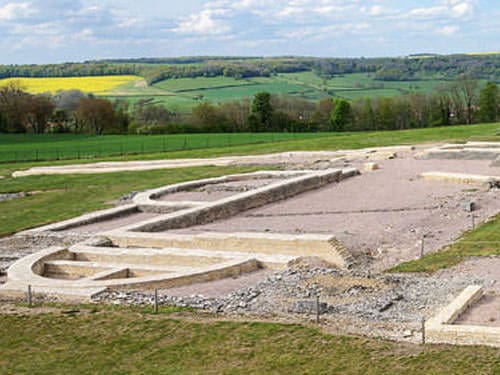
However, Alesia was abandoned at the end of the 5th century AD, a period that saw the decline of the Roman Empire, and over time, the city fell into ruin. Only the foundations of buildings remain such as the forum, the basilica, the theatre, and the temple. The layout of the streets, some of which are still paved, traces the outlines of former residential blocks, or insulae.
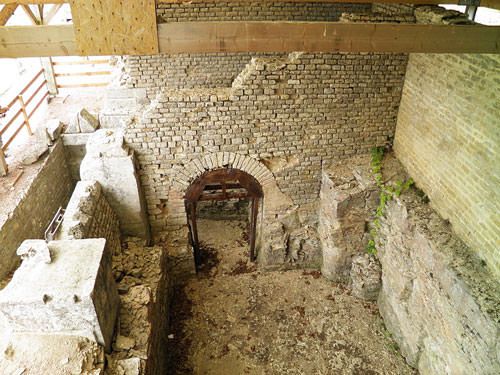
These ruins also include those of the Ucuetis building, which served as the headquarters of the prosperous guild of blacksmiths and bronze workers of Alesia.
Vercingetorix’s Watchful Presence

An imposing 6.6-metre-high statue of Vercingetorix stands at the western edge of the archaeological site, its gaze fixed on the battlefield.
This statue rests on a massive stone base, designed by the architect Viollet-Le-Duc.
In 1865, Emperor Napoleon III commissioned the sculptor Aimé Millet to create this commemorative statue of the Gallic leader to celebrate the completion of the excavations at Alise-Sainte-Reine.
Amazingly, Millet depicted Vercingetorix as a young emperor, sparking debate: was this an artistic liberty or a symbolic tribute from one great leader to another?
Where is the site of the Battle of Alesia?
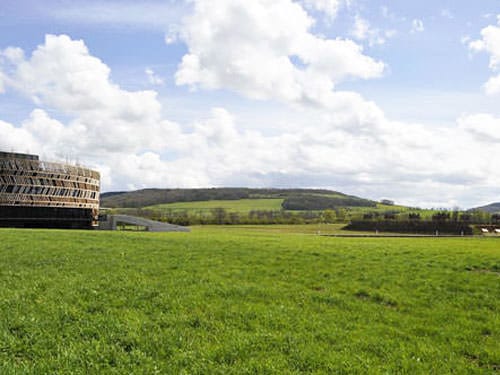
In the Muséoparc, inaugurated in March 2012, which encompasses the Interpretation Centre for the Battle of Alesia, the Archaeological Museum, and a vast 7,000-hectare park, the site once occupied by the Romans.
The Interpretation Centre is housed in a striking, fully glazed cylindrical building.
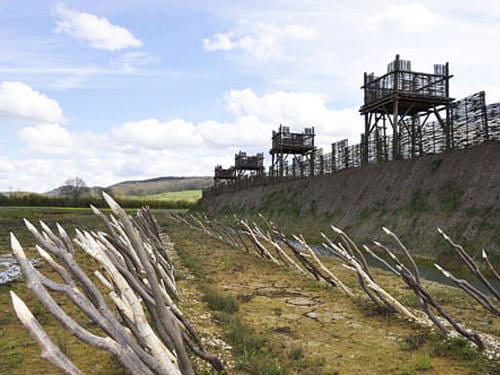
The Gallic oppidum of Alesia is now a vast open-air museum where you can discover the vestiges of the city, as well as the Roman fortifications that were rebuilt over a 100-metre section.
The Gallo-Roman archaeological museum was inaugurated in 2018, and displays the results of archaeological excavations and highlights the ancient city of Alesia, which extended beyond the oppidum’s walls.
Department of Côtes – Alise-Sainte-Reine – Bourgogne
Coordinates: Lat 47.539049 – Long 4.501111
Photos via Wikimedia Commons: Basilica and Monument d’Ucuetis and Archaeological site by Myrabella CC BY-SA 4.0 – Museoparc and Line of defense fortification by Prosopee CC BY-SA 3.0 – Underground room in Monument d’Ucuetis by Carole Raddato CC BY-SA 2.0 – Vercingetorix surrenders by Lionel Royer (1852–1926) Public domain – Vercingetorix and Header by Jochen Jahnke Public domain – Photo1 by Pierre André Leclercq CC BY-SA 4.0


