
Origin of the Galette des Rois
The Galette des Rois (King Cake) is a traditional cake eaten on Epiphany, the twelfth day after Christmas, which commemorates the arrival of the Three Wise Men to the infant Jesus, and is known in France as the Fête des Rois – Feast of the Kings.
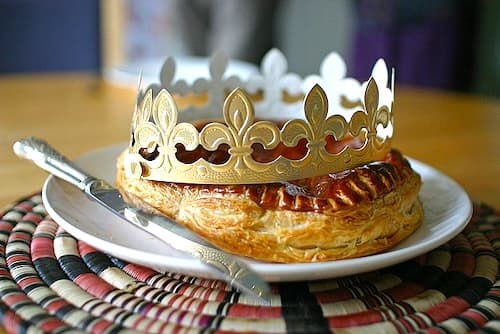
The tradition of eating a Galette des Rois dates back to the Middle Ages. Indeed, parishioners collected donations during the twelve days following Christmas. Those who volunteered to do this collection received a cake as a reward, which they shared equally among themselves on Epiphany Day.
The tradition spread, and families began to prepare their own Galette des Rois. Each cake was divided equally among family members and servants, with the first slice reserved for the first poor person who knocked on their door. Called the “Lord’s slice,” the “Virgin Mary’s slice,” or the “poor person’s slice,” this first slice symbolised generosity and kindness. Over time, the tradition evolved: the first slice was reserved for absent family members and kept in the bread box until their return, and the condition of this slice was considered a good omen! During the French Revolution, the Galette des Rois was briefly renamed the Galette de l’Egalité (Equality Cake). Today, Epiphany banquets have been replaced by simpler celebrations; however, the tradition of eating the Galette des Rois endures.
Galette des Rois’ Hidden Bean
Each cake contains a bean or a porcelain figurine, called fève.

A fève, originally a small bean, is traditionally placed in the Galette des Rois before baking. The person who finds the bean in their slice is crowned king or queen and can choose a spouse; both are treated like royalty throughout the day. Modern fèves are made of porcelain and may depict traditional religious figures, Disney characters, or other popular themes.
The tradition of the bean dates back to the Saturnalia, a Roman festival celebrated at the beginning of January. These festivities included masquerades, gift exchanges, sumptuous meals, and role reversals between masters and slaves. During the Saturnalia, a black or white bean was hidden in a cake, and whoever found it was designated king or queen of the banquet for the evening and had to choose their queen, and wear an improvised crown. Although the Church of Rome replaced the Saturnalia with Epiphany, the tradition of crowning a king or queen with a golden paper crown during the Galette des Rois celebration continues.
Galette des Rois Recipe
Preparation: 20 minutes
Cooking: 50 minutes in an oven preheated to 200°C (gas mark 6)
Ingredients:
- 2 ready-rolled sheets of puff pastry
- 100g softened butter
- 100g caster sugar
- 100g ground almonds
- 1 small glass of rum
- 3 eggs
Method
Frangipane
- In a large bowl, combine the softened butter, almond flour, sugar, and rum.
- Whisk until smooth.
- Add 2 eggs one at a time.
- Continue whisking until the sugar is dissolved.
Galette
- Cut each sheet of puff pastry to fit a round baking sheet.
- Dampen the baking sheet and place the first sheet on it.
- Spread the frangipane filling over the pastry, leaving a 2 cm border.
- Separate the egg white from the yolk of the third egg.
- Brush the 2 cm border with the egg white.
- Cover the frangipane with the second sheet of puff pastry.
- Gently fold and roll the edge to seal the two layers together.
- Using the tip of a knife, score the edge and top of the tart in a crisscross pattern of diamonds.
- Prick the tart with 5 or 6 holes.
- Brush the top of the tart with the egg wash.
- Glaze the top of the tart
- Bake for 20 minutes in a preheated oven.
- Remove the tart from the oven and brush it a second time with the remaining beaten egg white.
- Continue baking for 30 minutes, until the tart is golden brown.
- Since every oven is different, you’ll know for sure when your galette des rois is ready. Perfectly baked, it won’t bend when you lift it.
Happy Fête des Rois!
Photo via Wikimedia Commons: Header and Photo1 by Steph Gray CC BY-SA 2.0


