Eggs, a pagan symbol of life and rebirth
The tradition of Easter eggs has its roots in ancient pagan rituals, symbolising the life and rebirth that accompany the arrival of spring. Across various cultures and civilisations, eggs have long been revered as powerful symbols of fertility and renewal.

In ancient Egypt and Persia (modern-day Iran), dyeing eggs symbolised the rejuvenation of life, mirroring nature bursting into vibrant colours.
Among the Celts, red-painted eggs paid homage to the sun, whose warmth and light fostered the germination of seeds and the emergence of new life.
Similarly, for the Hebrews, eggs held a dual meaning, symbolising both life and death. At Easter, or Pesach (the Jewish Passover), eggs served as a reminder of the cyclical nature of existence, while also representing the Jewish people’s passage from slavery to freedom during the Exodus. They also considered eggs a food of mourning because of their round shape, symbolising the cycle of life.
For Christians, Easter eggs embody the promise of Christ’s Resurrection and his triumph over death. The image of a chick emerging from its shell is a powerful metaphor for the passage from darkness to light, reflecting the miraculous rebirth experienced through faith in Christ.
Easter Eggs, a Christian tradition
Until the 17th century, the Church of Rome forbade the consumption of eggs during Lent, however, the major problem was that hens continued to lay eggs despite the religious edicts!
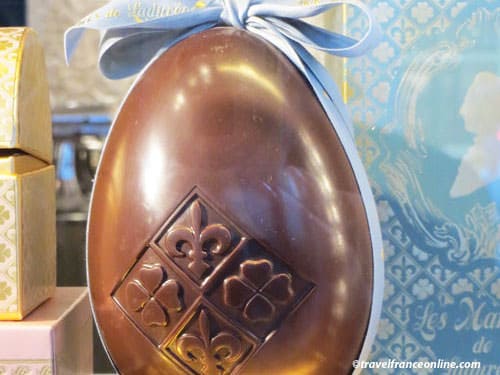
To manage the surplus of eggs that accumulated until Easter, it is said that King Louis XIV “invented” the tradition of decorating eggs to celebrate Easter.
The king would indeed request that the largest eggs laid during Holy Week be brought to him, which he would then have gilded with gold leaf and distributed to his court on Easter Sunday.
This royal tradition quickly spread among the people, who began to paint hard-boiled eggs, not with gold dust, of course, but with natural pigments.
Today, while few people abstain from eating eggs during Lent, the tradition of the Easter egg hunt remains popular, with chocolate eggs now being the norm.
According to Christian tradition, the church bells, silent on Holy Thursday, return from Rome on Easter Sunday to announce the Resurrection of Christ.
Along the way, they distribute eggs, rabbits, and chickens, all symbols of renewal and fertility, to celebrate the event. The Easter egg hunt, where chocolate eggs are hidden among flowerbeds and bushes, is a tradition much loved by children.
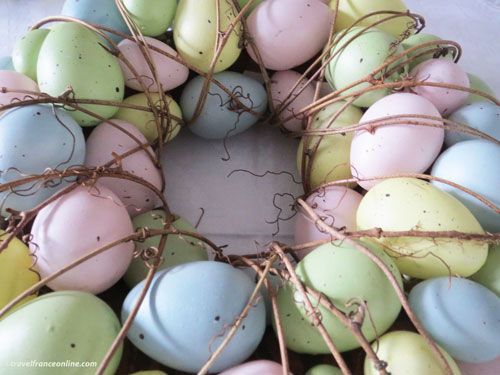
Many people also paint their Easter eggs to decorate the table on Easter Sunday, adding a festive touch.
N.B. Keep in mind that Good Friday is not a public holiday in France, but Good Monday is. Visit our public holiday page to find out Easter dates.