
Villa Les Rhumbs, Christian Dior’s childhood home in Granville
The French fashion designer Christian Dior is worldwide renowned, but did you know he was from Normandy?

Christian Dior was indeed born on January 21, 1905, in the small coastal town of Granville, into a wealthy family of five children. His father, an industrialist, ran a fertiliser manufacturing company. Christian was only a year old when his family acquired Villa Les Rhumbs, a large bourgeois house located by the sea and nestled within a vast park. Built at the end of the 19th century, the villa takes its name from a nautical term referring to the 32 points of the compass rose, depicted on the entrance tiles.
In 1925, the young designer undertook the redesign of the gardens, transforming the greenhouse into a pergola and creating a decorative pond. His mother, meanwhile, created a rose garden adjoining the pergola, a veritable sun trap situated along the wall bordering the Chemin des Douaniers (Customs Officers’ Path), the coastal trail once used by smugglers.
Sadly, the 1929 stock market crash ruined many people, including Mr. Dior, who was forced to sell the house in 1932. Tragically, that same year also saw the death of Mrs. Dior.
The town of Granville acquired the Belle Époque residence, and opened its gardens to the public in 1938. This childhood home, which profoundly influenced Dior’s life and style, was transformed into a museum in 1997. Today, it hosts an annual exhibition dedicated to its magnificent collections.
Christian Dior’s passion for fashion
From a very young age, Christian Dior was fascinated by fashion, often sketching designs that he sold for a few cents. His artistic career began in 1928, after he finished his studies, when his father provided him with the necessary funds to open an art gallery. However, this first venture was abruptly cut short by the 1929 stock market crash.
It wasn’t until seven years later that he began his career as a couturier, joining the fashion house Robert Piguet. During this period, he collaborated closely with Pierre Balmain, another internationally renowned designer. Christian Dior’s career was temporarily interrupted by his compulsory military service.
In 1942, he joined the Maison Lucien Lelong and continued to work alongside Balmain until the end of the war. His crowning achievement came on December 8, 1947, when he founded his own fashion house. He was 43 years old.
In the years that followed, Christian Dior devoted himself to creating and establishing his unique style, which earned him international renown. In 1955, he chose YYves Saint-Laurent, then only 17 years old, as his assistant, and in 1957, he named him his successor as head of the Maison Dior.
Sadly, his exceptional career came to a tragic end on October 24, 1957, when he succumbed to a heart attack during a trip to Italy.
Christian Dior’s style, an ode to femininity
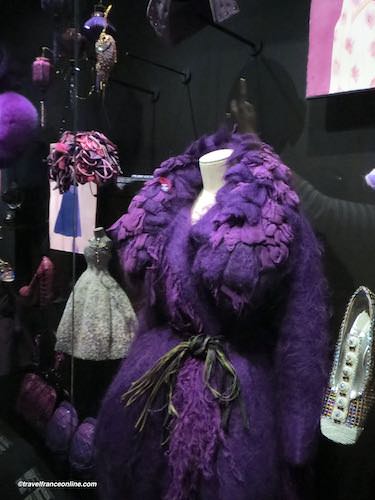
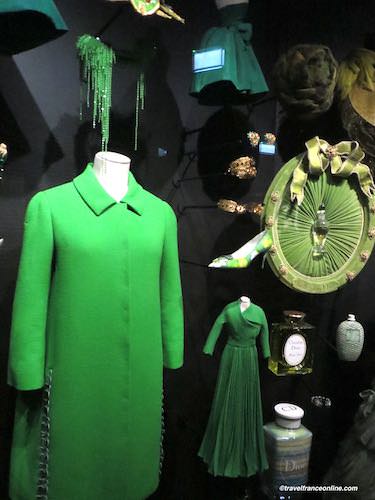
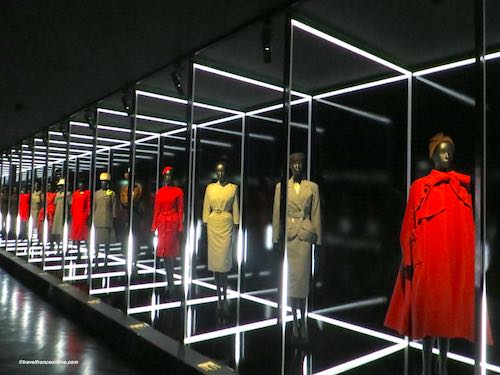
I took all the photos illustrating this article during my visit to the Christian Dior exhibition at the Louvre Museum in September 2017.
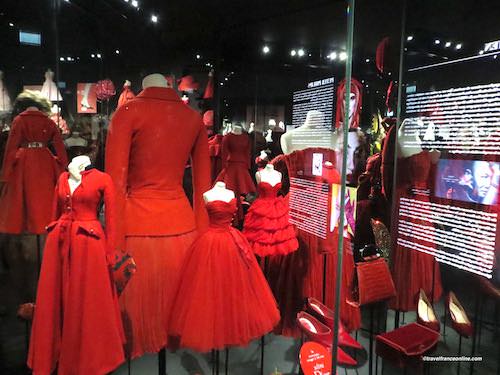
His creations were presented by colour themes, brilliantly tracing the evolution of the couturier’s style throughout his tragically short career. The overall effect was sublime, culminating in a magical sound and light show featuring a myriad of tiny pastel-hued stars projected onto the ceiling and walls of the room.
The Christian Dior exhibition was truly magical, offering a glimpse into the couturier’s unique and refined style.
He proudly acknowledged that “Robert Piguet taught me the virtues of simplicity, the source of all true elegance,” a motto he cultivated throughout his illustrious career.
Beyond simplicity and elegance, Dior’s style was characterised by a profound appreciation of the female silhouette, favouring shapes and materials that enhanced and celebrated femininity.
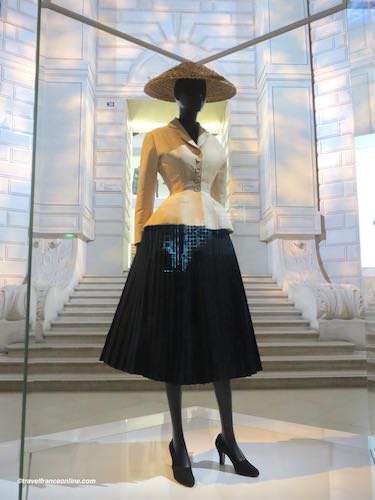
In an era marked by austerity and rationing following years of war, Dior’s innovative creations stood out, offering a break from the rigid and conservative styles of the time.
His designs played on the length of the fabrics to gracefully drape the silhouettes, incorporated structured bustiers to accentuate the upper body, and cinched the waist to emphasise the hips, creating dresses that exuded femininity and grace.
As Christian Dior so aptly put it, “I created flower-women.”
While his hyper-feminine creations were sometimes criticised for being retrograde, the revolutionary New Look he launched caused a sensation in the fashion world.
The New Look indeed paved the way for more innovation and boldness in fashion, solidifying Paris’s status as the undisputed capital of Haute Couture.
Today, the Christian Dior brand is under the aegis of the Arnault group.
Granville, Christian Dior’s hometown
Located on the southern coast of the Cotentin Peninsula, facing the Archipelago of Chausey, Granville is a lively coastal town with a bustling port, which gained prominence in the 15th century as a cod fishing port, its ships sailing off the coast of Newfoundland.
In the following centuries, many sailors from Granville became privateers, like those from Saint-Malo in Brittany, sailing the seas in the service of the King of France.
In the 19th century, Granville transformed into a fashionable seaside resort, thanks in particular to the opening of a railway line that connected it to Paris in just a few hours.
However, despite its development as a seaside resort, Granville has preserved its rich fishing heritage and is now France’s leading port for shellfish harvesting, particularly whelks, scallops, clams, cockles, cuttlefish, and sea bream.
The old town developed on the heights overlooking the port, notably on the Roc (rocky outcrop), where the Germans built a major battery during World War II.
Today, the Batterie de Granville is an open-air memorial that preserves the bunkers and gun emplacements left in place by the signal station.
As you venture deeper into the old town, nestled behind its ramparts, you will discover the Musée du Vieux Granville (Museum of Old Granville) and the Musée d’Art Moderne Richard Anacréon (Museum of Modern Art), both of which offer a glimpse into different facets of the local and artistic heritage.
And of course, Granville is home to the Musée Christian Dior!
How to get to Granville, Christian Dior’s hometown?
Department of Manche
Coordinates Musée Christian Dior – 1 rue d’Estouteville : Lat 48.843121 – Long -1.592612
By road: A13 to and from Paris and A84 linking Northern and Southern France
By train: Paris Gare Montparnasse – Granville (direct around 3h20)
By ferry: Brittany Ferries from and to the UK
: Irish Ferries from and to Ireland
: Manche Iles Express to and from the Channel Islands
Photos via Wikimedia Commons: Villa Les Rhumbs by Nikater Domaine public


