Château de Montal – Repaire Saint-Pierre

Perched atop the cliffs overlooking the Dordogne Valley, the Château de Montal offers breathtaking panoramic views of the surrounding countryside.
Montal is a castle of singular duality, having evolved from a medieval fortress into a Renaissance edifice of great beauty.
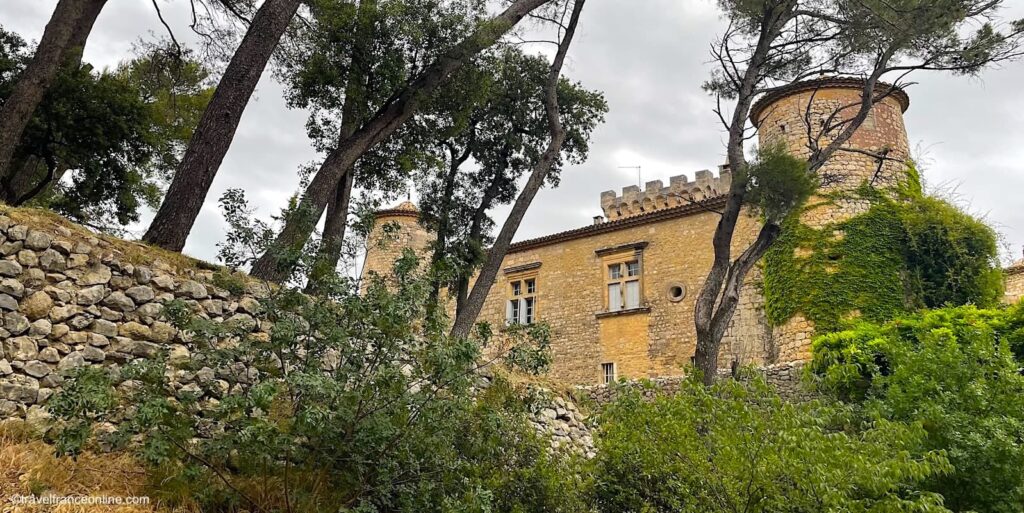
The austere, unadorned north facade is the only remaining vestige of the Repaire Saint-Pierre, the stronghold of the Lords of Balsac.
Defended by three imposing round towers topped with pointed roofs, this facade contrasts sharply with the elegant Renaissance facades that adorn the south side, overlooking the formal French garden.
Château de Montal, a masterpiece of the Early French Renaissance

The “new” château is not only a masterpiece of the early French Renaissance, but it also has the distinction of being the only château in the Quercy region built by a woman!
Indeed, Jeanne de Balsac, Lady of Montal, initiated its construction in 1520. However, at her death in 1534, only two of the four planned wings were completed.
A grand staircase, housed in a square pavilion, gracefully connects the Renaissance wings overlooking the courtyard and the formal French garden. Renowned for the sculpted details adorning its steps, this staircase leads visitors to the Great Hall.
Inside, the interior decoration reflects an undeniable feminine influence, characterized by refinement, elegance, and harmony.
The castle houses a rich collection of cherubs, allegorical sculptures, war trophies and a vast collection of carpets, 16th and 17th century furniture and paintings, all of which contribute to its majestic atmosphere.
Renaissance facades decor, a testament to Jeanne’s beloved departed
The château’s L-shaped Renaissance façades are adorned with mullioned windows and sculpted cornices, but their ornamentation transcends mere aesthetics, for it is imbued with symbolism.

A magnificent frieze adorns the upper sections, depicting mythological and allegorical figures symbolising Virtue. Among them are Hermes riding a unicorn, Hercules battling Antaeus, and Mars alongside Victory.
The rich decoration also includes numerous cherubs, fantastical creatures, coats of arms, and the ubiquitous initials of Jeanne and Amaury de Balsac, as well as those of their sons, Robert and Dordet.
These intricate details not only enhance the château’s beauty but also offer a glimpse into the values and aspirations of its inhabitants.
However, beneath the surface of its ornate facade lies a story of profound sadness and sorrow. I

ndeed, Jeanne de Balsac never recovered from the hardships she endured during the construction of the château: the deaths of her parents, her husband Amaury (Lord of Montal and Governor of Haute-Auergne), and even her cousin, and later the loss of her eldest son during military campaigns in Italy in 1523, leaving only her younger son, Dordet, as her sole heir.
These family tragedies profoundly affected Jeanne, permeating the very essence of the château’s decor. She carefully chose every to pay poignant tribute to the memory of her loved ones. She commissioned seven sculpted busts of her deceased parents and the cardinal virtues, Fortune and Providence, as funerary monuments.
These busts, each nestled within a triangular pediment adorned with mythological animals, are placed between the mullioned windows, imperishable witnesses to mourning and remembrance.
Even the allegorical sculptures in the skylights bear the weight of Jeanne’s sorrow, displaying the sombre motto she chose: “plus d’espoir – no more hope”.
The tragic decline of the Château de Montal

Unfortunately, Jeanne’s descendants showed little interest in Montal, and the Perusse d’Escars family acquired it at the end of the 16th century.
A century later, the Plas de Tanes family acquired the château and adorned it with Baroque elements, notably sumptuous fireplaces.
Unfortunately, during the French Revolution, the château was converted into a simple farmhouse.
Finally, at the end of the 19th century, an unscrupulous merchant bought Montal. He had it ruthlessly dismantled and auctioned off its magnificent art collections, including the moving funerary sculptures, doors, windows, and dormer windows. All that remained of the Château de Montal was a ruin, slowly decaying with age and neglect.
Maurice Fenaille, the savior of the Château de Montal
In 1908, industrialist and art collector Maurice Fenaille purchased the Château de Montal, then in ruins. He invested a considerable fortune to restore it to its former glory and undertook the painstaking task of tracking down and repurchasing the scattered sculptures and vast art collections scattered all around the world. He even commissioning Rodin’s disciples with the creation of replicas of works he could not recover.

He thus meticulously restored the Renaissance facades to their full splendour and furnished the ground floor with a sumptuous array of furniture, paintings, and carpets.
On September 13, 1913, President Raymond Poincaré presided over the official handover of the château, with Maurice Fenaille generously bequeathing Montal and its priceless art collections to the French state.
Although the Fenaille family retained ownership of the château until 2006, it was eventually placed under the guardianship of the French National Monuments.
Maurice Fenaille, an important figure in the oil industry and a passionate patron of the arts, left his mark on French heritage through his vision and unwavering support. Among his other acts of generosity was his acquisition of the Hôtel de Jouéry in Rodez, a 13th-century mansion, which he transformed into the Musée Fenaille, dedicated to the archaeology and history of the Rouergue region.
Let’s finish with an amazing anecdote: during the German occupation of Paris, between 1943 and 1945, Leonardo da Vinci’s iconic masterpiece, the Mona Lisa was transported from the Louvre and discreetly stored at Montal where it stayed until the end of the war.
Department of Lot – Saint-Jean-Lespinasse
Coordinates: Lat 44.860759 – Long 1.868356