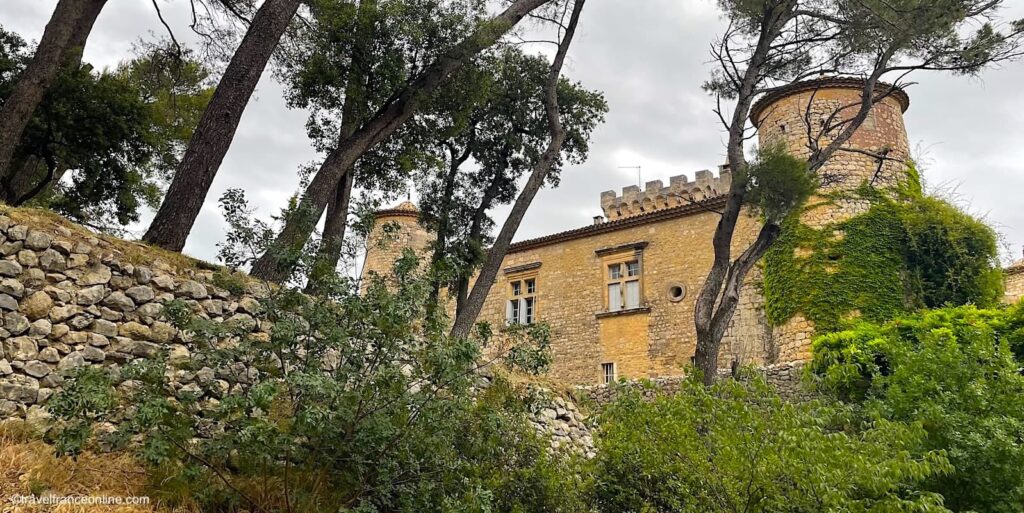
Cahors, the capital of the historic Quercy
Cahors, the former capital of historic Quercy, is today the préfecture of the Lot department.
In the 13th century, Cahors, then known as Cadurca, attracted Lombard merchants, bankers and Knights Templar, transforming into a flourishing financial centre. Its importance was such that the term “cahorsin” became synonymous with usurer in the common language of the time.
Tragically, this prosperous period came to an abrupt end with the outbreak of the Hundred Years War and the terrible plague epidemic of 1347-1349.
Despite its allegiance to the French crown during the Anglo-French conflict, Cahors fell under English rule with the Treaty of Brétigny in 1360. Cahors experienced a revival in the following century, thanks to efforts to revive its economy and rebuild the city after its destruction.
Unfortunately, the Wars of Religion dealt another heavy blow to Cahors in 1560, with the massacre of all its Protestant inhabitants.
Twenty years later, the city suffered further turmoil when it was besieged, captured and looted by the troops of the Protestant leader Henry of Navarre, the future Henry IV.
Gallo-Roman Cahors
Cahors boasts a rich architectural heritage, including a few Roman remains, and a wealth of picturesque half-timbered houses dating from the 14th to the 17th centuries, a majestic cathedral and a magnificent fortified bridge.
Its origins date back to the Gallic period, when the Caduici tribe settled near a sacred spring nestled at the end of a peninsula in the Lot.
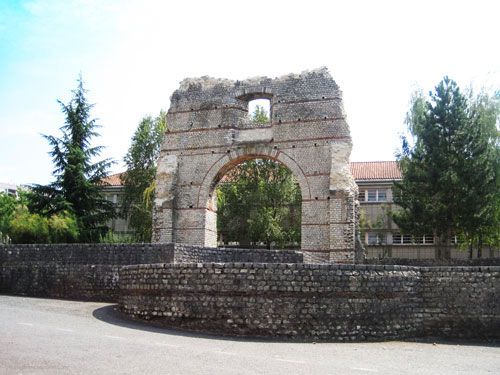
From these modest beginnings, Cahors flourished to become the thriving Gallo-Roman city of Divona Cadurcorum. The Romans built a large forum, baths, a temple, a theatre and elegant villas arranged according to a checkerboard plan, of which only the Arche de Diane remains, the sole vestige of the splendid Roman baths.
The legend of the Pont Valentré
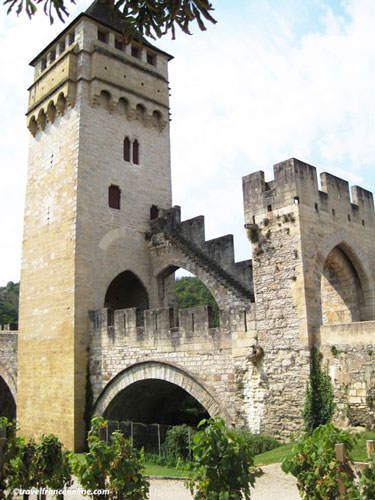
The Valentré Bridge is one of the most emblematic monuments of Cahors. Built during the Hundred Years’ War, this imposing fortified bridge with seven arches defended the city’s western flank.

The Valentré Bridge is a magnificent example of 14th-century French military architecture, characterised by its broken arches and three imposing fortified structures, each 30 metres high and crowned with crenellations.
A legend is attached to the construction of the bridge. It is said that, faced with the slow progress of the work, the architect made a pact with the devil, offering his soul in exchange for an early completion of the project. Despite this diabolical pact, the construction of the bridge lasted almost 50 years! Ironically, the architect tricked the devil by tasking him with fetching water using a sieve. Outwitted and furious, the devil left, but not before cursing the central tower.
For centuries, the tower’s summit stone thus broke repeatedly under the evil influence of the Devil, it is said. However, in the 19th century, it was solidly reinforced and adorned with a sculpture depicting the Devil’s vain attempts to dislodge it. Since then, the stone has remained unshaken, and the tower has inherited the nickname Tour du Diable (Devil’s Tower), forever protected from infernal forces.
Cahors vineyard

However, Cahors is not only a city, but also the name of a renowned wine!
The local vineyards produce a distinctive dark red wine, renowned for its full-bodied structure, which improves with age, gaining in depth and complexity.
The winemaking roots of Cahors go back twenty centuries, when the Romans planted the first vines on the fertile hillsides of the Lot Valley.
Throughout the Middle Ages, Cahors wines acquired great renown and even attracted royalty, notably King Francis I during the Renaissance.
Legend has it that the king had barrels of Cahors wine delivered directly to his sumptuous Château of Fontainebleau.
Exported to different regions of France and beyond, Cahors wines were transported by barges locally called gabares, argentats or sapines, sailing on the Lot to the port of Bordeaux, then to their final destinations.

However, the devastating phylloxera epidemic of 1868 dealt a severe blow to the French vineyard, precipitating a period of economic decline for the region.
After the Second World War, the vineyard was replanted with the Auxerrois grape variety, which adapted perfectly to the region’s sunny hillsides and rocky terraces.
In the 1960s, local wine production experienced a remarkable revival, with Cahors wines regaining great popularity and obtaining the prestigious Appellation d’Origine Contrôlée (AOC).
Department of Lot
Coordinates: Lat 44.447523 – Long 1.441989