
Explore the charms of a Petite Cité de Caractère

Perched on a promontory, Auzon is a medieval gem nestled between the fertile Limagne Plain and the majestic Livradois mountains.
Its ancient ramparts offer breathtaking panoramic views over the Auzon and Gaudurel valleys. Designated a “Petite Cité de Caractère” (Small Town of Character) and a “Ville d’Art et d’Histoire” (Town of Art and History), it lends itself to exploration on foot thanks to marked trails that wind through its picturesque cobbled streets and alleyways. These trails are organised around different themes and lead to the discovery of hidden treasures in the charming lower village, nestled on the banks of the river.
The citadel is also home to the beautifully restored Collegiate Church of Saint-Laurent, a magnificent example of 12th-century Romanesque architecture, listed as a Historic Monument in 1906. The church once housed the famous Coffret d’Auzon, a remarkable whalebone casket, renowned for its exquisite carvings, which was made in Northumbria around 700 AD. This object is now kept at the British Museum.

Auzon’s historical heritage also includes the medieval market hall, the castle and the Chapel of Saint-Michel, as well as the Écomusée du Pays d’Auzon (Auzon Countryside Ecomuseum). This fascinating museum displays nearly 800 original objects related to local trades and traditions of yesteryear.
Auzon also boasts another unusual museum, the Vespa Museum, which showcases a collection of original Vespas produced between 1947 and the present day!
Finally, the peaceful banks of the Allier are a haven for fishermen.
Unraveling the history of the lords of Auzon
Although a Gallo-Roman inscription suggests the existence of an ancient community on the promontory, there are no other documents related to this distant era.

The first written mention of Castrum Auzon appears in a charter from the late 10th century, extracted from the Cartulaire de Sauxillanges,, which marks the beginning of the town’s documented history.
At the beginning of the 11th century, documents reveal the establishment of a Viguerie, a medieval administrative court, coinciding with the construction of the castle.
It seems that the lords of Bompar were among the first owners of Auzon, although they shared their authority with the influential Counts of Auvergne and Lords of Bourbon. Consequently, the castle of Auzon was commonly known as Château Bourbon. This territorial alliance shaped the town’s political and social landscape.
The rise and fall of Auzon’s fortunes
In 1211, a decree by King Philip Augustus transferred the lordship of Auzon to the Montmorin family, marking a major turning point in the town’s administration.
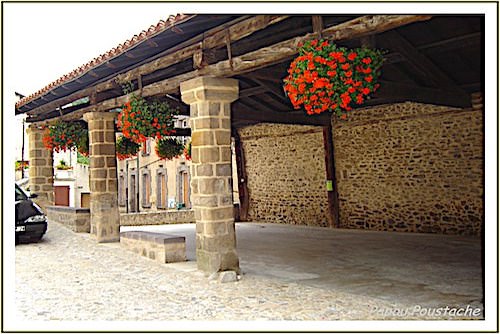
By the end of the 13th century, the citadelle of Auzon had transformed into a prosperous village, leading to the granting of a charter of liberties that conferred administrative power upon the local bourgeoisie. This period of prosperity was marked by the construction of the covered market hall, now a listed historical monument.
The northern fortifications were reinforced in the 15th century.
The southern flank, vulnerable to external attacks, was reinforced by the construction of a fortified wall, complete with towers and an imposing gate, the Porte Brugelet, which was listed as a historical monument in 1997.

Despite these defensive measures, Auzon suffered a setback in 1557 when François de Montmorin acquired the Château Bourbon and the surrounding lands, thus depriving the town of its status as a “royal town.”
The following centuries saw the seigneury pass into the hands of the Polignac family, leading to the gradual decline of the castle, which eventually fell into ruin and was transformed into a stone quarry.
In 1639, the Polignac family founded a Benedictine monastery on the castle grounds. The surviving buildings of the castle were restored over time and have been listed as historical monuments.
A thriving town at the heart of a coal basin

Nestled amidst lush landscapes, Auzon nevertheless conceals a rich industrial past. The town stretches across the Bassin de Brassac, a coalfield that has fueled economic activity since the late 15th century.
Throughout the 18th century, numerous coal mines, glass-works, and a large brick-works, located near the town of Chappes, flourished, attracting workers and families to the region. This industrial expansion led to a population boom, which was further amplified by the arrival of the railway in 1855.
Despite recurring epidemics, Auzon’s population reached a peak of approximately 1,600 inhabitants in 1896! It was during this period that the figure of the “Auzon peasant-worker” stereotype emerged, embodying the dual role of miner and small farmer.
The surrounding hills, once densely wooded, were transformed: vineyards appeared on the south and southwest slopes, while gardens, orchards, and meadows occupied the alluvial plains of the Allier Valley.
However, this industrial prosperity was accompanied by environmental challenges. The establishment of the arsenopyrite metallurgical plant at the beginning of the 20th century raised concerns about pollution, as the ore processing required the use of arsenic.
The outbreak of the First World War brought further upheaval, leading to depopulation and a long period of decline for the village.
Petites Cités de Caractère in Auvergne
Auzon has joined the prestigious list of 28 Small Towns of Character in Auvergne, further enhancing the charm of destinations such as Allègre, Chilhac,, La Chaise-Dieu, Le Monastier-sur-Gazeille, Saint-Paul-de-Chalençon, and Saint-Paulien in the Haute-Loire department.
In the neighbouring Allier department, you’ll find Bourbon-l’Archambault, renowned for its thermal baths and royal history, as well as s Hérisson, a picturesque fortified village full of charm.

The Puy-de-Dôme department, for its part, is brimming with captivating towns, including Artonne, Besse-et-Saint-Anastaise, Champeix, Châteldon, La Sauvetat, Le Broc, Nonette, and Saint-Florêt. The towns of Sauxillanges and Chauriat are currently candidates for this prestigious designation.
Further afield, the Cantal department offers a collection of enchanting villages, including Laroquebrou, Marcolès, Menet, Murat, Pleaux, Raulhac, Saint-Urcize, and Montsalvy, famous for its vibrant basket-weaving festival.
These charming towns are just a glimpse of the countless attractions awaiting visitors in the picturesque Auvergne region.
Located 15 km north of Brioude and equidistant from Le Puy en Velay and Clermont-Ferrand, Auzon invites travellers to explore its rich heritage and magnificent landscapes. Whether for a leisurely stroll through its historic streets or an immersion in its cultural life, Auzon promises an unforgettable experience amidst the natural splendours of the Auvergne.
Department of Haute-Loire – Auvergne region
Coordinates: Lat 45.391899 – Long 3.374186
Credits photos: Cpauvergne.com


