
Hérisson, a medieval walled village ranked as small town of character
Hérisson (yes, like hedgehog) is a charming medieval village renowned for its exceptional archaeological and historical heritage, and is listed among the “Petites Cités de Caractère” (Small Towns of Character).
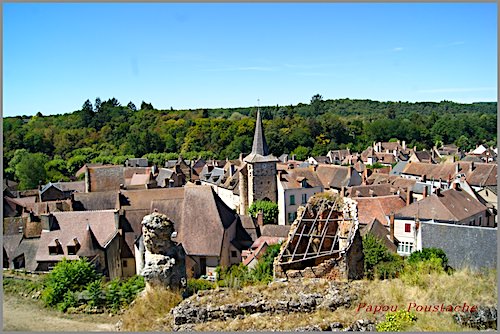
Its origins date back to the end of the 5th century, a period marked by the decline of the Roman Empire and the massive influx of barbarian invasions, notably those of the Visigoths, who swept across France.
Before this time, the Romans had ruled the region for over four centuries, leaving behind numerous fortified towns and a flourishing Gallo-Roman culture.
Thus, perched on a rocky spur about 1.5 kilometres northwest of Hérisson, the Gallo-Roman fortress of Cordes occupied a strategic position overlooking the confluence of the Aumance (then called the Oeil) and the Louise rivers, at the crossroads of three important Gallic territories.
This rocky outcrop was indeed a sacred Gallic site where the druids held their sacred rituals.
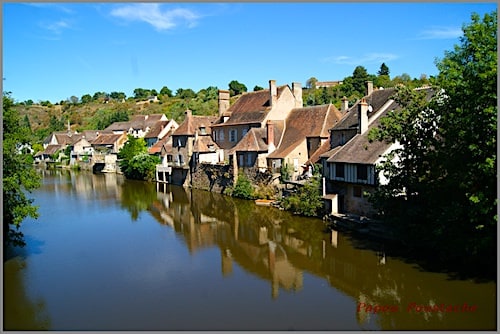
However, as the invaders approached Cordes, the inhabitants fled and took refuge on a hill nestled in a bend of the Aumance River, where they founded a new fortress, Erictio, meaning “fortress above the ford.”
Over time, the village’s name evolved into Hérisson.
Some inhabitants returned to Cordes once the danger had passed. They rebuilt the fortress, which they renamed Châteloy (or Castellum Oculi – Castle overlooking the Oeil).
Château de Hérisson, castle of the Dukes of Bourbon
Erictio, the fortress above the ford, gave rise to the medieval village of Hérisson.
Many legends tell of the ingenious inhabitants who even diverted the river’s course to reinforce the fortress’s natural defences during the invasions.
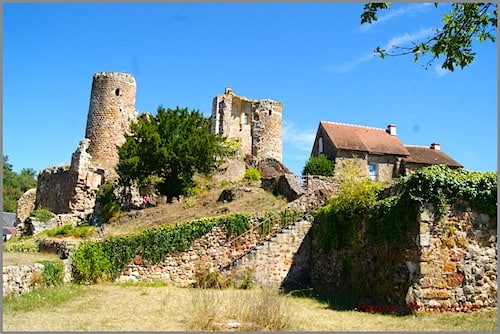
However, what is known for certain is that the medieval town of Hérisson prospered at the foot of its castle, which was built in the 10th century by the Dukes of Bourbon to protect the border of their Duchy of Bourbonnais against the Duchy of Aquitaine.
Over time, Hérisson became one of the seventeen castellanies of Bourbonnais and served as a ducal castle.
The castle’s strategic importance did not go unnoticed and attracted the attention of the English, who dominated Aquitaine after Eleanor of Aquitaine‘s marriage to Henry II.
In response, Duke Louis II of Bourbon undertook significant fortification work in the 14th century, expanding the castle and the surrounding village with thick ramparts, 22 towers, curtain walls, and an imposing keep.

Then came the 17th century, a tumultuous period for the old fortress. Indeed, Duke Louis II of Bourbon-Condé, the cousin of King Louis XIV, found himself embroiled in a conflict with Cardinal Mazarin, advisor to the regent Anne of Austria.
This disagreement culminated in the civil war known as the Fronde, from which Louis XIV ultimately emerged victorious thanks to Mazarin’s support. In retaliation, Mazarin ordered the dismantling of Hérisson Castle in 1651, which was then used as a stone quarry.
Fortunately, the collapse of the keep in 1899 put an end to the demolition works, and the remains of the castle were then preserved and restored.
The renaissance of Hérisson
The rehabilitation of the Castle of Hérisson began in 1966 with the creation of the association Les Amis du Vieux Hérisson (Friends of Old Hérisson), which is dedicated to restoring the castle.
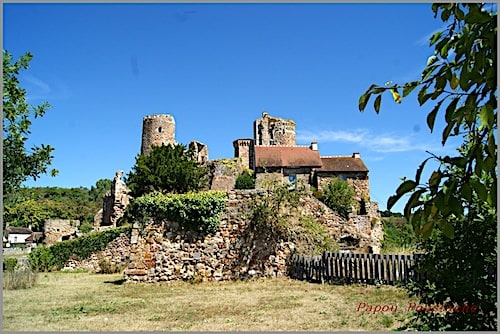
Classified as a historical monument in 1968, the imposing ruins of the castle of the Dukes of Bourbon still dominate the fortified village and the Aumance River.
These remains include the keep, vestiges of towers, a small section of the rampart, and architectural elements of the lord’s residence.
A model of the original building, displayed in the town hall, offers a glimpse of this once imposing fortress.
And while strolling through the medieval streets, you will discover a multitude of 15th, 16th, and 17th-century houses, all built with stones from the castle!
Six compelling reasons to visit the medieval village of Hérisson
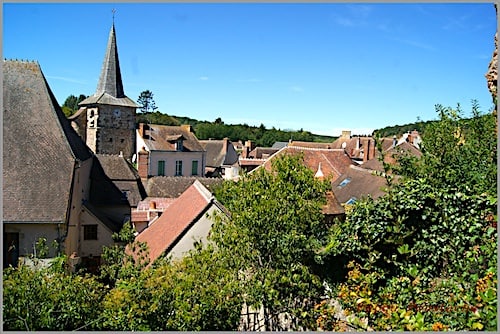
1- The Porte de Gateuil and the Porte de Varenne are the only two remaining fortified gates of the original three in Hérisson.
The imposing Gateuil Gate, initially called the Porte du Pont or Porte de Gatoeil, controlled the bridge and the road leading to the town of Soulongis.
To the north of the rampart, the Porte de Varenne overlooked the road to Châteloy-Cordes. This gate was nicknamed the Porte de l’Enfer (Hell Gate) because of a statue of the Virgin Mary placed beneath its arch to protect the town from demons and evil forces.
2- Located in the heart of the village, the Church of Saint-Sauveur is a listed historical monument. Although it underwent significant alterations in the 17th century, its bell tower is original and dates from the 12th century.
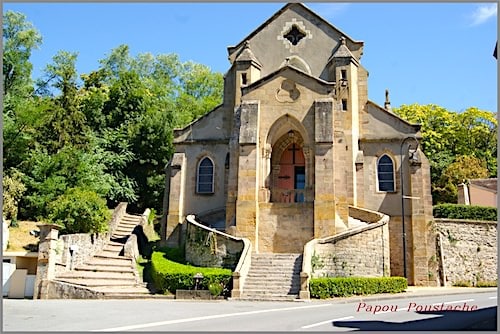
3- The Church of Saint-Pierre in Châteloy, consecrated in 1170, served as the parish church of Hérisson from the 13th century until 1725, when the first Church of Notre-Dame was built.
Renowned for its 12th-century sculpted capitals and the murals adorning its apse, the Church of Saint-Pierre in Châteloy is an integral part of the Bourbonnais Painted Churches Route. A listed historical monument, it also hosts summer concerts organised by the Festival de Musique en Bourbonnais association.
4- Built in 1548, the Flamboyant Gothic-style Chapel of Saint-Étienne is also known as Chapelle de la mi-voie (mid-way chapel). It acquired this name before the construction of the Church of Notre-Dame, when parishioners would stop there on their journeys from Hérisson to Châteloy. This chapel is one of the few 16th-century religious buildings still standing in the Bourbonnais region.
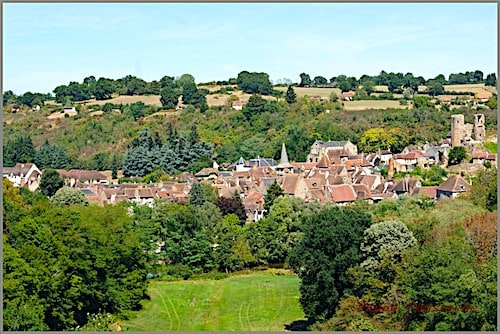
5- The Church of Notre-Dame, built in the Neo-Gothic style in the 1850s, stands near the castle and is renowned for its remarkable horseshoe-shaped staircase. It also houses a rich collection of liturgical furnishings and stained-glass windows created in 1996.
6- Finally, the Musée du Terroir Hérissonnais (Hérisson Regional Museum) takes visitors on a journey to discover the archaeological remains unearthed at the former fortress of Cordes-Châteloy.
Department of Allier – Auvergne region
Coordinates: lat 46.509127 – Long 2.711865
Credits photos: Jean Piludu @cpauvergne


