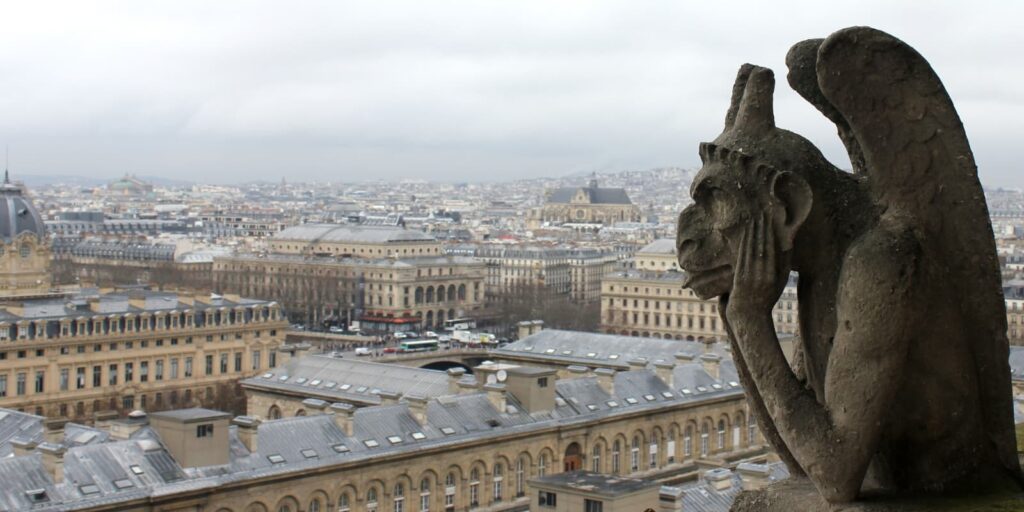
Arènes de Lutèce on the Rive Gauche
The Arènes de Lutèce is the oldest Roman monument in Paris.

It is located in the 5th arrondissement, the district with the highest concentration of Roman remains in the city. Nearly two millennia ago, the Romans developed a new settlement on the Rive Gauche – Left Bank. Lutetia (Lutèce) on the Ile de la Cité had indeed become too small to accommodate a growing population.
This new city, with its forum, baths, theatres, and numerous districts, flourished until the barbarian invasions of 285 AD. The inhabitants then dismantled their monuments to reinforce the old ramparts of the Île de la Cité, where they took refuge.
Few people, likely still reeling from the recent devastation, returned to the Left Bank. Only a few modest communities settled among the ruins of the Roman city.
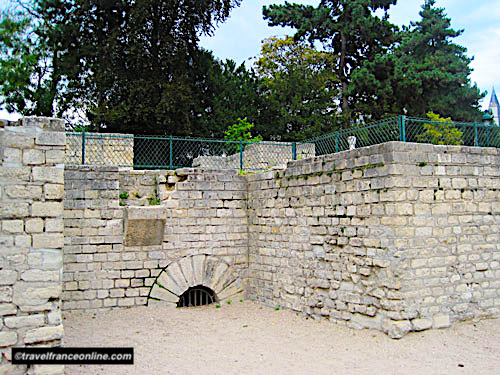
It wasn’t until the 5th century that the Left Bank began to be repopulated around the newly founded Abbaye de Sainte-Geneviève. But this revival was relatively short-lived, as the Normans besieged Paris at the end of the 9th century, destroying everything in their path.
The unprecedented population boom of the 11th century, combined with the creation of the Paris University two centuries later, eventually revived the district’s development.
The 5th arrondissement thus became one of the most densely populated districts of Paris until the 1860s, when Haussmann‘s extensive urban renewal projects led to the demolition of the medieval quarter. Fortunately, important Roman remains, such as the Arènes de Lutèce and the Baths of Cluny, were spared.
Arènes de Lutèce, Paris’ oldest Roman monument
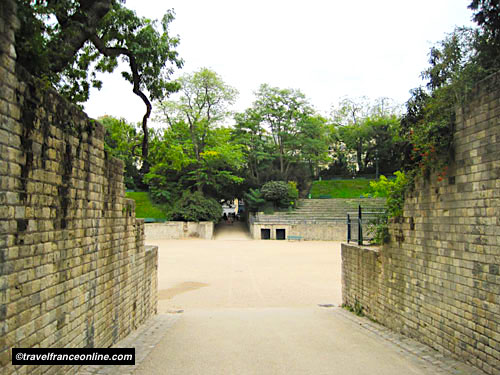
The Arènes de Lutèce was a semi-circular amphitheatre with a capacity of 10,000 seats, a capacity considered a small at the time.

Smaller amphitheatres were common in northern and central Gaul, where population density was lower.
It was built around 200 AD on the eastern slopes of Mont Lucotius (the current Mont Sainte-Geneviève) and had an unobstructed view of the confluence of the Bièvre and Seine rivers.
The Arènes de Lutèce served as both a theatre and an arena, meeting the entertainment needs of the population.
However, it was only used for three generations. The barbarian invasions of 285 AD led to its rapid dismantling, as its stones were reused to build a protective rampart around the Île de la Cité.
Further dismantling took place during the Norman invasions of the 9th century, as the stones were needed to fortify the old ramparts and later to construct new buildings in peacetime.
The ruined amphitheatre gradually fell into oblivion and was eventually buried under layers of earth.
However, it was rediscovered in the 1860s, with the opening of Rue Monge.
It remained relatively forgotten until 1883, when Victor Hugo mobilised public support and the necessary funds for its restoration, thus saving it from destruction.
Dr. Capitan restored the Arènes de Lutèce
The debate over whether to preserve or demolish the Arènes de Lutèce persisted until 1918, when major restoration and reconstruction work was finally undertaken.
However, so little remained of the southern stands that new buildings were erected on their foundations. However, the remaining ruins were meticulously restored to their original state.
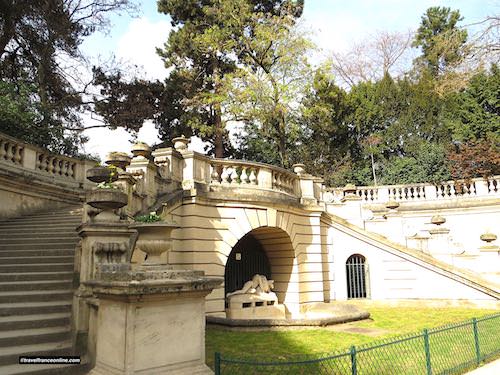
The Square Capitan, a small public garden with a children’s playground, was created on its northern side. The site reveals numerous remains of ancillary structures, hidden among the shrubs and flowerbeds.
The Arènes de Lutèce is an ideal destination for families, as it offers ample space where children can run and play freely, making it also a perfect spot for a picnic.
Directions: 5th district
Metro: Monge, Jussieu, Cardinal Lemoine on Lines 7, 10
Coordinates: Lat 48.844859 – Long 2.353125