
Amboise Castle – First Renaissance château of the Loire Valley
The origins of Amboise Castle date back more than 20 centuries, when the local Gallic tribe erected a fortress on the promontory overlooking the Loire River and its valley.

Later, the Romans replaced it with a larger fortified camp and built a bridge where they levied tolls for the transport of goods.
In the 11th century, the Count of Amboise had the first fortress built.
King Charles VII seized it in 1422, and his son, Louis XI, rebuilt and enlarged it.
Charles VIII, who was born and died in the castle, was impressed by the elegance and refinement of the Italian Renaissance during his military campaigns in the 1490s. Upon his return, he thus commissioned a series of modifications and embellishments, making Amboise Castle a perfect example of early Renaissance architecture.
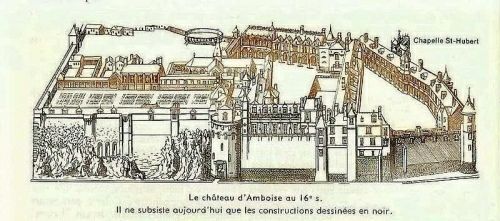
These improvements included the addition of the Gothic wing overlooking the river, the construction of the Tour des Minimes (Tower), the Oratory of Anne of Brittany, and the acquisition of sumptuous furnishings.
The king also commissioned Italian gardeners to design the gardens that then surrounded the château. Amboise Castle was nearly complete at his death in 1498.
Amboise Castle’s Gothic Wing
The Gothic wing overlooks the majestic Loire River and adjoins the Tour des Minimes, also known as the Tour des Cavaliers, because horsemen accessed the castle via a ramp that ran inside the tower. This tower once also served as the castle’s entrance.
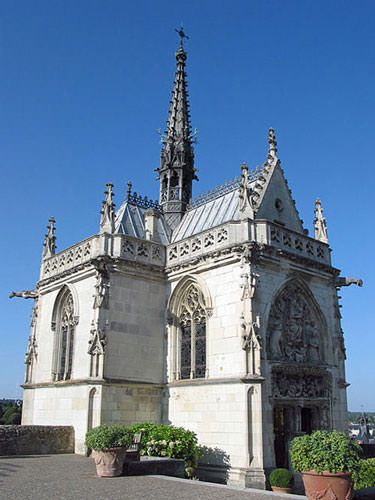
The Oratory of Anne of Brittany, the work of Flemish master architects, is considered one of the finest examples of the Flamboyant Gothic style.
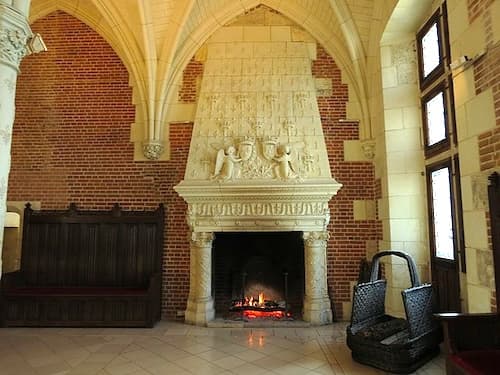
The Salle des Etats (Hall of the Estates) is a large room with brick and stone walls and a vaulted ceiling supported by columns. In 1560, it became the scene of a major historical event known as the Conspiracy or Tumult of Amboise. A group of Protestants had indeed gone to the Château de Blois to petition Francis II for freedom of worship.
However, some of them plotted to assassinate the Duke of Guise, leader of the Catholic party, but their plans were discovered. Francis II took refuge with his court at Amboise Castle, but the conspirators pursued them. They were eventually captured, tried, and hanged from the balcony of the Hall of the Estates, now known as the Balcony of the Conspirators.
The Edict of Amboise, signed by the king in 1563, brought an end to this tumultuous episode of the Wars of Religion and established peace. From 1848 to 1852, this hall served as the prison of Abd-el-Kader, leader of the Algerian resistance against French colonisation.
Amboise Castle’s Renaissance wing
Louis XII, successor to Charles VIII, enlarged Amboise Castle by adding a Renaissance wing perpendicular to the existing Gothic wing. Francis I further embellished the castle by adding a level to the Renaissance wing. The king was particularly fond of Amboise, where he spent his youth and lived for the first five years of his reign. A man of pleasure, luxury, and beauty, Francis I contributed to the prestige of Amboise by organising sumptuous festivities there.
A great patron of the French Renaissance, he surrounded himself with the greatest minds of his time. He even invited Leonardo da Vinci to live at the nearby Clos Luçé, where he frequently visited the old master, using a secret passage connecting the two estates.
Louis XIII bequeathed it to his brother, Gaston d’Orléans. However, Gaston spent much of his life plotting against his own brother, who, in retaliation, had the castle bombarded and its ramparts destroyed!
Amboise Castle eventually reverted to the French Crown. At the beginning of the 19th century, Napoleon I bequeathed it to Roger Ducros, a member of the Directory government, who, due to financial difficulties, turned it into a stone quarry!
Today, unfortunately, only vestiges of the castle remain: the King’s Lodgings, the Gothic and Renaissance wings, the Heurtault Tower on the rampart, and the Saint-Hubert Chapel. The private apartments located on the upper floor of the Renaissance wing were later redecorated in the Empire style for Louis-Philippe.
Gardens and terraces now occupy the site of the former buildings, and boast breathtaking views of the Loire River and the town.
It is said that Leonardo da Vinci is buried in the flamboyant Gothic Saint-Hubert Chapel, built in 1491 for Ann of Brittany (Charles VIII’s consort).
Amboise Castle now belongs to the Saint-Louis Foundation, a trust created by the Count of Paris to preserve French national heritage.
Department of Indre-et-Loire
Coordinates: Lat 47.413336 – Long 0.985551
Photos via Wikimedia Commons: Castle overlooking Loire by Emmanuel Debouzy Public domain – Renaissance fireplace by xorge CC BY-SA 2.0 – Castle drawing before 1579 by Jacques Ier Androuet du Cerceau (1510–1585) edited by Chroniqueur Public domain – Chapelle Saint-Hubert by Arnradigue CC BY-SA 3.0


