Jean Gobelin’s workshops along the Bièvre
The Manufacture des Gobelins is world-renowned for the quality and craftsmanship of its tapestries.
Its history began in the 1440s, when Jean Gobelin, a highly talented Flemish dyer, established a tapestry workshop on the banks of the Bièvre, which at that time meandered through the Right Bank.
Jean Gobelin mastered the art of dyeing, and his productions quickly became renowned for their exceptional, vibrant scarlet hues.
His descendants, and successors, perpetuated and developed the family legacy. At the beginning of the 17th century, the name Gobelin had become synonymous with prestige in Parisian high society.
Many family members indeed pursued brilliant careers in the ecclesiastical and financial worlds, while those who had taken over the reins of the factory made it prosper.
The Manufacture des Gobelins became so successful that the Bièvre was nicknamed “Rivière des Gobelins – Gobelins’ River”.
Colbert – Foundation of the Manufacture des Gobelins
The first Gobelins tapestries were created under the direction of the Canaye family, taking the factory to unparalleled heights.
A decisive turning point came in 1666, when the Grand Treasurer Colbert acquired the Manufacture des Gobelins, thus laying the foundations of the Manufacture Royale des Meubles et Tapis de la Couronne – Royal Manufacture of Furniture and Carpets of the Crown.
This prestigious institution hired the most talented craftsmen of the time, including the famous Flemish tapestry maker Jean Liansen. New buildings were erected, and old ones restored, considerably developing the factory. Drawing inspiration from masters such as Rubens, Charles Le Brun, Mignard, Desportes, Jouvenet, De Troy and Oudry, the new workshop wove tapestries of unparalleled magnificence.
The Manufacture des Gobelins became synonymous with the production of exceptional tapestries, thus consolidating its international prestige.
The factory miraculously escaped demolition during the French Revolution. However, all the tapestries adorned with the royal emblem, Fleur-de-Lys, were destroyed.
Manufacture des Gobelins post-Revolution
The Manufacture des Gobelins (Manufacture Royale des Meubles et Tapis de la Couronne) expanded in 1825 by purchasing the Manufacture de la Savonnerie de Lodève, an establishment founded by Henri I and specialising in knotted stitch techniques.
A decisive turning point came when the chemist Chevreul discovered the method for stabilising a multitude of dyes. At the time, the factory’s clientele consisted mainly of members of royalty, presidents, and emperors.
The factory was renamed the Manufacture Nationale des Gobelins upon the proclamation of the Third Republic in 1870.
The Manufacture de Beauvais, founded in 1664, was integrated into the Gobelins in 1989.
Finally, the Manufacture Nationale des Gobelins founded a school and a museum retracing the prestigious history of the Manufcature des Gobelins and the evolution of the art of tapestry.
Mobilier National
Today, the Manufacture des Gobelins, the Manufacture Nationale de la Savonnerie de Lodève, and the Ateliers Nationaux de Dentelle du Puy et d’Alençon work under the aegis of the Mobilier National.
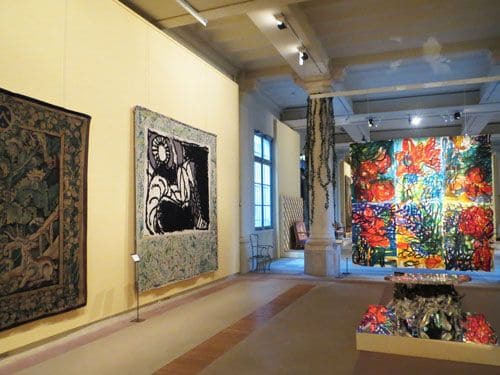
Together they produce a wide variety of tapestries inspired by the works of renowned 20th-century artists, such as Chagall, Picasso, Matisse, Miró and Jean Lurçat. Despite the passage of time and the evolution of artistic styles, their commitment to craftsmanship and quality remains intact.
The Mobilier National plays an essential role in furnishing the official buildings of the French Republic, notably the Elysée Palace, the Hôtel Matignon (prime minister’s house), ministries and embassies.
It makes available to these spaces a selection from its vast collection of more than 200,000 pieces: furniture, tapestries, ceramics, art objects and bronzes, from the 17th century to the present day.
As the custodian of these treasures, the Mobilier National assumes responsibility for their conservation and maintenance, operating under the aegis of the Department of Arts within the French Ministry of Culture.
Enclos des Gobelins
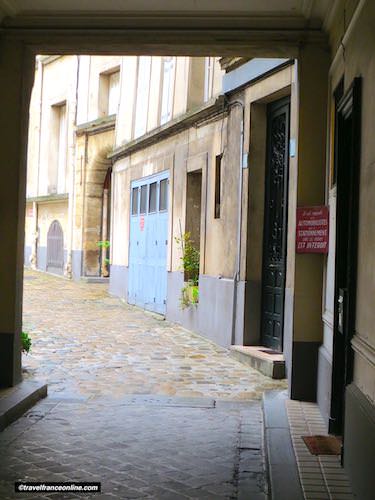
The influence of the Manufacture des Gobelins was such that the entire 13th arrondissement of Paris is still affectionately nicknamed the Quartier des Gobelins.
Most buildings of the Enclos des Gobelins, the historic site of the factory, are classified as a historical monuments, and are bounded by Rue des Gobelins, Avenue des Gobelins, Rue Croulebarbe and Rue Berbier-du-Mets.
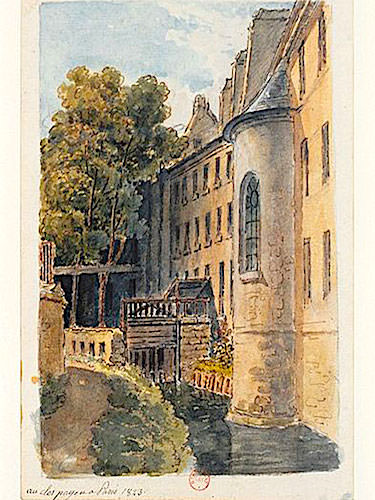
In the 18th century, the architect Gabriel built the Chapelle des Gobelins wich today houses an exhibition space. It overlooks Rue Berbier-du-Metz, a street built over the bed of the River Bièvre, when it was diverted underground in 1910.
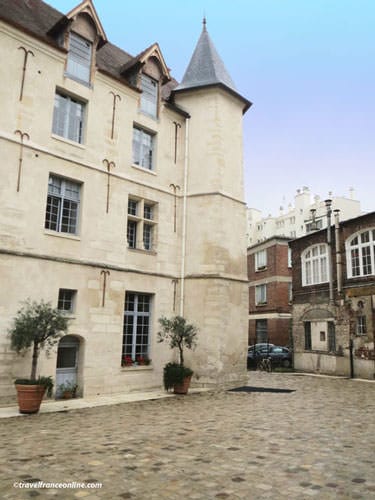
Rue des Gobelins was known as Rue de la Bièvre until 1636. At No. 17 and No. 19, you will find two remarkable Gothic houses built around 1500 and belonging to the Gobelins family until the 17th century.
These historic houses were later converted to accommodate various businesses, including a shop and even a tannery.
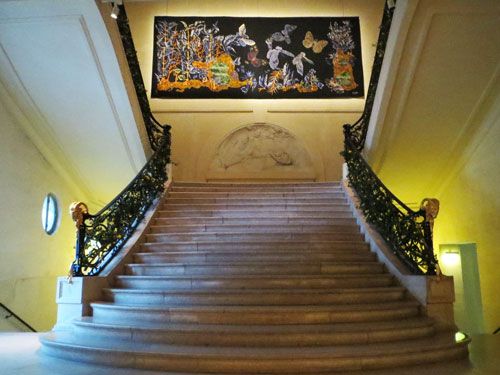
They were fortunately classified as historical monuments, restored, and are now among the oldest houses in Paris.
The Hôtel de la Reine-Blanche, a remarkable example of medieval architecture, is a private mansion that belonged to the Gobelins family.
It was fully restored in the early 2000s. Its main entrance is on Rue Gustave Geffroy, but it is also connected to Rue des Gobelins by a network of interior courtyards.
It is believed that the Hôtel de la Reine-Blanche was a private mansion built around 1300 for Blanche, the daughter of King Saint Louis. The current private mansion replaced this first residence around 1500.
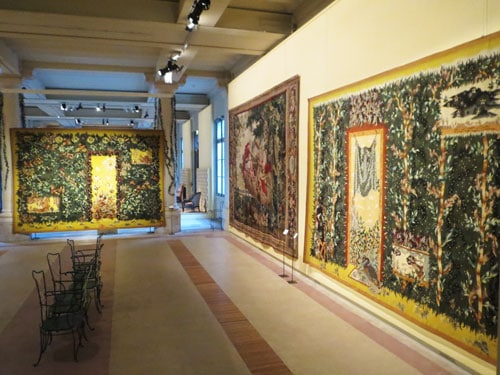
The Hôtel de la Reine-Blanche was classified as a historical monument for its exceptional architectural features: magnificent windows, pepper-pot-roofed tower, vaulted cellars, stairwell, and Gothic lintels. It is also one of the very few Parisian buildings to have retained a unique combination of living space and workshops.
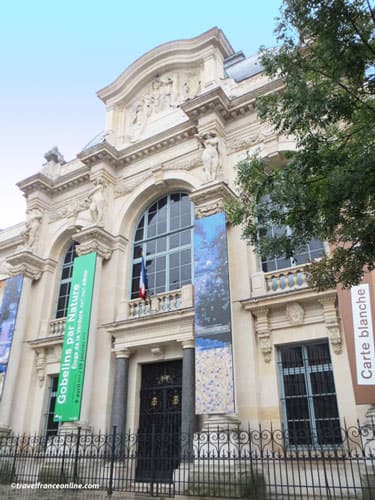
Finally, in 1912, the architect Jean-Camille Formigé designed the majestic building at No. 42 Avenue des Gobelins, which served as the main entrance to the factory and its outbuildings.
Directions: 13th District – 42 Avenue des Gobelins
Metro: Gobelins on Line 7
Coordinates: Lat 48.835254 – Long 2.352458
Photo via Wikimedia Commons: Manufacture chapel in 1830 Public domain