
Peyzac le Moustier village
Peyzac le Moustier is located on the north bank of the Vézère, near its confluence with the small river Moustier, opposite La Roque Saint-Christophe.
Known as Moustier-Saint-Robert until the French Revolution, this charming parish once belonged to the Bishop of Périgueux, who also owned a castle in the nearby village of Plazac.
In 1793, it took the name Moustier-de-Montignac, and in 1925, that of Peyzac le Moustier.
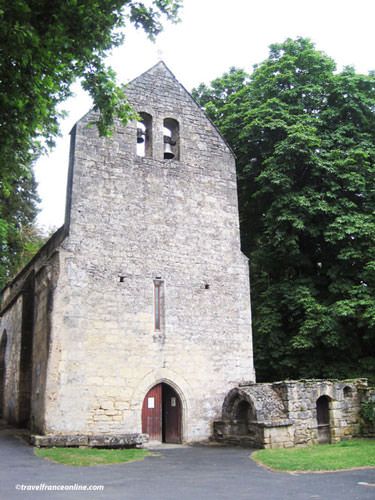
Today, the village consists of a few scattered houses, a bakery-grocery store, a restaurant and a charming, unpretentious 12th-century fortified church.
Le Moustier, a major Neanderthal site
The discovery of a significant Neanderthal shelter in 1863 brought considerable attention to this unassuming village!
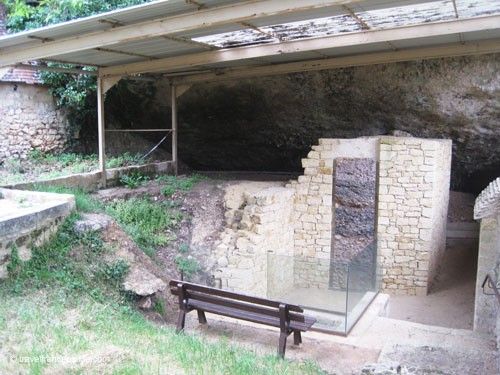
Le Moustier rock shelter is nestled in the cliff, behind the bakery located opposite the church square.
This shelter, approximately 300,000 years old, is one of the oldest traces of human occupation in the Vézère Valley.
Neanderthals, who inhabited the region around 150,000 years ago, preceded Homo sapiens by several thousand years.
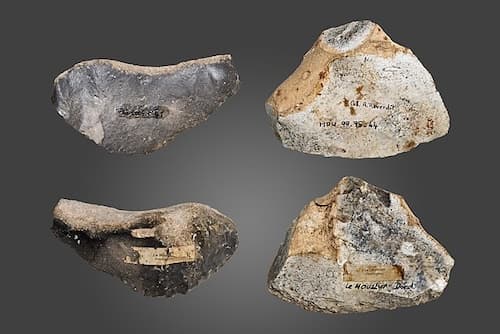
The characteristic artefacts discovered at Le Moustier have made it possible to define a specific type of Neanderthal tools and materials, known as the Mousterian industry, which spans from approximately 300,000 to 30,000 years ago.
But even more exciting, Le Moustier site has two shelters, dated to different archaeological periods!
Le Moustier upper shelter
The palaeontologist Édouard Lartet and his patron Henry Christy made a major discovery in the upper rock shelter of the cliff. This shelter yielded an important collection of stone tools dating back to the Middle Palaeolithic period, 40,000 years ago. This period coincides with the fourth and final glacial period, known as the Würm, which spanned from approximately 70,000 to 12,000 years ago. Neanderthals demonstrated remarkable skill in producing a wide variety of stone tools using knapping techniques. Their creations included bifaces, side scrapers, small triangular tools with sharp edges resembling knives, and serrated tools used as saws. They also made wooden spears for hunting large game, demonstrating their ingenuity and ability to adapt to prehistoric environments.
Le Moustier lower shelter
The lower shelter, located at the foot of the cliff, was excavated at the beginning of the 20th century, revealing several layers of occupation.
Thus, in 1908, the partial skeleton of an adolescent was unearthed, followed in 1914 by the discovery of a newborn’s almost complete skeleton, both approximately 45,000 years old.
The study of the adolescent’s fossilised skull played a crucial role in establishing the facial and physical characteristics attributed to Neanderthals: an elongated skull, a receding forehead, a prominent middle third of the face, small stature, and a robust bone structure.
Although the visible remains at Le Moustier shelter are limited due to the transfer of the excavations to different museums, the site remains accessible to the public by reservation only, facilitated by the Font de Gaume Tourist Office, in Les Eyzies de Tayac.
Department of Dordogne
Coordinates: Lat 44.994029 – Long 1.059481
Photo via Wikimedia Commons: Mousterian tools by Didier Descouens CC BY-SA 4.0


