Uzès – Roman aqueduct
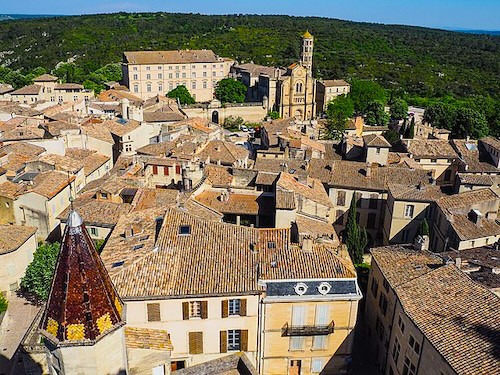
Uzès developed from the ancient camp of Ucetia or Eutica, which the Romans established in the 1st century BC near the Fontaine d’Eure, the source of the Alzon River.
The Romans built an aqueduct to utilise this resource and supply water to Nîmes, located some 50 kilometres to the south.
The most remarkable vestige of this ancient aqueduct is the magnificent Pont du Gard which spans the Gardon River.
This imposing structure, considered a feasts of Roman engineering, needs no introduction!
Episcopal city then Duchy
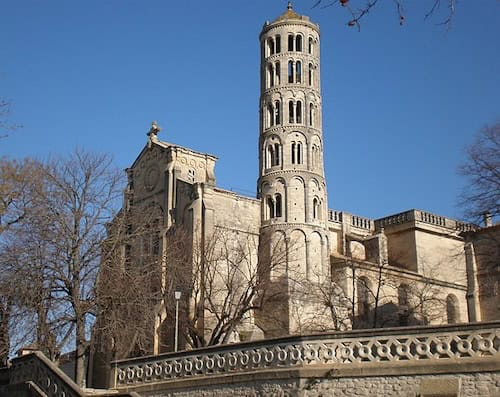
Uzès experienced significant growth in the 5th century, when it became the seat of a prominent bishopric, which by the 17th century comprised no fewer than 193 parishes. The town’s importance was further enhanced by the privileges granted to its bishops, who retained the right to mint coins and administer justice until the French Revolution.
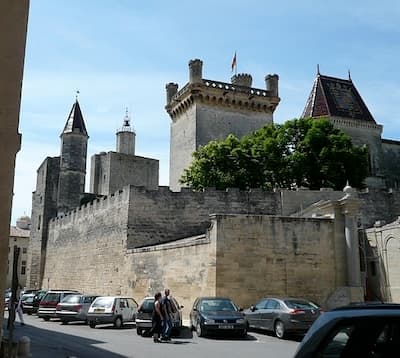
The County of Uzès was founded in 1088, and was a major entity within Languedoc province. In the 13th century, Languedoc, and therefore Uzès, were incorporated into the Kingdom of France.
Three centuries later, recognising the importance of securing local support, the King of France conferred the title of Duke of Uzès upon Count Antoine de Crussol. Today, the Crussol family still resides in the historic Château des Ducs d’Uzès, a magnificent building that exemplifies centuries of architectural evolution.
It indeed boasts medieval cellars, imposing ramparts crowned with defensive towers such as the Tour de Bermonde, Tour du Roi, andTour de l’Evêché, as well as a resplendent French Renaissance facade adorned with classical orders. Its interior decor is equally impressive, and boasts a wealth of splendid furniture collections.
A Protestant stronghold
The city’s industrial past
From the 15th century onward, the town of Uzès was founded on the production of serge, wool cloth, leather, and silk.
However, a devastating epidemic of silkworm disease in the 19th century precipitated the decline of this industry, which employed nearly 200 people at its peak. The vestiges of this bygone era can be seen in the ruined windmills scattered throughout the town.
The arrival of the railway gave rise to two industries that continue to thrive today: the production of liquorice-based confectionery and pottery. Uzès is indeed home to the Haribo-Zan-Ricqlès factory, and for those with a sweet tooth, a visit to the Haribo Candy Museum is a must.
Besides confectionery, pottery has long been a hallmark of Uzès’ artisanal heritage. A family-run factory founded in 1802 perpetuates the tradition by preserving and promoting know-how passed down from generation to generation.
Ville d’Art et d’Histoire
In January 1965, the historic centre of Uzès was designated a “protected area,” marking the beginning of meticulous restoration work. In 2008, the town was thus awarded the prestigious title of City of Art and History for its commitment to preserving its cultural heritage.
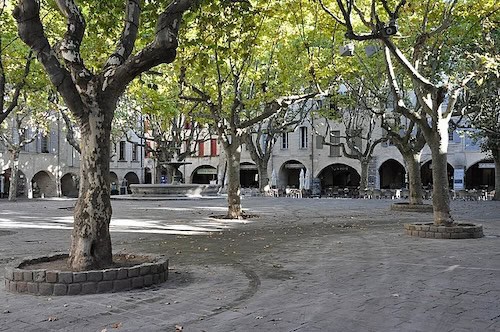
Renowned for its charming medieval cobblestone streets lined with elegant 16th- and 17th-century buildings, Uzès is a major tourist destination.
The Place aux Herbes, in the heart of the town, is a lively meeting place where locals and tourists gather to stroll through the farmers’ markets and soak up the vibrant atmosphere.
Finally, a visit to the Georges-Borias Museum is a must if you want to discover more about the rich history of Uzès through its diverse collection of objects and exhibits.
Department of Gard
Coordinates: Lat 44.012110 – Long 4.419946
Photos via Wikimedia Commons: Cathedral and Tour Fenestrelle by Vpe Public domain – Castle by ByacC CC BY-SA 3.0 – Place aux Herbes by Michel Bourdais CC BY-SA 4.0 – Header and photo1 by Mike Prince CC BY 2.0 – Tour Fenestrelle by Petri Krohn CC BY-SA 3.0