
Ussé Castle – Sleeping Beauty Castle
The Ussé Castle, a fairytale castle in the Loire Valley…
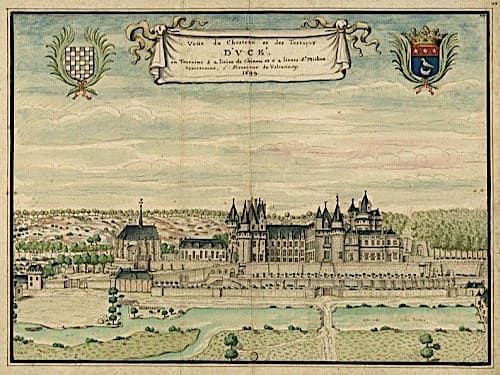
Once upon a time, there was a magnificent castle, named Ussé, which stood on the edge of the dark and mysterious Chinon forest…
With its numerous turrets, towers, sloping roofs, chimneys, dormer windows, and various romantic architectural features, it inspired Charles Perrault for his famous tale, Sleeping Beauty
That is why Ussé Castle is also known as the Château de la Belle au Bois Dormant – Castle of Sleeping Beauty. A permanent wax figure exhibition, located in the Tour de la Belle au Bois Dormant (Tower) in the medieval wing, brings the story of Sleeping Beauty to life.
Children love visiting the Château d’Ussé… and so do adults!
Ussé, from a fortress to a château
Around 1004, the Viking Gelduin built a wooden fortress on the banks of the Indre River.
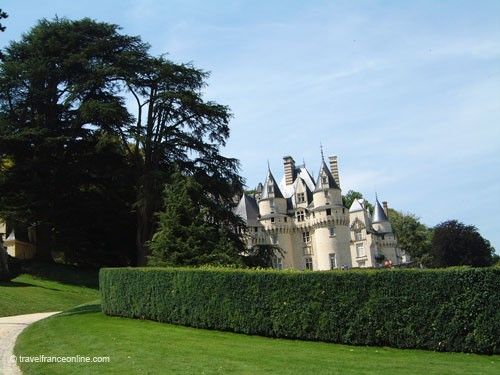
In 1485, Antoine de Breuil, captain of King Charles VII’s guards, acquired the estate and replaced the old fortress with a stone castle.
In 1521, he sold the castle to Charles d’Espinay, chamberlain to the Duke of Brittany, who had a chapel built in the park.
This chapel, considered a masterpiece of Renaissance architecture, was never restored. It is still adorned with the initials of Charles and his wife, Lucrezia, and houses a superb terracotta Virgin.
As for the majestic Lebanese cedars that surround, they were planted in 1808 by the poet René de Châteaubriand.
The transformation of Ussé Castle
In the 17th century, the Marquis de Valentinay made significant alterations to Ussé Castle. He indeed had the north wing demolished to open up the view of the river and commissioned the renowned landscape architect André Le Nôtre to design the formal French gardens.
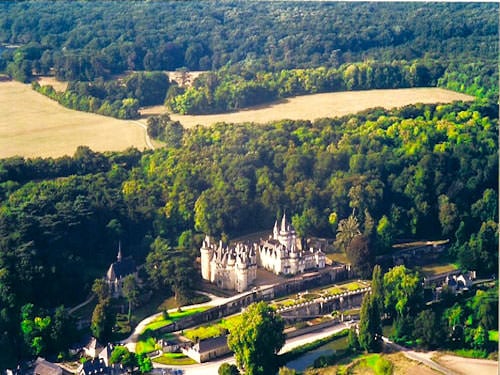
He also undertook the construction of the Pavilion, now the left wing of the château, to celebrate his wedding. He transformed the former guardroom in the medieval wing, adorning it with a magnificent trompe-l’œil ceiling.
The château’s drawing room boasts a collection of porcelain and weapons brought back from East Asia by the Duke of Blacas, whose family has owned the château since 1885.
In place of the former drawbridge, Valentinay had a large window installed, and he also transformed the old chapel into an elegant day room. One of Ussé’s many legends tells of a secret underground passage in the kitchen cellar leading to the heart of the mysterious Chinon forest…
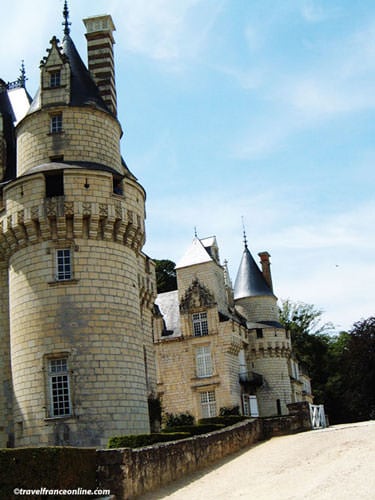
An old vaulted passageway, once converted into staff quarters, was transformed in the 18th century to create the impressive Grande Galerie. This gallery houses a permanent exhibition of an extraordinary collection of Brussels tapestries. It also provides access to the Grand Staircase and the Renaissance wing of the castle.
The renowned architect François Mansart designed this Italian-style staircase that leads to the King’s Chamber. Amazingly, this richly decorated room has retained its original silk curtains and walls. Located apart from the other apartments, it was always kept ready to receive the king, who never actually visited Ussé Castle!
Although less well-known to the general public, Ussé Castle is considered one of the most beautiful châteaux in the Loire Valley.
Department of Indre-et-Loire
Coordinates: Lat 47.250278 – Long 0.292751
Photo via Wikimedia Commons: Castle drawing 1699 by Louis Boudan (1687–1709) source Bibliothèque nationale de France Public domain


