
Place du Parvis Notre-Dame
Beneath the Parvis Notre-Dame-Place Jean Paul II lies a secret place most visitors never suspect: the Archaeological Crypt Notre Dame!
The cathedral square was once a bustling medieval district of narrow streets, houses, shops, churches, even a hospital and an orphanage.
That all changed in the 1860s, when Baron Haussmann’s sweeping renovations reshaped Paris. The medieval district was demolished to enlarge the square, and only the lighter paving stones you see today trace the outline of the old lanes.
Haussmann demolished the Hôtel-Dieu, the oldest hospital in Paris founded in 660 AD on the riverside, and rebuilt it in the nearby Rue d’Arcole. The equestrian statue of Emperor Charlemagne stands in its place.
A piece of the past did survive, though: the spectacular portal of the Eglise Saint-Pierre-aux-Bœufs was reused as the main entrance of Saint-Sévérin Church in the Latin Quarter.
Today, the Parvis Notre Dame is a spacious square that provides a picturesque backdrop for Notre Dame Cathedral. This is also where you’ll find the Bronze Star embedded in the ground, by the cathedral’s entrance.
Archaeological Crypt Notre Dame, a hidden time capsule
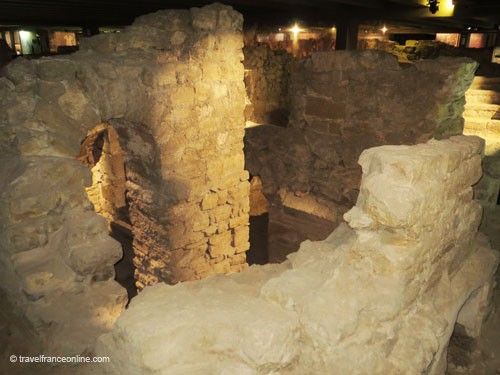
The story of the crypt began unexpectedly in the 1960s, during the construction of an underground car park. Instead of concrete, workers uncovered layers after layers of Roman and medieval Paris. Too precious to move, the remains were kept as they were, and an on-site museum was created to protect and showcase them.

The Archaeological Crypt Notre Dame will take you through 20 centuries of history, from the Gallo-Roman era when the Ile de la Cité stood 7 metres lower than today, to the medieval lanes.
You will discover sections of the rampart hastily erected by Parisians during the barbarian invasions of 285 AD. These defenses were constructed using stones repurposed from monuments in the Latin Quarter on the Left Bank. Many of these boulders thus feature intricate carvings, engravings, or sculptures.
One of the most renowned artefacts is the Pilier des Nautes, or Watermen’s Pillar, unearthed beneath the cathedral’s chancel and now exhibited in the Cluny Museum.
The excavations also unveiled the remnants of three Gallo-Roman buildings equipped with hypocaust heating systems, as well as the foundations of the Church of Saint-Etienne, erected in the 6th century under the patronage of King Childebert.
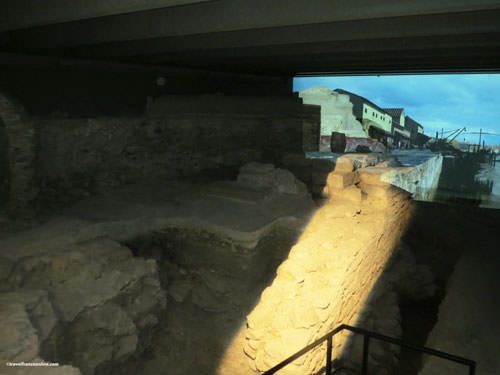
The visit will also transport to the Middle Ages through a path that mirrors the layout of the medieval lanes and the foundations of the structures that once lined them.
These buildings, initially demolished in 1745 for the widening of Rue Neuve (the square’s main thoroughfare) and the construction of the Hospice des Enfants-Trouvés orphanage, were later reconstructed.
A visit of the Archaeological Crypt Notre Dame usually takes about an hour, perfect for archaeology lovers, history buffs, or anyone curious to see a quieter, hidden side of Paris.
The crypt is one of the coziest, and most fascinating escapes when it rains in Paris.
Directions: 4th District
Metro: Cité on Line 4
Coordinates: Lat 48.853622 – Long 2.347711


