
Agincourt or Azincourt?
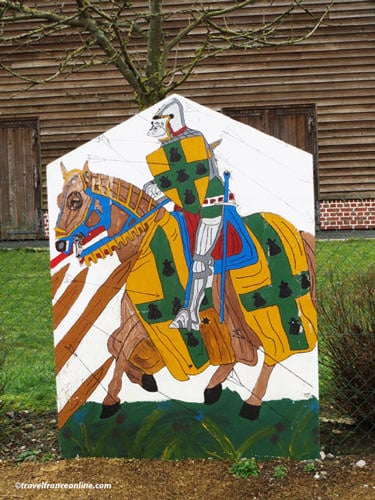
The Battle of Agincourt, known in French as Azincourt, is among France’s most tragically famous military defeats.
Located in the Pas-de-Calais, department, Azincourt had always been on one of the English invasion routes.
Fought during the Hundred Years War, a conflict that in fact lasted 116 years, the Battle of Agincourt was one of the many sporadic conflicts that took place during that time.
However, this historic battle, which led to the near decimation of the French nobility in the 15th century, took place not on a battlefield, but in a modest clearing, halfway between the forests of Azincourt and Tramecourt, which today has given way to cultivated fields.
Thus, standing in this rather unremarkable rural setting, it’s hard to imagine the cataclysmic events that unfolded here centuries ago!
The roots of the Hundred Years’ War go back to the 11th century, with the rise of the Plantagenêts dynasty, originally from the County of Anjou.
Henry Plantagenêt, who later ascended the throne of England as Henry II, consolidated his family’s influence by marrying Alienor of Aquitaine.
Her whose considerable dowry indeed included a significant portion of the Kingdom of France.
Strengthened by these acquisitions, Henry’s descendants harboured the ambition of seizing the French crown, which led to a series of sporadic invasions of French territory.
The capture of Calais in 1347, a strategic stronghold they held until 1557, is a prime example of their influence in the region.
Battle of Agincourt, a battle that could have been avoided!
On August 13, 1415, the English launched a new invasion and successfully landed at Chef-de-Caux, not far from the port of Harfleur.
They besieged Harfleur from August 17 to October 7, finally capturing the port to establish a bridgehead in Normandy.
Initially, Henry V of England had planned to march on Paris, but he changed his mind due to unfavourable weather conditions that threatened to jeopardise the operation’s success.
He thus chose to redirect his troops to Calais to embark once again for England.
However, it was at this crucial moment that the French King Charles VI, known as Charles le Fou (Charles the Mad because of his bouts of madness) made a fateful decision.
Disregarding all caution, he sent troops to intercept the English and prevent them from returning to Calais and England. And on October 24th, his troops thus met the English in the village of Azincourt!
Battle of Agincourt, the battle won by Welsh archers

Azincourt thus remains the scene of one of France’s most crushing military defeats!
The numerical superiority of the French army, composed of 18,000 men, including 3,000 knights and 300 archers, against 1,000 English infantry and 5,000 Welsh archers, should have easily ensured a French victory.
Alas, incessant rain transformed the battlefield into a slippery, sticky quagmire that hampered the French troops’ advance.
Negotiations stalled, with the English king refusing to relinquish his claim to the French throne, while nevertheless offering to return Harfleur in exchange for passage to Calais.
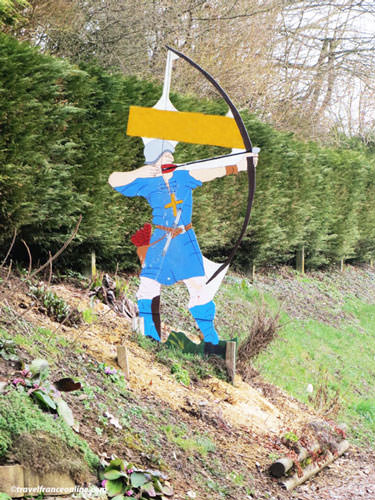
The battle began at 11:00 a.m. The English infantry held the centre of the battlefield, while the Welsh archers defended the flanks with rows of stakes to slow the French cavalry.
The sodden ground proved disastrous for the French. Caught between English and Welsh forces, the French fought valiantly, but men and horses struggled to advance through the mud and under a hail of arrows from Welsh archers. Many succumbed to exhaustion or drowning. Furthermore, hampered by the conditions, the French crossbowmen were unable to protect the French cavalry and infantry, as their arrows became ineffective once soaked. The relentless assault lasted until 5 p.m., and King Henry V ordered the massacre of the French prisoners to quell any rebellion.
The Battle of Agincourt marked the beginning of the decline of French chivalry and decimated an entire generation of French nobility. Among the considerable losses were 6,000 French knights, including 5 counts and 90 barons.
The site of the Battle of Agincourt
The scale of the tragedy that befell the French in just seven hours at the Battle of Agincourt defies modern comprehension.

Today, the battlefield is a vast cultivated field, situated between the villages of Azincourt, Trémecourt, and Maisoncelle, and roughly bordered by the D104 and D71E3, the roads where the Welsh archers initially positioned themselves. They moved from Maisoncelle before advancing towards Rue Henri V (D71) as the battle progressed.
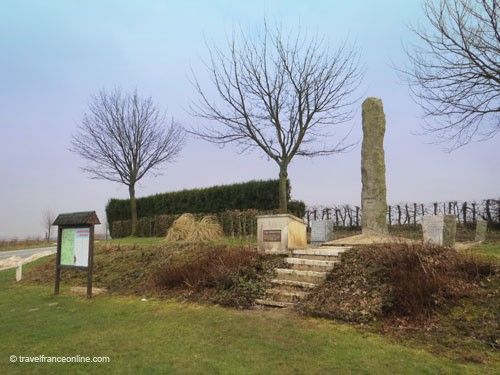
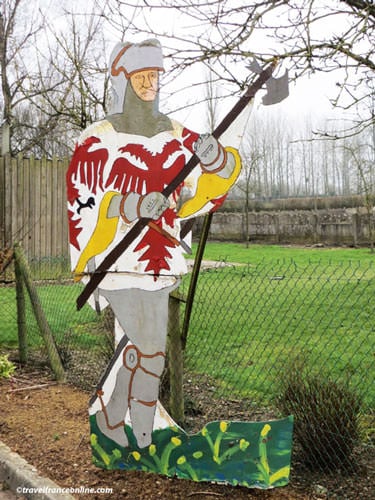
A memorial marks the intersection of the D107E2 and D104 roads, and metal silhouettes of archers are installed along the Route du Printemps, marking their positions during the conflict.
After the battle, the British cremated the bodies of their fallen soldiers in a barn in the small village of Maisoncelle. As for the French, they were buried in a mass grave along the D104, near Trémecourt. It’s easy to miss this discreet site, a clearing hidden in the heart of a thicket, where a simple cross and a commemorative plaque mark the place where hundreds of French knights and soldiers who died during the Battle of Agincourt rest! The Museum of the Battle of Agincourt – Medieval Historical Centre, in the centre of the village of Azincourt, recognisable by its arched architecture, recounts the tragic story of the battle.
Department of Pas-de-Calais – Azincourt
Coordinates: Lat 50.462982 – Long 2.128470


