Palais de Tokyo – foundation
The Palais de Tokyo is a museum dedicated to contemporary international art movements. Its creation stemmed from an architectural competition launched in 1934 by the City of Paris and the French State.

These two institutions wanted to create a new space capable of housing the collections of the Petit Palais (owned by the City of Paris) as well as those of the Jeu de Paume and the Palais du Luxembourg (owned by the French State).
Out of 128 submissions, the design by architects Jean-Claude André Aubert Dondel, Marcel Paul, and Viard Dastugue was selected.
The Palais de Tokyo boasts a series of terraced patios and fountains that overlook the Seine and slope gently down towards the Avenue de New York. This avenue was called Avenue de Tokyo from 1918 to 1945, and gave its name to the building.
Museum of Modern Art
The Palais de Tokyo is U-shaped, and each of its wings houses a modern art museum.
The Palais des Musées d’Art Moderne (Palace of Museums of Modern Art), in the East Wing, was inaugurated on May 24, 1937, on the occasion of the International Exhibition “Arts and Technology in Modern Life”. It now houses the Musée d’Art Moderne de la Ville de Paris (Museum of Modern Art of the City of Paris), which was founded in 1961.

The West Wing, owned by the French state, housed the Musée National d’Art Moderne (National Museum of Modern Art), established in 1947. In 1977, the French state transferred this museum to the Centre Georges Pompidou, while retaining ownership of the West Wing.
After serving various purposes, the West Wing reopened in March 2002 as the Site de création contemporaine (Site for Contemporary Creation). This establishment is dedicated to contemporary French and international art.
It includes the Pavillon Neuflize OBC, a creative laboratory of the Palais de Tokyo, founded in 2001 by the artist Ange Leccia, who is also its director. Each year, ten young international artists from various disciplines, accompanied by an exhibition curator, are invited for an eight-month residency. In 2012, the Palais de Tokyo was expanded from 8,000 m² to 22,000 m², thus consolidating its place among the largest contemporary art spaces in Europe.
Art Deco Palais de Tokyo
The two perpendicular wings of the Palais de Tokyo frame the terraces, which are connected by several flights of stairs. An imposing portico, framed by a spectacular U-shaped colonnade, connects the upper parts of these wings.
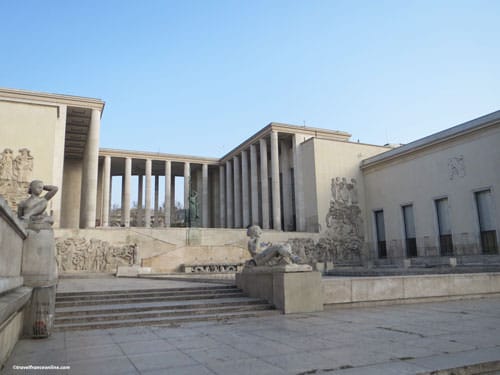
The Palais de Tokyo is a perfect example of Art Deco architecture. It harmoniously blends classical and modern features, with monumental symmetrical facades adorned with columns and decorative motifs. Built from lightweight concrete and enhanced with limestone slabs, the building gives an impression of grandeur.
Among the many sculptures and statues, you will find Apollo, the Greek god of the arts, surrounded by nymphs and centaurs.
The monumental allegory “Allegory to the Glory of the Arts” or “Legend of the Earth and the Sea”, a work by the sculptor Alfred Janniot (1889-1969), adorns the base of the terrace and the south facade, covering an impressive area of 300 square metres!
A visit to the Palais de Tokyo is a must for lovers of modern art and Art Deco architecture. Others can enjoy a refreshing drink in the terrace tea room, offering a splendid view of the Seine and the iconic Eiffel Tower on the opposite bank.
Directions: 16th district – 13, avenue du Président Wilson
Metro: Iéna et Alma Marceau on Line 9
RER Ligne C: Station Pont de l’Alma
Coordinates: Lat 48.864510 – Long 2.296990*Opening hours palaisdetokyo.com:
From noon to midnight every day except Tuesday
Annual Closure 1Jan, 1May and 25Dec
Exceptional closure at 18h on 24Dec and 31Dec