
St Méloir des Bois in Roman Brittany
St Méloir des Bois is located approximately 10 kilometres west of the historic walled city of Dinan and just 3 kilometres west of the ancient Gallo-Roman city of Corseul.

This region was once inhabited by four Gallic tribes: the Curiosolites, the Lexobii, the Ambiliates, and the Osismii.
Two millennia ago, the inhabitants of Armorica, the name then given to Brittany, united to resist the Roman conquest. However, their efforts were ultimately crushed in 58 BC, and Armorica was incorporated into the Roman province of Lugdunian Gaul.
The capital of the Curiosolites, present-day Corseul, became the principal city of the region under Roman rule. Numerous remains of temples, cities and the vast road network built by the Romans still dot the region.
The 5 columns of St Méloir des Bois
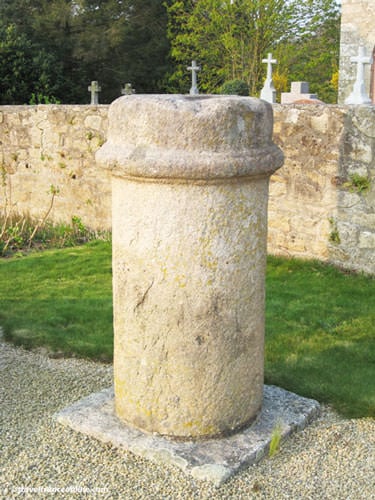
The four Gallo-Roman granite columns that stand in the Chruch square of St Méloir des Bois are a source of curiosity. Their origins are indeed mysterious and, of course, subject to much speculation.
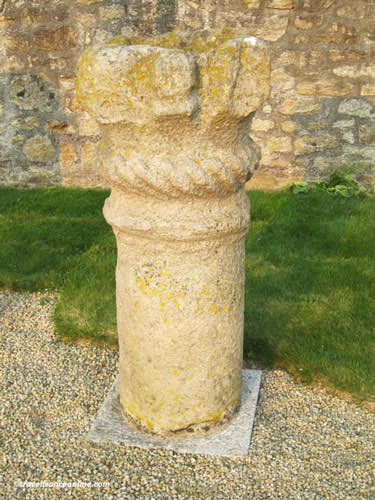
One theory suggests that the largest column may have served as a milestone on the Voie de l’Etrat (Road to L’Étrat), also known as the Via Statra, the Roman road linking Vannes to Corseul.
Another theory implies that it could be a monument dedicated to the Emperor Victorinus, who reigned over Gaul from 267 to 268 AD, based on partial inscriptions discovered on the column:
“To the Emperor Caesar Avionus Victorinus, pious, fortunate, and invincible prince, his ambassador dedicates and consecrates this monument.”
As for the second and third columns, it is believed that they come from an earlier Roman monument, now lost.
The fourth column, however, remains an even greater enigma. The meaning of its complex decoration, including a twisted moulding and a small opening for a drainage basin, as well as sculptural remains suggesting a sacrificial altar, has not yet been deciphered.
Will we ever discover the secrets of these ancient stones? Only time will tell.
St Méloir des Bois, a village named after a Cornish saint
These newcomers were recognised by the Church of Rome, which officially endorsed their religious leaders, who, in return, established the seven dioceses of Brittany and endeavoured to convert the local population to Christianity.
To facilitate this process, charismatic leaders were elevated to the rank of minor saints to guide the local population in their transition from paganism to Christianity.
The appeal of these minor saints lay in their perceived ability to protect and help people in their daily lives.

Thus, countless churches, villages, and places were named in their honour. This is how St Méloir des Bois takes its name from Saint Méloi or Melar, a major figure in local tradition. According to this tradition, Saint Méloi was the son of Queen Aurélie of Vannes and Saint Millau of Cornwall, who was King of Brittany.
The current church of St Méloir des Bois was built in 1828 on the site of an old chapel and crypt that once housed the relics of Saint Méloi. Although the crypt remains intact, the relics have since been transferred to the church in Redon.
The charming Breton village of St Méloir des Bois is a “must-see”.
You’ll be intrigued by its ancient columns, of course, but also charmed by its traditional Breton houses and its many flowerbeds and flower-adorned homes, which have earned it the prestigious “Ville Fleurie” (Flowering Town) label.
Department of Côtes d’Armor
Coordinates: Lat 48.457497 – Long -2.249754


